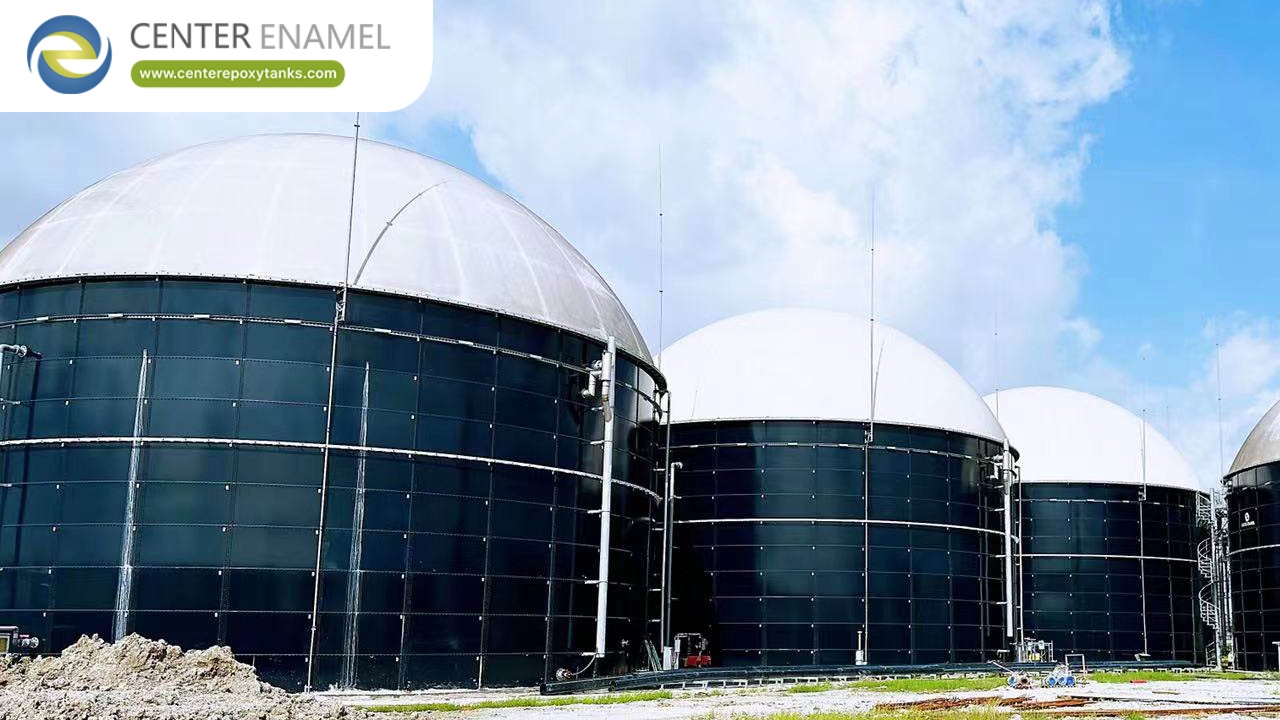
Bolted Steel Tanks as Biogas Preliminary Tanks: Optimizing Pre-Treatment and Equalization in Anaerobic Digestion
In any high-efficiency anaerobic digestion (AD) or biogas production facility, the primary success of the biological core relies heavily on upstream preparation. Before organic feedstock—whether agricultural slurry, food waste, industrial wastewater, or municipal sewage sludge—enters the main fermenter, it must undergo meticulous conditioning, homogenization, and thermal or chemical balancing.
Using bolted steel tanks as biogas preliminary tanks (often functioning as equalization, hydrolysis, or pre-acidification tanks) has rapidly become the preferred engineering standard worldwide. Combining modular agility with industrial-grade corrosion resistance, bolted steel vessels ensure that raw, aggressive organic streams are safely managed before downstream biological processing.
The Critical Role of Preliminary and Equalization Tanks in Biogas Plants
Raw feedstocks entering a biogas facility are rarely uniform. Variations in chemical oxygen demand (COD), solid content, pH levels, and hydraulic flow rates can shock methanogenic bacteria in the primary digester, leading to process failure or reduced gas yields. Preliminary and equalization tanks address these challenges by performing three vital functions:
Feedstock Homogenization: Blending variable organic streams into a consistent, uniform slurry to ensure steady biological loading.
pH and Temperature Stabilization: Allowing initial acidogenesis and hydrolysis stages to occur in a controlled environment, buffering sudden pH drops before the substrate enters the main reactor.
Solids Separation and Grit Removal: Acting as an initial settling or screening stage to prevent heavy inert materials from accumulating in downstream piping and primary digester floors.
Why Bolted Steel Outperforms Conventional Materials for Pre-Treatment
Raw organic waste streams in preliminary phases are frequently characterized by high acidity, organic acids, and variable sulfur compounds that attack standard construction materials. Modern bolted steel tanks—particularly those utilizing Glass-Fused-to-Steel (GFS) or advanced Fusion-Bonded Epoxy (FBE) coatings—provide distinct engineering advantages:
Exceptional Corrosion Defense: The factory-applied glass or polymer coating creates an inert, non-porous barrier that withstands aggressive organic acids, high moisture, and abrasive sludge particles.
Modular Prefabrication and Quality Control: Panels are engineered and coated in strict, climate-controlled factory environments, eliminating the variable quality risks associated with on-site concrete pouring or field-welded applications.
Hydraulic Adaptability: Bolted tank configurations can easily accommodate specialized internal mixing equipment, heating jackets, piping manifolds, and liquid-level sensors tailored to pre-treatment specifications.
Technical Performance Matrix: Biogas Preliminary Tank Technologies
Technical Parameter | Bolted Steel Tanks (GFS / FBE) | Cast-in-Place Concrete Basins | Field-Welded Carbon Steel Tanks |
Corrosion Resistance to Raw Sludge & Acids | Superior; inert glass/epoxy surface completely resists chemical attack | Low to moderate; prone to concrete carbonation and sulfate attack requiring liners | Moderate; highly vulnerable to pitting and weld seam corrosion without constant upkeep |
Installation Speed & Construction Footprint | Rapid modular erection completed in weeks without heavy civil curing delays | Slow civil construction requiring extensive formwork and multi-week concrete curing | Moderate labor-intensive construction dependent on weather conditions |
Capacity Expansion & Flexibility | High scalability; modular panels allow easy height or diameter extensions | Monolithic structure; impossible to modify or expand once poured | Difficult to modify without extensive hot-work cutting and re-welding |
Lifecycle Maintenance Overhead | Minimal; periodic visual inspection and seal check | Moderate to high; requires crack injection, joint sealing, and re-lining | High; requires scheduled abrasive blasting and complete recoating cycles |
Engineering Design Considerations for Biogas Pre-Treatment Systems
Deploying a bolted steel tank as a preliminary or equalization vessel requires careful integration of specialized accessories to handle heavy organic matter:
Agitation and Mixing Integration: Because preliminary tanks collect settling solids, tanks are engineered with structural reinforcement to support side-entry mixers, submersible propeller agitators, or hydraulic jet-mixing systems to maintain complete homogenization.
Odor and Vapor Containment: Fitted with specialized gas-tight covers (such as aluminum geodesic domes, stainless steel roofs, or double-membrane options), preliminary tanks effectively trap volatile organic compounds (VOCs) and hydrogen sulfide, routing them safely through biofilters or gas scrubbing units.
Thermal Management: Integration of external insulation panels and internal heating coils maintains optimal mesophilic or thermophilic pre-conditioning temperatures, jump-starting biological breakdown before the substrate reaches the primary digester.
Frequently Asked Questions (FAQ)
Q: Why use a bolted steel tank specifically for biogas preliminary and equalization processes?
A: Bolted steel tanks offer superior corrosion resistance, rapid modular installation, and long-term structural reliability. Their factory-applied glass or epoxy coatings protect against aggressive organic acids and raw sludge, ensuring a longer operational lifespan than traditional concrete or field-welded tanks.
Q: Can bolted preliminary tanks handle high-solid organic waste and food slurry?
A: Yes. Engineered with high-tensile steel substrates and abrasion-resistant interior coatings, bolted tanks successfully manage high-solid agricultural slurries, municipal sewage sludge, and industrial food processing waste without structural degradation.
Q: How are bolted joints sealed to prevent liquid or gas leakage in pre-treatment tanks?
A: Bolted tanks utilize specialized, chemically compatible elastomeric mastic sealants applied between panel overlaps. These industrial-grade sealants maintain elasticity and chemical resistance for decades, ensuring a 100% leak-proof seal.
Q: Is it possible to expand the capacity of a bolted preliminary tank later if the biogas plant scales up?
A: Absolutely. The modular design of bolted steel tanks allows facility managers to unbolt and add additional vertical panel rings or expand the tank diameter, provided the foundation was engineered to accommodate the future load increase.


