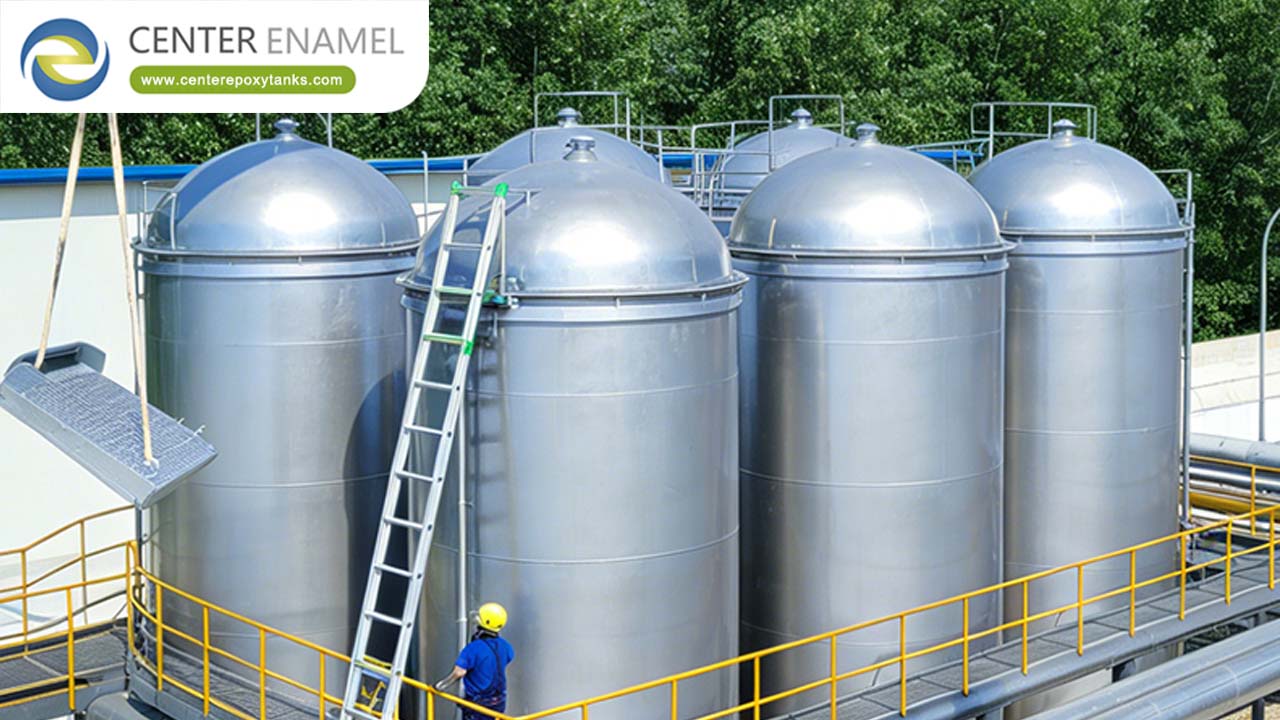
Center Enamel: Global Manufacturer of Welded Stainless Steel Fuel Storage Tanks
In the critical sector of hazardous liquid storage, structural failure is not an option. Shijiazhuang Zhengzhong Technology Co., Ltd. (Center Enamel) is a premier China-based manufacturer dedicated to the engineering and fabrication of Welded Stainless Steel Fuel Storage Tanks.
Our welded solutions are designed for clients who require monolithic structural integrity, high-pressure capacity, and absolute chemical inertness. Unlike bolted tanks, our welded stainless steel vessels offer a seamless, leak-proof containment solution ideal for refined petroleum, aviation fuel, and high-purity chemical storage.
1. Engineering Excellence: The Stainless Advantage
Stainless steel is the material of choice for fuel storage applications involving demanding environmental conditions or high-purity fuel requirements.
Corrosion Resistance: Unlike carbon steel, which requires heavy-duty coatings and frequent maintenance, stainless steel provides inherent, self-healing resistance to corrosion, significantly reducing the Total Cost of Ownership (TCO).
Fuel Compatibility: Stainless steel (specifically 316L) is chemically inert, ensuring that fuels—including biofuels, ethanol blends, and aviation kerosene—remain uncontaminated and within specification.
High-Pressure Integrity: Welded construction provides a monolithic tank body. This removes the "leak paths" associated with gasketed connections, making welded stainless steel the gold standard for high-risk fuel storage.
2. Regulatory Compliance & Global Standards
Storage of hazardous fuels is heavily regulated to prevent environmental and safety incidents. Center Enamel designs and fabricates all welded stainless steel tanks in strict accordance with the following international standards:
Regulatory Code | Application Relevance |
API 650 | Standard for Welded Tanks for Oil Storage (Global Benchmark) |
UL 142 | Standard for Steel Aboveground Tanks for Flammable and Combustible Liquids |
NFPA 30 | Flammable and Combustible Liquids Code (Fire safety requirements) |
ASME Section VIII | Rules for Construction of Pressure Vessels |
ISO 9001:2015 | International Quality Management System |
3. Advanced Welding & Fabrication Protocols
At Center Enamel, we employ advanced manufacturing technologies to ensure that every weld maintains the mechanical properties of the parent metal.
1.1. Certified Material Selection:Metallurgical Sourcing。
We utilize only premium-grade stainless steel plates (ASTM A240/A480, SS304/316L). Every batch is accompanied by Mill Test Reports (MTR) to verify tensile strength and chemical composition.
2.2. CNC Cutting & Rolling:Precision Fabrication。
Automated plasma and CNC laser cutting ensure tight tolerances in plate fit-up. Precision rolling ensures the vessel maintains perfect circularity, which is critical for distributing stresses in fuel tanks.
3.3. Fusion Welding (TIG/MIG/SAW):Advanced Welding。
Our certified welders (ASME/AWS compliant) utilize Submerged Arc Welding (SAW) for thick plates and TIG/MIG for high-precision seams, ensuring full-penetration, defect-free joints.
4.4. Non-Destructive Testing (NDT):Integrity Testing。
Every tank undergoes rigorous inspection, including Radiographic Testing (RT), Ultrasonic Testing (UT), and hydrostatic leak testing to ensure absolute containment security.
4. Frequently Asked Questions (FAQ)
Q: Why is welded construction preferred for fuel storage over bolted?
A: Welded tanks offer a seamless, monolithic structure. For hazardous fuel storage, this eliminates potential failure points at gaskets or joints. While bolted tanks are excellent for water or dry bulk, welded stainless steel tanks provide the high-pressure tolerance and zero-leak reliability required for petrochemical and fuel containment.
Q: Which grade of stainless steel should I choose for my fuel project?
A: The choice typically depends on the fuel type and climate. Grade 304 is standard for general industrial fuel storage. Grade 316L (containing Molybdenum) is recommended for high-chloride environments (coastal/marine) or when storing fuels that may have acidic contaminants, as it offers superior pitting and crevice corrosion resistance.
Q: Can Center Enamel provide tanks compliant with UL 142?
A: Yes. We are equipped to manufacture fuel storage tanks that meet the structural and safety requirements of UL 142, providing fire safety and structural integrity for aboveground flammable liquid storage. Our engineering team conducts the necessary stress analysis for every project to ensure compliance.
Q: Do you provide on-site installation support for large welded tanks?
A: Absolutely. For large-scale projects, we provide comprehensive EPC technical support. Our engineers can supervise on-site assembly, provide final welding and inspection protocols, and assist with commissioning to ensure your facility meets local safety and environmental codes.


