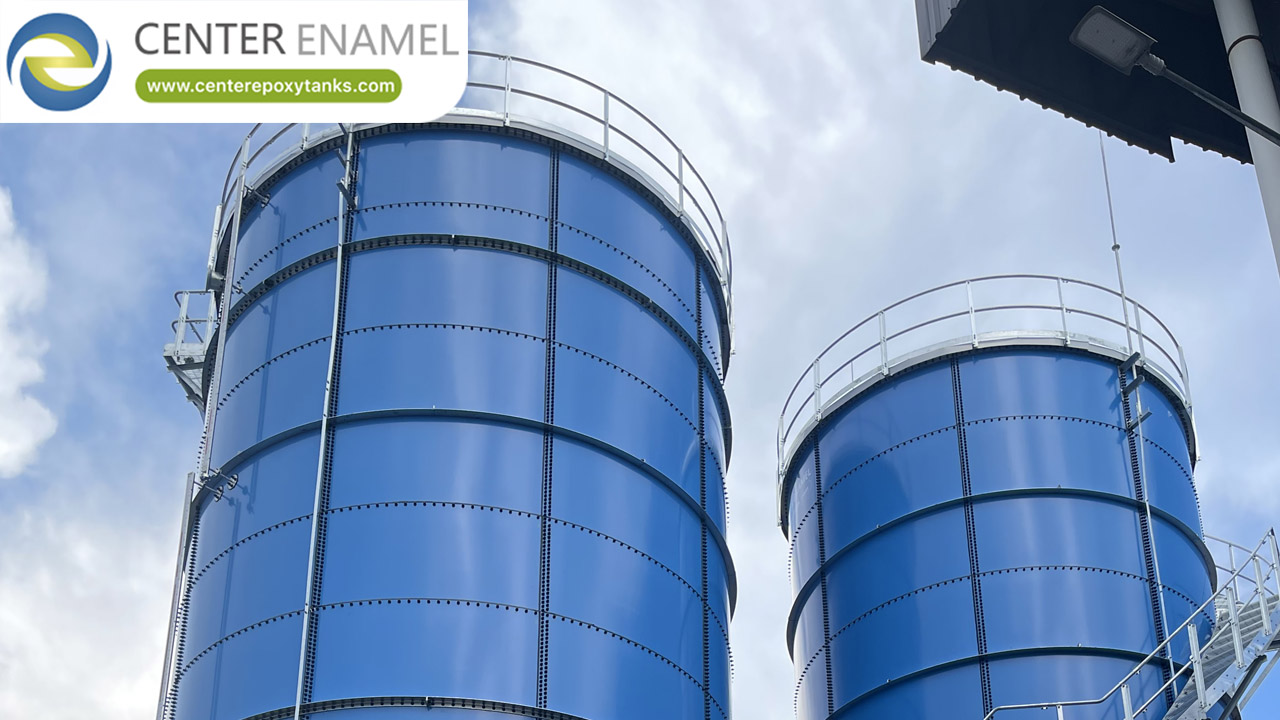
Water Tanks for Municipal Sewage Treatment: Complete Engineering & Design Guide
A municipal sewage tank is a highly engineered industrial containment vessel designed to store, process, and treat urban wastewater, raw sewage, and biological sludge. Because municipal sewage contains highly corrosive elements—including hydrogen sulfide (H2S), volatile fatty acids, and high concentrations of chlorides—these tanks must be constructed from advanced, chemical-resistant materials rather than standard untreated steel or vulnerable concrete.
Modern municipal wastewater plants increasingly rely on modular bolted steel tanks, specifically Glass-Fused-to-Steel (GFS) and Epoxy-Coated Tanks, to serve as primary clarifiers, aeration basins, and anaerobic digesters. These vessels are essential for maintaining continuous civil infrastructure without the risk of groundwater contamination or structural failure.
How Municipal Sewage Tanks Function in Wastewater Treatment
A municipal sewage tank is rarely just a static holding vessel; it is an active biological and chemical processing environment. The specific design of the tank depends heavily on the treatment process type and the nature of the sewage:
Primary Clarification: Raw sewage enters the tank where heavy solids settle to the bottom as sludge, while lighter materials float. The tank must feature smooth internal walls to ensure efficient mechanical scraping and prevent bio-fouling.
Biological Aeration (MBR / SBR / A2O): In secondary treatment, tanks act as aeration basins. Oxygen is pumped into the sewage to encourage bacteria to break down organic matter. These tanks endure constant agitation and require highly durable interior coatings to resist abrasion and oxygen-induced corrosion.
Anaerobic Digestion (UASB / IC): Specialized sealed sewage tanks are used to ferment biological sludge without oxygen, producing biogas. These tanks face extreme internal corrosion from hydrogen sulfide gases, making Glass-Fused-to-Steel the global standard for this stage.
Effluent Storage: Fully treated water is held in equalization or effluent tanks before being safely discharged into the environment or redirected for agricultural reuse.
Technical Specifications & Process Compatibility Matrix
Merely knowing the volume of a tank is insufficient for modern engineering. The table below outlines the core tank technologies and aligns them with their most effective wastewater process applications:
Tank Technology | Core Material & Coating | Best Suited Wastewater Process | Operational Impact & Durability |
Glass-Fused-to-Steel (GFS/Enamel) | Steel plates fired with borosilicate glass at 850°C. | Anaerobic Digestion (UASB, EGSB), Sludge Holding. | Unmatched resistance to H2S gases and acidic sludge. Lifespan of 30+ years with zero recoating needed. |
Epoxy-Coated Bolted Steel | Factory-applied thermosetting electrostatic epoxy. | Aeration Basins, A2O, Membrane Bioreactors (MBR). | Excellent abrasion resistance for turbulent aeration tanks. Highly cost-effective for large municipal volumes. |
Stainless Steel (304/316L) | Raw stainless alloy, often corrugated or welded. | Sequencing Batch Reactors (SBR), Odor Control. | High structural strength and aesthetic finish, though highly susceptible to localized chloride pitting if misapplied. |
Concrete (Traditional) | Poured-in-place reinforced concrete. | Primary Grit Chambers, Massive underground basins. | Prone to micro-cracking and rebar corrosion from sewage acids. Requires extensive on-site construction time. |
Key Benefits of Bolted Steel Tanks for Municipal Sewage
For decades, concrete was the default for municipal sewage, but the industry has shifted rapidly toward modular bolted tanks (GFS and Epoxy) due to significant engineering advantages:
Rapid Field Installation: Bolted tanks are manufactured in a factory and assembled on-site using standard tools. This cuts construction time by up to 60% compared to pouring and curing concrete, allowing municipalities to commission plants faster.
Superior Corrosion Resistance: Unlike concrete, which deteriorates under the attack of microbial-induced corrosion (MIC) and sewage acids, factory-applied glass and epoxy coatings create an impermeable, chemically inert barrier.
Expandable and Relocatable: As city populations grow, modular bolted tanks can be expanded in volume by adding additional rings of steel plates to the existing structure—an impossibility with poured concrete.
Frequently Asked Questions (FAQ)
Q: What is a municipal sewage tank used for?
A: A municipal sewage tank is used to safely contain and process urban wastewater, raw sewage, and sludge through various stages of treatment, including clarification, biological aeration, and anaerobic digestion, before the water is discharged.
Q: Why are Glass-Fused-to-Steel (GFS) tanks preferred for sewage treatment?
A: GFS tanks combine the structural strength of steel with the extreme chemical and corrosion resistance of glass. This makes them immune to the highly corrosive hydrogen sulfide gases and acidic conditions found in municipal raw sewage and sludge.
Q: How does the wastewater process type affect tank selection?
A: The process dictates the required chemical resistance. For example, an anaerobic digestion process (like UASB) generates highly corrosive biogas, requiring GFS enamel tanks. A standard aeration basin (like MBR) might utilize highly abrasion-resistant epoxy-coated steel to withstand continuous water turbulence.
Q: Can bolted steel sewage tanks be expanded if city wastewater volume increases?
A: Yes. Unlike concrete basins, modular bolted steel tanks can be dismantled, expanded by adding new plate rings, or entirely relocated, offering municipalities scalable infrastructure as population demands change.


