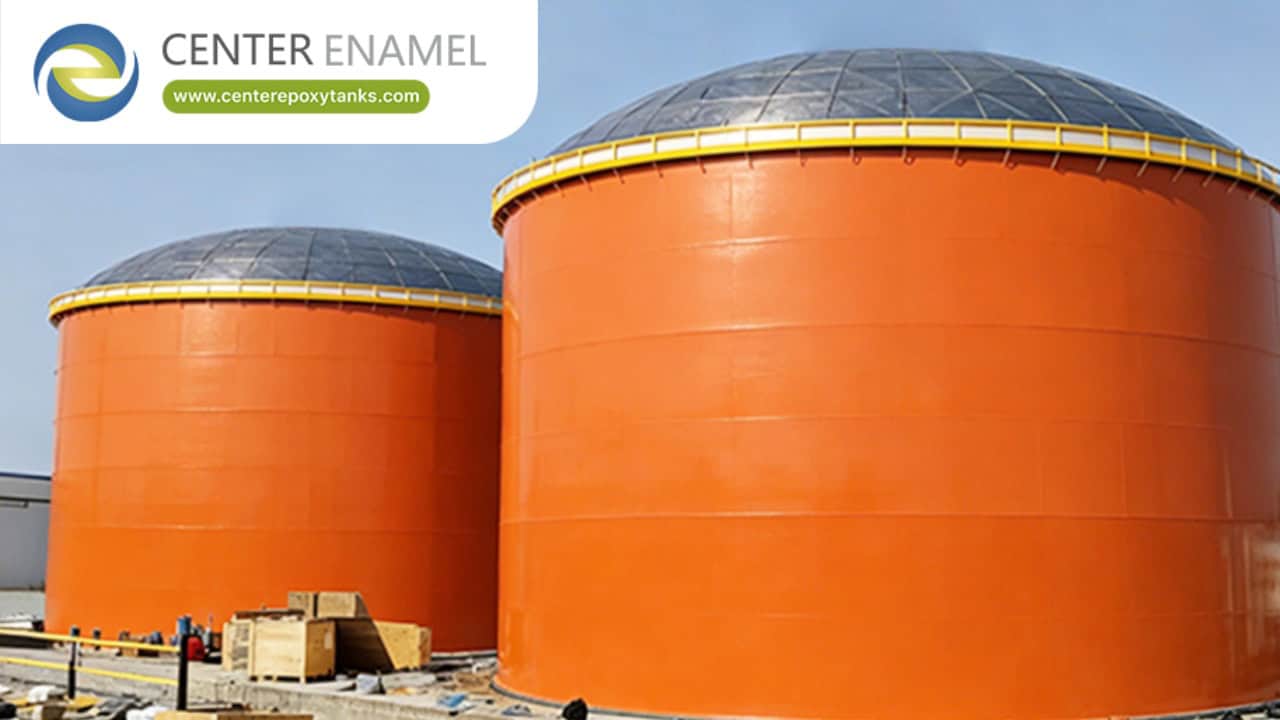
As global urbanization accelerates, the management of municipal solid waste—specifically food waste—has become a paramount environmental challenge. Food waste is characterized by its high moisture content, rapid biodegradability, and the presence of complex organic compounds. Transforming this "waste" into a resource through anaerobic digestion is the most sustainable path forward. At the heart of this transformation are Food Waste Fermentation Tanks, which serve as the controlled biological reactors where waste is converted into renewable energy and high-grade organic fertilizer.
Shijiazhuang Zhengzhong Technology Co., Ltd (Center Enamel), a premier China Food Waste Fermentation Tanks manufacturer, stands at the leading edge of this technology. By engineering modular Water Tanks that combine the advanced chemical resistance of Epoxy Coated Tanks with the gas-tight precision of Aluminum Dome Roofs, we provide municipalities and industrial operators with the infrastructure needed for high-efficiency waste-to-energy projects. With a track record of successful installations in more than 100 countries, Center Enamel is the global authority in providing reliable, long-term fermentation solutions.
Designing Food Waste Fermentation Tanks requires a deep understanding of the biochemical processes occurring within the reactor. Food waste is not a uniform material; it is a volatile mixture of carbohydrates, proteins, fats, and organic acids that creates a uniquely hostile environment for storage and processing.
During the hydrolysis and acidogenesis phases of fermentation, food waste undergoes rapid acidification. The production of volatile fatty acids (VFAs) causes the pH levels in Water Tanks to drop significantly. This acidic "soup" is highly corrosive to conventional concrete and unprotected metal tanks. Without a specialized, inert barrier, the structural integrity of the tank would be compromised within a short period.
The methanogenesis phase of fermentation typically operates in mesophilic or thermophilic temperature ranges. To maintain the health of the bacterial colonies, the internal temperature of the Food Waste Fermentation Tanks must be kept stable. This puts thermal stress on the tank coating and requires the structure to be compatible with high-performance insulation systems.
The degradation of organic matter releases biogas, which is a mixture of methane, carbon dioxide, and hydrogen sulfide. In the presence of moisture, hydrogen sulfide converts into sulfuric acid, particularly in the headspace of the Water Tanks. This biogenic sulfuric acid attack is the leading cause of roof and upper-shell failure in standard fermentation systems.
As a specialized China Food Waste Fermentation Tanks manufacturer, Center Enamel utilizes Fusion Bonded Epoxy (FBE) technology to create a permanent, molecularly bonded shield against the aggressive chemistry of fermentation. Our Epoxy Coated Tanks are engineered to offer a service life that far exceeds traditional field-applied coatings.
Our FBE process involves the electrostatic application of high-performance epoxy powder to preheated, high-strength steel panels in a strictly controlled factory environment.
Unpenetrable Molecular Barrier: The epoxy melts and fuses with the steel, creating a dense, cross-linked polymer layer. This barrier is completely inert to the organic acids and VFAs found in food waste, preventing the "pitting" corrosion common in untreated metal Water Tanks.
Superior Thermal Resistance: Our epoxy technology is designed to withstand the continuous thermal loading of mesophilic and thermophilic fermentation cycles. The coating maintains its adhesion and flexibility, preventing delamination during the expansion and contraction of the tank shell.
Smooth, Non-Porous Surface: The glass-like finish of our Epoxy Coated Tanks prevents the buildup of "scaling" or biological crusts on the tank walls. This ensures efficient mixing within the Food Waste Fermentation Tanks and simplifies the cleaning process during maintenance.
To ensure total containment and maximize biogas recovery, Center Enamel integrates Aluminum Dome Roofs into our fermentation systems. The roof is a critical component for both environmental safety and economic efficiency.
Immunity to Biogenic Corrosion: Aluminum naturally forms a protective oxide layer that resists the hydrogen sulfide and moisture in the headspace of Water Tanks. Unlike steel roofs, our Aluminum Dome Roofs require no painting or maintenance throughout their service life.
Superior Gas-Tight Seal: Capturing methane is the primary economic goal of food waste fermentation. The geodesic design provides a highly secure seal, preventing the leakage of biogas and ensuring that all produced methane is directed to energy generation systems.
Odor and VOC Control: Food waste is notoriously odorous. By providing an airtight envelope, we help facilities meet the strictest urban air quality standards and maintain positive community relations.
Clear-Span Structural Integrity: The geodesic structure provides high strength without the need for internal support columns. This allows for the unobstructed installation of large-scale mixers and heaters within the Food Waste Fermentation Tanks, which are essential for optimizing gas production.
Shijiazhuang Zhengzhong Technology Co., Ltd stands as the most professional bolted tank manufacturer in China. Our status as a premier China Food Waste Fermentation Tanks manufacturer is built on precision manufacturing and global service excellence.
Our Water Tanks are produced on automated production lines to ensure exact tolerances. We comply with international standards such as ISO 28765 and AWWA D103-09. Every panel of our Epoxy Coated Tanks undergoes high-voltage spark testing to ensure 100% coating integrity, providing a leak-proof solution for municipalities and industrial clients in more than 100 countries.
In the municipal sector, project timelines are often compressed. Our modular, bolted design allows for rapid assembly on-site without the need for on-site welding or coating. The components are shipped in standard containers, and the use of specialized hydraulic jacking systems ensures that the Food Waste Fermentation Tanks can be erected safely and efficiently, even in restricted urban spaces.
The effectiveness of our technology in handling high-load organic waste is proven by our extensive project portfolio. We select these cases from our verified list to demonstrate our capability in the waste-to-energy sector.
The Beijing Daxing Anding Circular Economy Industrial Park Project is a flagship installation. This project utilized 2 units of tanks to manage complex waste streams in a high-density urban environment. The success of this facility highlights the reliability of our Food Waste Fermentation Tanks in supporting critical municipal infrastructure and resource recovery goals.
In a major regional deployment, the Hebei Cangzhou Industrial Wastewater Project involved the installation of 13 units of tanks. This large-scale deployment demonstrates our manufacturing capacity and the ability of our Water Tanks to be integrated into massive networks for the treatment and fermentation of industrial-scale organic waste.
The Muyuan Group Suining 4 Farms Breeding Wastewater Project utilized 2 units of tanks. While focused on agricultural waste, the biological challenges—including high organic loading and methane capture—are highly similar to food waste fermentation. The successful use of our Epoxy Coated Tanks and containment technology in this sector proves our versatility in high-load biological reactors.
Modern waste management is no longer about disposal; it is about resource reclamation. Our Food Waste Fermentation Tanks are the engine of this circular economy.
Renewable Energy Generation: By capturing methane within gas-tight Water Tanks topped with Aluminum Dome Roofs, facilities can generate electricity and heat, offsetting their operational costs and providing green energy to the grid.
Nutrient Recovery: The fermented digestate is a high-quality organic fertilizer. Secure containment allows for the stabilization of this material, returning essential phosphorus and nitrogen to the agricultural supply chain.
Carbon Footprint Reduction: Diverting food waste from landfills to Food Waste Fermentation Tanks significantly reduces the emission of greenhouse gases, helping municipalities meet their carbon neutrality goals.
In the public and private sectors, the total cost of ownership (TCO) is a critical metric for any capital investment. Center Enamel’s Water Tanks provide superior value through:
Minimal Maintenance: The combination of Epoxy Coated Tanks and Aluminum Dome Roofs eliminates the need for the periodic sandblasting and repainting required by traditional steel tanks.
Durability in Aggressive Media: Our materials are specifically engineered to resist the unique chemistry of food waste fermentation, preventing the structural failures that lead to environmental liabilities.
Adaptability: Our bolted design allows for the capacity of the Food Waste Fermentation Tanks to be expanded as urban populations grow, protecting the initial capital investment.
The future of sustainable cities depends on our ability to turn urban waste into a resource. A high-performance Food Waste Fermentation Tank is the foundation of a modern, efficient, and profitable waste-to-energy facility.
As the leading China Food Waste Fermentation Tanks manufacturer, Shijiazhuang Zhengzhong Technology Co., Ltd (Center Enamel) is dedicated to providing the global market with the most advanced containment solutions. Our combination of high-durability Epoxy Coated Tanks and structurally superior Aluminum Dome Roofs ensures that your fermentation project will deliver consistent performance for decades. With a presence in more than 100 countries, Center Enamel is the trusted choice for engineering excellence in the circular economy.


