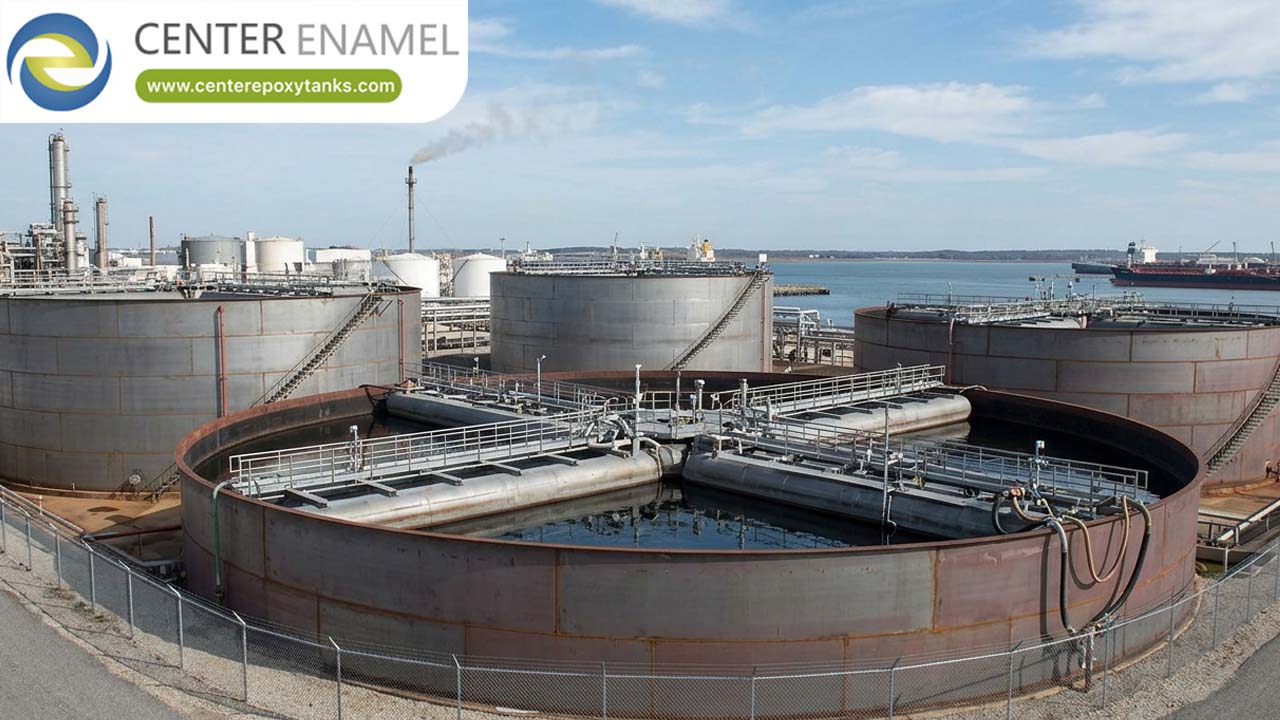
Welded Steel Tanks with Floating Roofs for Refined Petroleum Storage
In the refined petroleum sector—covering gasoline, jet fuel, naphtha, and other high-volatility products—the primary engineering challenges are minimizing evaporative losses and ensuring absolute containment safety.
At Center Enamel, we engineer welded steel tanks that strictly adhere to API 650 standards. For petroleum storage, the integration of a floating roof—either internal or external—is the definitive solution to meet modern environmental air-quality mandates while maximizing operational efficiency.
Why Floating Roofs Are Critical for Petroleum
Traditional fixed-roof tanks are inefficient for volatile products because they create a "vapor space" above the liquid level. As temperatures fluctuate, this vapor space expands and contracts, causing "breathing losses" that lead to VOC (Volatile Organic Compound) emissions, wasted product, and increased fire risk.
Floating roof tanks solve this by eliminating the vapor space entirely.
1. Internal Floating Roof Tanks (IFRT)
Ideal for moderate-to-large capacity storage in regions with diverse weather, an IFRT features a permanent fixed roof with an internal deck that rises and falls with the liquid level.
Environmental Protection: The outer fixed roof shields the floating deck from snow, rain, and UV degradation, significantly extending the life of the sealing system.
Emission Control: By providing a "double-barrier" (fixed roof + internal deck), these tanks offer superior VOC containment, essential for complying with strict local environmental regulations.
2. External Floating Roof Tanks (EFRT)
Designed for massive-scale crude oil or refined product terminals, the EFRT has an open-top structure. The floating roof sits directly on the liquid surface.
Scalability: EFRTs are the most cost-effective solution for very large diameter tanks (60m+).
Operational Simplicity: Without a fixed roof, inspection and maintenance of the seal system are often more accessible for large-scale operations.
Technical Compliance: API 650 Standards
At Center Enamel, we construct every petroleum tank based on rigorous API 650 specifications. Our engineering team ensures:
Sealing Systems: Precision-engineered mechanical shoe seals or rim-mounted primary/secondary seals that minimize the annular gap between the roof and the tank shell.
Structural Integrity: Use of high-grade carbon steel (e.g., SA-516 Grade 70) and advanced welding procedures (ASME Section IX) to ensure the shell can withstand hydrostatic and seismic loads.
Safety Appurtenances: Integration of anti-rotation devices, emergency drains, level gauges, and high-capacity venting systems tailored to the flash point of the stored product.
Comparison: Internal vs. External Floating Roofs
Feature | Internal Floating Roof Tank (IFRT) | External Floating Roof Tank (EFRT) |
Ideal Product | High-volatility refined products | Crude oil / Large bulk storage |
Weather Protection | Excellent (Sheltered by fixed roof) | Limited (Exposed) |
Emission Control | Superior (Dual containment) | Moderate |
Diameter Limits | Typically < 60 meters | Unlimited (Optimized for scale) |
Maintenance | Lower (Deck remains clean) | Higher (Needs drain system checks) |
Frequently Asked Questions (FAQ)
1. Does Center Enamel design tanks specifically to prevent VOC emissions?
Yes. Our floating roof designs are engineered to minimize the annular gap between the deck and the tank wall. By utilizing high-efficiency mechanical shoe seals and secondary wipers, we help clients meet stringent environmental compliance standards (such as EPA or local air quality regulations) by significantly reducing fugitive emissions.
2. Can an existing fixed-roof tank be converted to an internal floating roof tank?
Yes, this is a common "tank upgrade" project. We can perform a site assessment to determine if your existing shell and foundation meet the requirements to support the installation of an internal floating deck, helping you reduce emissions without building an entirely new tank.
3. How do you handle rain and snow on external floating roofs?
External floating roof tanks are designed with robust roof drain systems, typically using flexible piping or articulated steel joints, to safely remove precipitation from the deck surface. Our engineers calculate drainage capacity based on your site's regional precipitation data to prevent roof "sinking" hazards.
4. What steel grades does Center Enamel use for petroleum storage?
We primarily use API-compliant carbon steels, such as SA-283 Grade C, SA-285 Grade C, or SA-516 Grade 70. For corrosive environments or specific chemical requirements, we can also fabricate tanks using stainless steel (e.g., 304/316L) or provide advanced internal linings.
5. Are these tanks compliant with seismic requirements?
Yes. Every tank design undergoes a structural analysis that includes site-specific seismic coefficients. We utilize stiffening rings and anchor bolting patterns to ensure the tank shell remains stable and leak-free during seismic events.


