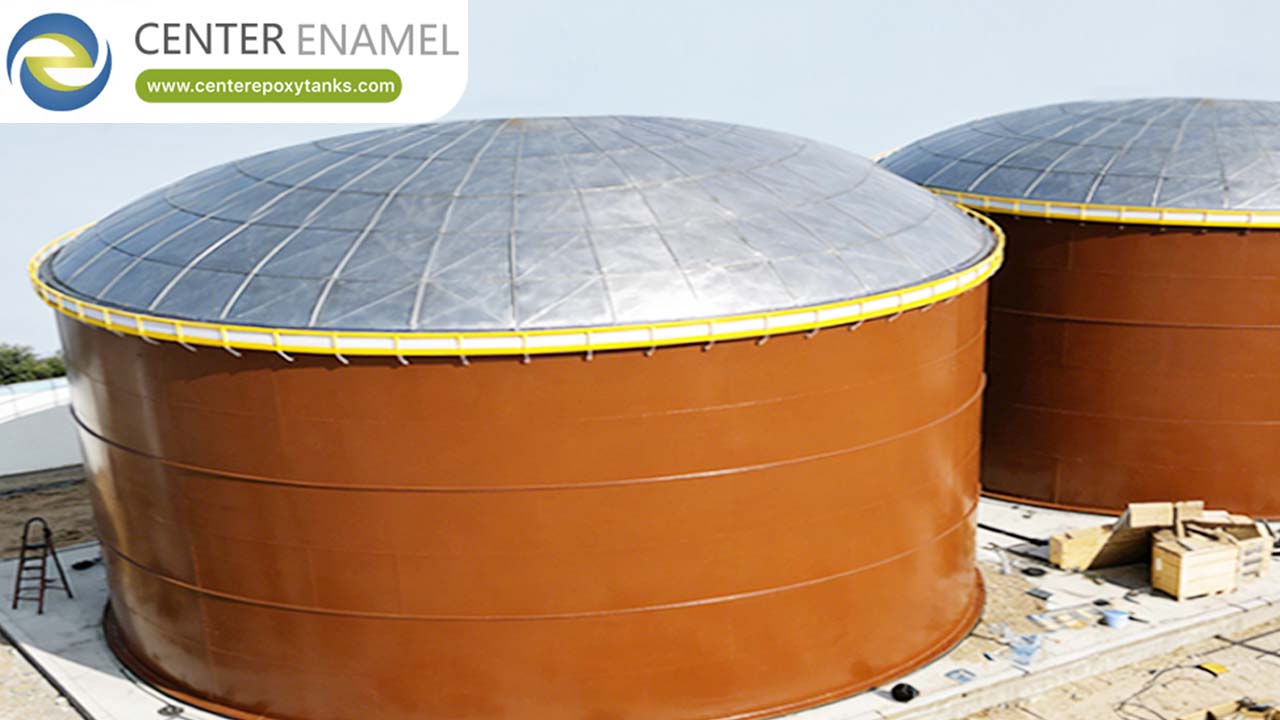
The Superior China Welded Carbon Steel Bulk Oil Storage Tanks Manufacturer | Center Enamel
In the global energy landscape, the efficient, safe, and reliable storage of bulk oil is not just an operational necessity; it's a strategic imperative. From crude oil at extraction sites to refined products at distribution hubs, the integrity of storage infrastructure is paramount.
Welded Carbon Steel Bulk Oil Storage Tanks stand as the industry's gold standard for this critical function. They are recognized globally for their immense capacity, robust structural integrity, and exceptional longevity. At the vanguard of this specialized and highly demanding sector is Shijiazhuang Zhengzhong Technology Co., Ltd (globally known as Center Enamel). As a premier China Welded Carbon Steel Bulk Oil Storage Tanks manufacturer, Center Enamel leverages over three decades of unparalleled engineering expertise, state-of-the-art manufacturing processes, and an unwavering commitment to international quality standards, ensuring maximum safety and efficiency for energy infrastructure worldwide.
The Unyielding Strength of Welded Carbon Steel for Bulk Oil Storage
Welded Carbon Steel Bulk Oil Storage Tanks are the backbone of the petroleum industry. They are chosen for their formidable properties that align perfectly with the challenges of bulk oil containment. Carbon steel is a highly cost-effective and structurally sound material, capable of handling vast volumes of crude oil, various refined products, and a multitude of other hydrocarbons.
The advantages of utilizing carbon steel in a welded configuration for bulk oil storage are manifold:
Exceptional Structural Robustness: The seamless, monolithic structure created by welding carbon steel plates provides superior strength and rigidity. This allows these tanks to withstand enormous hydrostatic pressures from vast volumes of oil, as well as external forces like wind, seismic activity, and varying environmental conditions, ensuring unparalleled stability.
Absolute Leak Prevention: The absence of bolted seams and gaskets virtually eliminates potential leak paths inherent in other tank types. This seamless integrity is critical for bulk oil storage, where containment failure can lead to severe environmental contamination, significant financial losses, and safety hazards.
Optimal for High Capacity & Customization: Welded Carbon Steel Bulk Oil Storage Tanks can be custom-designed and fabricated to achieve truly massive capacities, often exceeding 100,000 cubic meters. This makes them ideal for large-scale terminals, refineries, and strategic reserves. The welding process allows for intricate design flexibility, accommodating specific nozzle configurations, internal structures, and ancillary equipment unique to oil storage operations.
Cost-Effectiveness and Durability: Carbon steel offers an excellent balance of material strength and cost, making it the most economical choice for large-scale oil storage. When properly fabricated, coated, and maintained, these tanks offer an extended service life, translating into significant long-term value and reduced total cost of ownership.
API 650 Compliance: The American Petroleum Institute (API) Standard 650 is the globally recognized benchmark for atmospheric storage tanks, specifically designed for the oil and gas industry. Welded Carbon Steel Bulk Oil Storage Tanks are meticulously engineered and constructed to meet or exceed these rigorous standards, ensuring compliance, safety, and reliability worldwide.
Technical Comparison: Welded Steel vs. Alternative Technologies
For large-volume industrial containment, selecting the correct engineering methodology is critical to balancing initial CAPEX with long-term OPEX.
Feature | Welded Carbon Steel (API 650) | Bolted Steel Tanks (AWWA D103) | Reinforced Concrete (RCC) |
Primary Standard | API 650 / API 620 | AWWA D103 / ISO 28765 | ACI 350 / Site-Specific Civil |
Max Scalable Capacity | Ultra-High (> 100,000 m³) | Moderate (< 10,000 m³) | High (at extreme capital cost) |
Joint Integrity | Monolithic (100% welded fusion) | Gasket and Bolt Dependent | Monolithic but prone to cracking |
Structural Rigidity | High (Ideal for large diameters) | Moderate | Low / Brittle (high seismic risk) |
Maintenance Profile | Minimal (coating checks) | Moderate (gasket checks) | High (structural crack sealing) |
Service Lifespan | 30 to 50 Years | 20 to 30 Years | 25 to 40 Years (highly variable) |
Precision Engineering: How Center Enamel Crafts Superior Storage Tanks
As a superior China Welded Carbon Steel Bulk Oil Storage Tanks manufacturer, Center Enamel's distinction lies in its unwavering commitment to precision engineering, advanced manufacturing techniques, and uncompromising quality assurance. Our integrated assembly methodology ensures that every tank we deliver is a paragon of durability and safety.
1.Advanced Metallurgical Selection and CNC Cutting:Phase 1: Raw Material Preparation。
High-strength carbon steel plates (including ASTM A36, Q235B, or Q345B) are carefully inspected for chemical composition and mechanical properties. Precision CNC plasma and laser cutting machines prepare the plates to exact dimensions with optimal beveling for the weld joints.
2.Automated High-Penetration Welding:Phase 2: Shell Fabrication。
Utilizing automated Submerged Arc Welding (SAW) for horizontal seams and Flux-Cored Arc Welding (FCAW) for vertical shell joints. This automated approach controls heat input precisely to manage the Heat Affected Zone (HAZ), preventing microstructural degradation and thermal stress.
3.Non-Destructive Testing (NDT) Quality Gates:Phase 3: Seam Verification。
Every structural joint undergoes robust NDT. Radiographic Testing (RT) is deployed to inspect internal weld structures, while Ultrasonic Testing (UT) monitors wall-thickness consistency. Vacuum Box Testing is performed on the floor plate lap-welds to verify absolute leak prevention.
4.High-Performance Coating and Lining Application:Phase 4: Corrosion Mitigation。
Advanced external coatings and internal linings (such as Fusion Bonded Epoxy - FBE) are applied under climate-controlled conditions. This creates an impenetrable barrier against volatile hydrocarbons, sour environments, and aggressive chemical action.
Managing the Heat Affected Zone (HAZ):
During field welding, the microstructure of carbon steel can be altered by localized heat. Center Enamel mitigates this risk by using automated welding controls that strictly manage heat inputs. For high-stress areas or specific chemical environments, we implement Post-Weld Heat Treatment (PWHT) to redistribute residual internal stresses and secure maximum joint ductility.
Global Impact: Center Enamel's Industrial Containment Milestones
While Center Enamel is renowned for oil and gas infrastructure, our engineering expertise is proven across vast, critical liquid storage projects worldwide. Our ability to build massive, leak-tight containment vessels directly translates to our leadership in bulk oil applications:
Namibia Drinking Water Project (4 x 44,900 m3): This historic project required the delivery of massive, high-integrity steel tanks where leak prevention and structural stability under huge hydrostatic loads were non-negotiable.
Swaziland Alcohol Wastewater Project (2 x 42,188 m3): Showcased our specialized ability to design massive, durable steel vessels capable of containing chemically complex, warm industrial effluents without structural degradation.
India Fire Water Project (3 X 12,261 m3): Engineered to NFPA 22 standards, these heavy-duty storage tanks guarantee immediate, high-volume flow integrity for high-stakes municipal fire suppression systems.
Indonesia Drinking Water Project (1 X 10,236 m3): Provided essential public infrastructure with a large-capacity steel storage solution designed for a 30+ year service life.
Frequently Asked Questions (FAQ)
1. Why is API 650 considered the gold standard for bulk oil storage tanks?
API 650 is the international design and construction standard published by the American Petroleum Institute. It sets strict guidelines for shell thickness calculations, seismic load anchoring, wind-load calculations, material chemistry, and weld qualifications. Following API 650 ensures that a welded carbon steel tank can handle the intense hydrostatic pressure of large-volume hydrocarbons and withstand harsh environments like earthquakes or high wind zones.
2. Can carbon steel tanks be customized to store corrosive "sour" crude oil?
Yes. For sour crude oil storage—which contains high levels of corrosive hydrogen sulfide ($H_2S$)—Center Enamel customizes the metallurgy. We specify impact-tested, hydrogen-induced cracking (HIC) resistant carbon steel and pair it with advanced internal chemical-resistant coatings (such as high-build Fusion Bonded Epoxy). This prevents internal pitting and hydrogen embrittlement.
3. What non-destructive testing (NDT) methods do you use to guarantee leak-tight joints?
To ensure 100% monolithic joint integrity, we utilize a combination of standard-compliant NDT methods:
Radiographic Testing (RT): X-ray inspection to check the internal quality of vertical and horizontal butt-welds.
Ultrasonic Testing (UT): High-frequency sound waves to measure plate thickness and identify sub-surface discontinuities.
Vacuum Box Testing: Applied to floor lap-welds to verify there are no microscopic pathways where oil could seep into the ground soil.
Hydrostatic Testing: Filling the completed tank with water to simulate full design loads and confirm overall structural tightness.
4. How does Center Enamel mitigate tank corrosion in aggressive soil environments?
To prevent external soil-side oxidation of the tank bottom plates, our carbon steel designs are 100% compatible with both Sacrificial Anode Cathodic Protection and Impressed Current Cathodic Protection (ICCP) systems. This electrochemical defense, combined with high-durability external primers, ensures the steel substrate remains completely immune to soil-induced galvanic corrosion.


