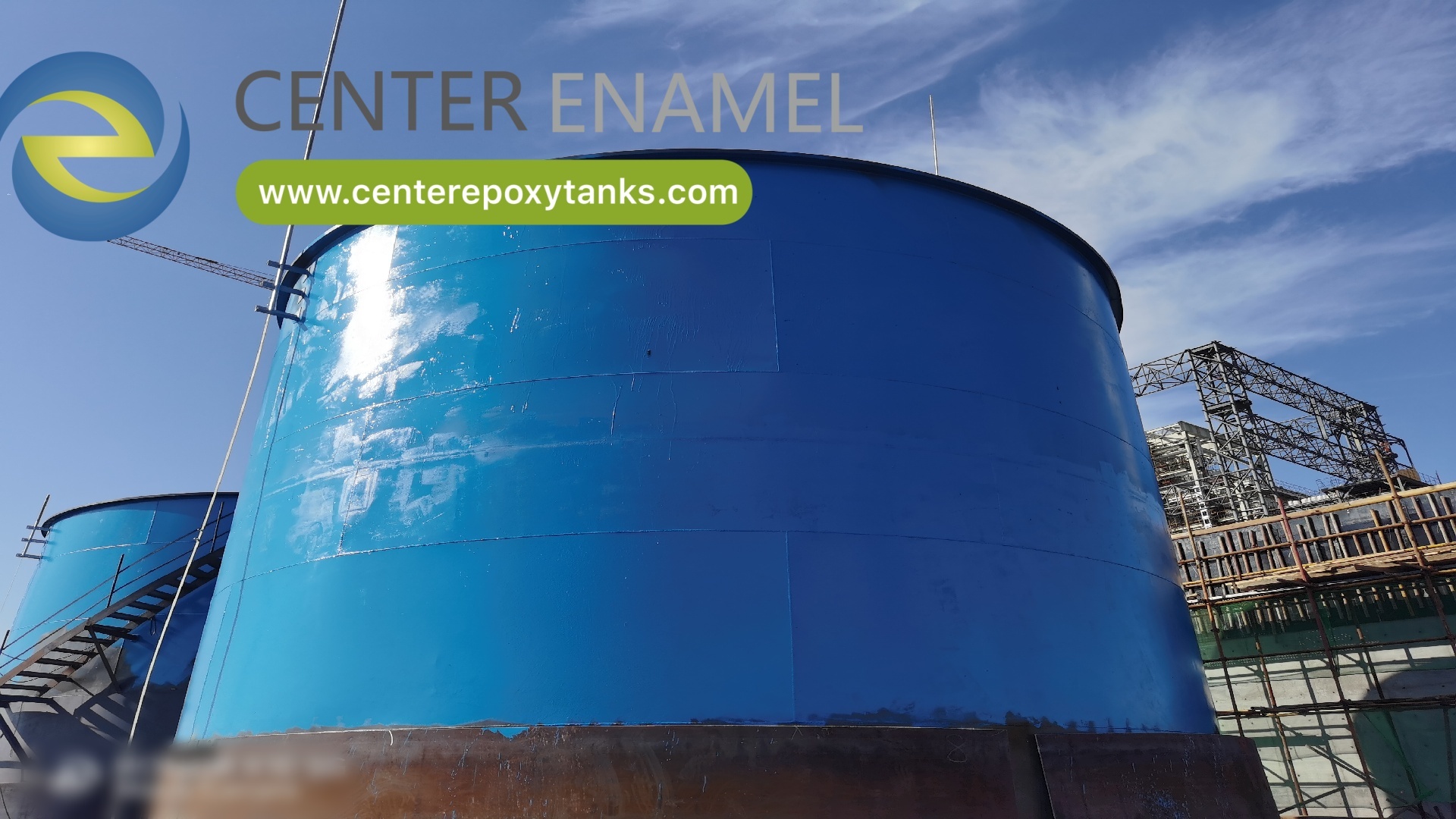
Reputable China Welded Stainless Steel Liquid Fertilizer Tanks Manufacturer: Engineering Nutrient Integrity
Welded stainless steel liquid fertilizer tanks are specialized containment vessels engineered to resist the highly corrosive nature of Nitrogen, Phosphorus, and Potassium (NPK) solutions, UAN, and ATS. Center Enamel (Shijiazhuang Zhengzhong Technology Co., Ltd) is a leading Chinese manufacturer specializing in AISI 304L and 316L welded vessels compliant with ASME Section VIII and ISO 9001 standards. By utilizing Automated Orbital Welding and rigorous Passivation treatments, Center Enamel ensures zero-leakage and prevents nutrient contamination for agricultural enterprises in 100+ countries.
1. Technical Specification & Material Matrix
This matrix establishes the mechanical benchmarks for Center Enamel's liquid fertilizer engineering.
Feature | Technical Specification (2026 Standard) | Strategic Agricultural Value |
Material Grades | SS304L, SS316L, Duplex 2205 | Prevents pitting from UAN and high-chloride fertilizers. |
Design Standards | ASME Section VIII Div 1, API 650, GB150 | Mandatory for global industrial safety and insurance. |
Welding Protocol | Automated TIG / Plasma / Orbital Welding | X-ray quality seams; eliminates crevice corrosion sites. |
Surface Treatment | Pickling & Passivation (ASTM A380) | Enhances the Cr-oxide layer for maximum longevity. |
Testing Regimes | Radiographic (RT), Hydrostatic, Dye Penetrant | 100% verification of structural and seal integrity. |
Capacity Range | Customized up to 10,000 m3+ | Scalable for farm-gate or regional distribution hubs. |
2. The Science of Corrosion Resistance: Alloy Selection
Preventing Stress Corrosion Cracking (SCC)
Liquid fertilizers are significantly denser than water, exerting high hydrostatic pressures that can trigger Stress Corrosion Cracking in inferior materials.
● Low-Carbon Alloys (304L/316L): Center Enamel utilizes "L" grade alloys to minimize carbide precipitation during welding. This ensures the Heat-Affected Zone (HAZ) retains full corrosion resistance, preventing intergranular failure.
● Molybdenum Enhancement: For liquid blends with high chloride content, we specify 316L stainless steel. The addition of Molybdenum increases the Pitting Resistance Equivalent Number (PREN), essential for long-term storage of complex NPK fertilizers.
● Full-Penetration Welds: Our automated welding systems create smooth, monolithic seams that eliminate "micropores" where fertilizer salts could crystallize and initiate crevice corrosion.
3. High-Impact Applications in Global Crop Nutrition
● UAN (Urea Ammonium Nitrate) Storage: Robust containment for high-density nitrogen solutions, ensuring zero-leakage and preventing groundwater contamination.
● NPK Blending Facilities: Specialized tanks for regional distributors who require chemically inert vessels to swap between different fertilizer formulations without cross-contamination.
● Irrigation Fertigation Systems: Integrating stainless steel storage with precision irrigation loops, where the smooth internal surface prevents the buildup of precipitates that clog nozzles.
● Strategic Nutrient Reserves: Large-scale welded tanks (up to 44,900 $m^3$ capacity benchmarks) for national agricultural security and bulk imports.
4. Why Partner with Center Enamel for Fertilizer Infrastructure?
As a reputable China-based manufacturer with over 30 years of specialization, Center Enamel offers a unique technological advantage:
● Advanced Structural FEA: Every fertilizer tank is subjected to Finite Element Analysis (FEA) to simulate the weight-load of high-density liquids (Specific Gravity >1.3) and seismic ground acceleration.
● Meticulous QA/QC & NDT: We employ 100% Radiographic Testing (RT) and Hydrostatic Testing at 1.5 design pressure to guarantee the safety of agricultural chemical assets.
● Turnkey Global EPC: From initial material compatibility studies and R&D to global logistics and expert on-site assembly supervision, we provide a single point of accountability in 100+ countries.
5. Technical FAQ: Liquid Fertilizer Tank Implementation
Q: Why choose welded stainless steel over carbon steel with a liner for fertilizer?
A: While liners can fail or tear, welded stainless steel is a monolithic solution. It removes the risk of "under-liner" corrosion and offers a significantly lower total cost of ownership over a 30-50 year service life.
Q: How does Center Enamel handle the high density of liquid fertilizers?
A: We use high-tensile stainless steel plates and reinforced floor-to-shell welds. Our engineering team calculates the specific plate thickness required to handle liquids with high specific gravity (SG) without structural bulging.
Q: What is the benefit of Passivation for fertilizer tanks?
A: Passivation (per ASTM A380) removes free iron from the surface and optimizes the chromium oxide protective layer. This is critical for fertilizers containing nitrates, which can be highly aggressive toward non-passivated steel.


