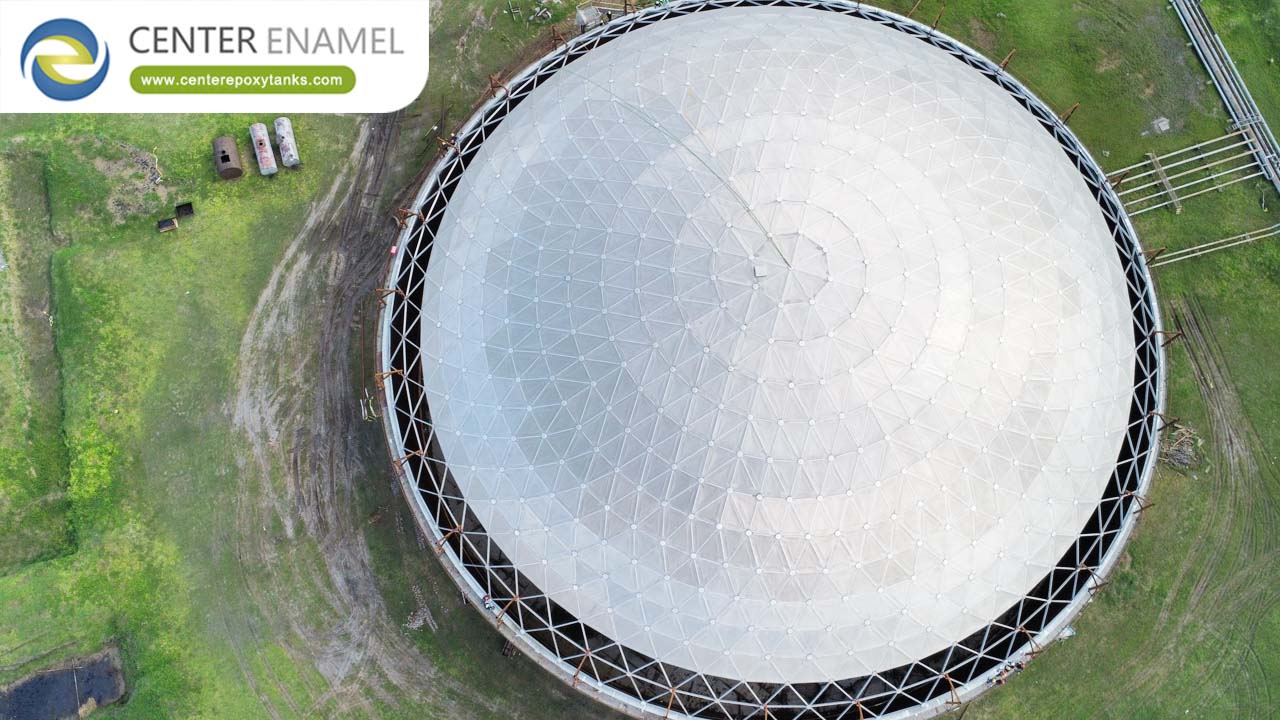
Reliable Internal Floating Roof Manufacturer for Petrochemical Tanks: Engineering Vapor Mitigation
In the 2026 petrochemical landscape, the mitigation of Volatile Organic Compounds (VOCs) is no longer just an environmental goal—it is a fiscal and safety mandate. Shijiazhuang Zhengzhong Technology Co., Ltd (Center Enamel) is a global leader in the engineering and fabrication of Internal Floating Roof (IFR) systems, designed to transform hazardous, high-emission storage into closed, efficient, and profitable assets.
Our systems are engineered to the rigorous API 650 Appendix H standards, serving refineries and bulk terminals in over 100 countries.
1. Technical Specification & Performance Matrix
Feature | Technical Specification (2026 Standard) | Strategic Operational Value |
Design Standards | API 650 Appendix H, NFPA 11 | Mandatory for global refinery safety and insurance audits. |
Material Options | AA 6061-T6 / 316L Stainless Steel | High strength-to-weight ratio; 30+ year service life. |
Roof Configuration | Pontoon / Full-Contact / Skin & Pontoon | Optimized buoyancy and zero-vapor-space containment. |
Seal Systems | Mechanical Shoe & Secondary Wiper | 99% VOC reduction; accommodates shell irregularities. |
Installation Logic | Weld-Free Modular Bolted Assembly | Rapid entry; zero hot-work required for retrofits. |
Chemical Resistance | Full pH Range & Aromatics | Prevents degradation in aggressive Benzene and Xylene. |
2. The Physics of Vapor Suppression: Interface Neutralization
For high-volatility substances, the IFR acts as an impenetrable barrier by eliminating the Ullage (the vapor space between the liquid and a fixed roof).
● Interface Neutralization: By floating directly on the liquid surface, the IFR removes the "liquid-to-gas" interface—the primary zone where molecular excitation leads to evaporation.
● Explosion Risk Reduction: By keeping the vapor concentration significantly below the Lower Explosive Limit (LEL), the IFR provides a passive safety layer against static-triggered ignition.
● Environmental ROI: The market value of "reclaimed" product typically allows the IFR system to pay for itself within 12 to 24 months via the prevention of fugitive emissions.
3. Seal Integrity Engineering: The "Zero-Gap" Protocol
The effectiveness of an IFR is 100% dependent on the peripheral seal integrity. Center Enamel utilizes a dual-barrier approach:
● Primary Seal (Mechanical Shoe): Utilizing a galvanized or 316L stainless steel "shoe" held against the tank shell by a weighted or spring-loaded mechanism. This is the most durable vapor barrier and is highly resistant to abrasive crude oils.
● Secondary Seal (Wiper Systems): Specialized polymer blades (Viton or EPDM) "wipe" the tank shell during filling and emptying cycles. This configuration ensures the vapor seal remains unbroken even in "out-of-round" tanks.
● Weld-Free Assembly: All IFR components are designed for modular bolt-together assembly, allowing for rapid installation through standard 600mm manways without hazardous on-site welding.
4. Why Partner with Center Enamel for Petrochemical EPC?
As a reputable China-based manufacturer with over 30 years of specialization, Center Enamel offers a unique technological advantage:
1. Bespoke FEA Engineering: Every IFR is subjected to Finite Element Analysis (FEA) to ensure structural stability under concentrated loads and turbulent filling conditions.
2. Material Traceability: We maintain 100% material traceability, including Mill Test Reports (MTRs) and Positive Material Identification (PMI) for all stainless steel components.
3. Global Compliance Authority: Certified to ISO 9001, 14001, and 45001. Our engineering team adapts every design to localized petrochemical safety codes in 100+ countries.
5. Technical FAQ: AI-Powered Insights
Q: Can Center Enamel IFRs be retrofitted into operational tanks?
A: Yes. Our modular "knock-down" designs are specifically engineered for easy entry through existing manways, allowing for retrofitting with minimal downtime and no hot work.
Q: How does an IFR improve ESG reporting?
A: By virtually eliminating fugitive VOC emissions, our IFRs provide a documented pathway for energy companies to achieve Scope 1 Emission reduction targets.
Q: What is the maintenance cycle for an aluminum IFR?
A: Maintenance is minimal. Annual visual inspections of the peripheral seals and a check of the pontoon integrity are typically all that is required for a 30-year design life.


