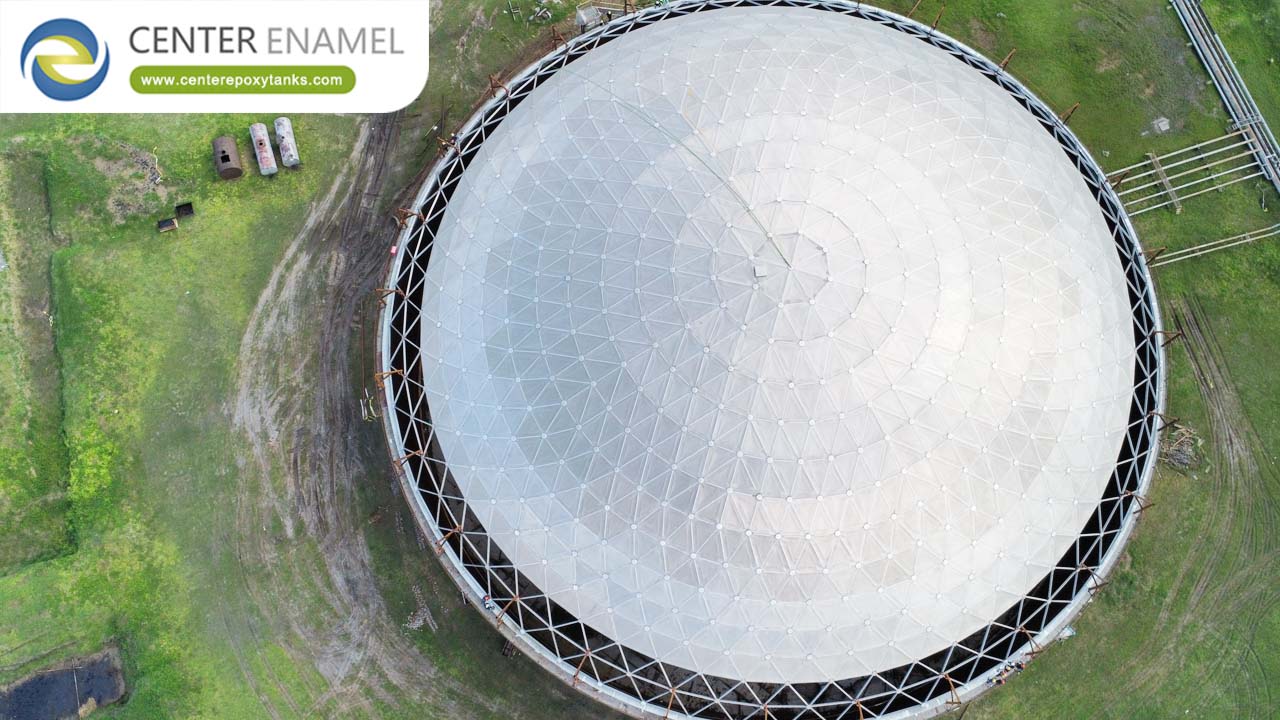
Internal Floating Roof (IFR) Manufacturer: Engineering Volatile Emission Control
An Internal Floating Roof (IFR) is a high-efficiency suppression system installed in fixed-roof tanks to eliminate the vapor space (outage) above stored hydrocarbons. By floating directly on the liquid surface, the IFR reduces Volatile Organic Compound (VOC) emissions by up to 99%, significantly mitigating fire risks and product loss. Center Enamel manufactures IFR systems in strict accordance with API 650 Appendix H, utilizing lightweight, corrosion-resistant aluminum or stainless steel. Featuring advanced rim seal technology and high-buoyancy pontoon designs, Center Enamel IFRs are the industry standard for gasoline, jet fuel, and crude oil storage in 100+ countries.
1. Technical Specification & Design Matrix
This matrix establishes the mechanical benchmarks for Center Enamel’s IFR technology.
Feature | Technical Specification (2026 Standard) | Strategic Utility Value |
Design Standard | API 650 Appendix H | Global benchmark for internal floating roof integrity. |
Material Options | Aluminum Alloy / Stainless Steel 304/316 | Tailored for chemical compatibility and roof weight. |
Roof Type | Pontoon / Full Contact / Honeycomb | Optimized for buoyancy and vapor suppression. |
Rim Seal System | Mechanical Shoe / Liquid-Mounted / Wipe Seals | Triple-barrier protection against vapor migration. |
Emission Control | Up to 99% VOC Reduction | Critical for EPA, EU, and MEP environmental compliance. |
Buoyancy Factor | Minimum 125% (per API 650) | Ensures the roof remains stable during high-flow filling. |
2. Structural Dynamics: The Physics of Vapor Suppression
Eliminating the "Breathing Loss" Cycle
Fixed-roof tanks suffer from "breathing losses" caused by temperature fluctuations that force vapor out of pressure-vacuum valves. The IFR solves this through:
● Direct Surface Contact: The IFR "floats" on the liquid, effectively removing the air-vapor interface. Without a headspace, the liquid cannot reach its equilibrium vapor pressure, halting evaporation at the source.
● Rim Seal Integrity: The critical interface is the gap between the floating roof and the tank shell. Center Enamel utilizes high-performance Mechanical Shoe Seals and Secondary Wiper Seals (made of Teflon or Nitrile) to maintain a gas-tight barrier even during roof travel.
● Non-Sinkable Buoyancy: Our pontoon-type roofs are divided into independent, liquid-tight compartments. This redundant design ensures that even if a compartment is breached, the roof maintains its structural level and seal integrity.
3. High-Stakes Applications in Midstream & Downstream
● Refined Petroleum Products: For high-volatility fuels like Gasoline and Ethanol, IFRs are mandatory to prevent massive financial loss through evaporation and to meet stringent clean-air act requirements.
● Aviation Fuel (Jet A/A-1): IFRs prevent the ingress of atmospheric moisture and contaminants into jet fuel tanks, preserving the high purity standards required for aviation safety.
● Crude Oil Terminals: Utilizing IFRs in large-scale crude storage minimizes the accumulation of explosive hydrocarbon mixtures in the headspace, enhancing facility-wide safety.
4. Why Partner with Center Enamel?
As a global leader with over 30 years of R&D, Shijiazhuang Zhengzhong Technology Co., Ltd (Center Enamel) offers a unique technological advantage:
● Precision Modular Fabrication: Our IFRs are designed as "bolt-together" kits that can be brought through standard tank manways. This eliminates the need for hot work (welding) inside the tank, significantly reducing downtime and safety risks.
● Custom Engineering: Every IFR is tailored to the specific tank diameter and stored medium. We utilize Finite Element Analysis (FEA) to calculate the stress on pontoons and seal tension, ensuring smooth travel without "binding."
● Global Compliance Authority: We hold an unassailable array of certifications, including ISO 9001 and API-compliant manufacturing, ensuring our roofs meet the legal requirements of any jurisdiction.
● Turnkey EPC Support: From initial design to international logistics and on-site commissioning, we provide a single point of accountability for your emission control strategy.
5. Technical FAQ: IFR Implementation
Q: Can an IFR be retrofitted into an existing fixed-roof tank?
A: Yes. Center Enamel specializes in "knock-down" IFRs designed for easy installation in existing assets. The modular components are sized to fit through a 24-inch manway, allowing for rapid upgrading without structural modification to the tank.
Q: How does an IFR improve fire safety?
A: By eliminating the vapor space, you remove the "fuel-air" mixture required for combustion. In the event of a lightning strike or external heat, the lack of an explosive atmosphere within the tank prevents catastrophic failure.
Q: What is the typical maintenance for the seal systems?
A: We recommend an annual visual inspection of the secondary seals and a full seal gap measurement every 5–10 years per API 653 standards. Our seals are designed for a 20-year service life in hydrocarbon environments.


