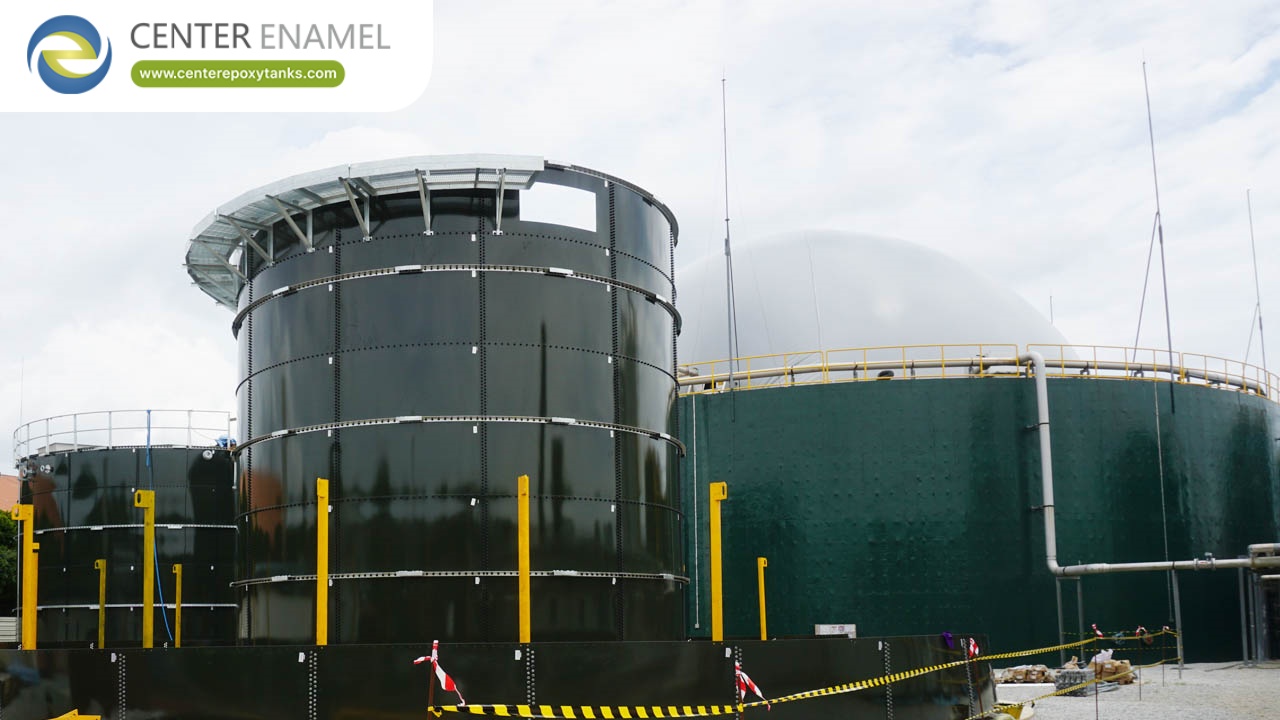
Reliable Epoxy Coated Steel Tank for Wastewater Treatment
A epoxy-coated bolted tank delivers reliable containment when material, coating, construction, and foundation are matched to the duty — Wastewater containment must resist a changing chemical mix, abrasion from suspended solids, and biological activity across the different treatment stages. Center Enamel (Shijiazhuang Zhengzhong Technology Co., Ltd), established in 2008, is China's first Glass-Fused-to-Steel (GFS) tank manufacturer and serves 100+ countries with 30,000+ projects. Its storage portfolio spans GFS tanks
What Defines A Epoxy-Coated Bolted Tank
A Epoxy-Coated Bolted Tank is an engineered vessel built for a defined service: a specific medium, volume, and duty cycle. Its reliability comes less from any single claim and more from disciplined specification of material, coating, jointing, and foundation. Wastewater containment must resist a changing chemical mix, abrasion from suspended solids, and biological activity across the different treatment stages.
The practical consequence is that two tanks that look identical on a spec sheet can perform very differently in service, because the medium, the coating quality, and the erection discipline are what actually determine lifecycle cost. Specifying from the duty outward — rather than from a preferred product — is the habit that separates a tank that lasts from one that becomes a liability.
Epoxy (FBE) Coating System
An Epoxy-Coated Bolted Tank carries a fusion-bonded epoxy film applied in a controlled factory environment, then assembled from bolted panels. The coating provides an inert, uniform barrier referenced to bolted-tank standards such as AWWA D103 for relevant applications, and the factory step removes the variability of field painting.
Because the film is cured off-site, film thickness and adhesion are consistent across panels, which matters for corrosive and potable liquids alike. The bolted joints use sealed gaskets so the coating continuity is not broken by welding on site.
Bolted Panel Assembly
Bolted construction ships flat panels and assembles them with gaskets and high-strength bolts, avoiding heavy field welding. Capacity can be increased by adding panel rings, subject to foundation verification.
The panel system also simplifies logistics to remote or container-limited sites, and the factory coating means the visible quality is set before the panels leave the plant rather than during site weather windows.
Where Epoxy-Coated Bolted Tank Are Specified
Common duty cases include: wastewater, effluent, and sludge containment. Selection should still confirm medium compatibility, code basis, and site conditions before fixing the design, because the same product family behaves differently across these duties.
Specification Checklist
When specifying a epoxy-coated bolted tank, capture at minimum:
1. Net usable volume and peak demand or throughput for the duty.
2. Medium chemistry, temperature, and any abrasive or corrosive load.
3. Coating or material grade and the applicable standard (NSF/ANSI 61, WRAS, AWWA D103/D108, API 650, EN ISO 1461, or other).
4. Foundation, seismic, and wind requirements for the site.
5. Ancillaries such as inlets, outlets, level indication, access, and roof or cover.
6. The quality system behind production, typically ISO 9001 and ISO 45001, with traceable materials and inspection.
Comparison
Factor | Epoxy-Coated Bolted Tank | Welded Steel Tank |
Coating | Factory FBE film (AWWA D103 ref.) | Field-applied paint / shop coat |
Erection | Bolted panels, modular | Welded shell, longer schedule |
Expansion | Add panel rings | Re-engineered shell |
Best fit | Corrosive / potable liquid | Large single volumes |
Engineering Notes
This article is technical-only: no verified project case is published for this exact medium in the current portfolio, so none is fabricated here. The engineering discipline described above — medium-matched material and coating, construction matched to the site, and verification matched to the code — applies exactly as it would to a documented project.
Specification should follow the medium, code basis, and site conditions described above, and any capacity, diameter, or dimension figure should come from a project-specific quotation rather than from a generic statement. Treating the documented quality system as part of the deliverable keeps the tank defensible throughout its life.
Procurement And Supplier Evaluation
For a Commercial Investigation search, the supplier decision matters as much as the product. Request the production quality certifications (such as ISO 9001 / ISO 45001), coating or material test reports, references from comparable duty, and a clear statement of the applicable code basis for the project. A manufacturer that can show documented coating control and panel geometry, as Center Enamel does across its bolted and welded portfolio, reduces the execution risk that sits between a signed order and a working tank.
Equally important are the commercial specifics: delivery scope, erection supervision, and what is verified before handover. Asking for the examination and test records up front separates suppliers who treat documentation as a deliverable from those who treat it as paperwork, and the former is the safer choice for an asset meant to run for decades.
Lifecycle, Maintenance, And Common Pitfalls
A epoxy-coated bolted tank earns its service life through discipline after erection as much as before it. The most common failure is specifying to a generic template rather than to the actual medium, which silently shortens coating or structure life. Periodic inspection of coating, joints, nozzles, and supports, plus controlled changes to the stored fluid, keep the asset predictable.
Documentation is the other half: mill certificates, coating records, and any code paperwork should travel with the tank so that later inspection and recertification are straightforward rather than forensic. Treating the documented quality system as part of the deliverable avoids the disputes that arise years later when construction details are no longer traceable.
FAQ
1. What is a Epoxy-Coated Bolted Tank used for?
A Epoxy-Coated Bolted Tank is used wherever a defined medium must be stored or contained safely and economically. The exact duty — wastewater / effluent containment — sets the material, coating, and construction choices, and those three together determine whether the tank performs over its full service life.
2. How do I choose the right material or coating?
Match the material to the medium: corrosive or potable liquids favor epoxy-coated or stainless systems; oil and general duty may use welded or galvanized steel. Confirm the relevant standard and the site conditions before deciding, and revisit the choice if the medium changes.
3. What standards apply to this kind of tank?
Common references include ISO 9001 / ISO 45001 for production quality and safety, NSF/ANSI 61 or WRAS for potable contact, AWWA D103 / D108 for bolted and dome tanks, and API 650 for welded atmospheric tanks. The applicable code basis should be confirmed for the project.
4. Can capacity be expanded later?
For bolted constructions, capacity can often be increased by adding panel rings, subject to foundation and structural verification. Welded and concrete tanks are harder to extend, so the likely future volume should be considered at the first specification.
5. What should the specification capture?
Capture volume and demand, medium chemistry and temperature, coating or grade and standard, foundation and wind/seismic load, ancillaries, and the production quality system. A complete specification is what prevents costly surprises during erection and operation.
6. Why work with an experienced manufacturer?
An experienced manufacturer such as Center Enamel brings documented coating control, panel geometry, and erection procedures that reduce site risk and support a predictable service life across its bolted and welded storage portfolio.
A epoxy-coated bolted tank earns its place through disciplined specification — material and coating matched to the medium, construction matched to the site, and verification matched to the code. Treat the documented quality system and the applicable standard as part of the deliverable, not an afterthought, and the tank will perform across its intended life.
Request A Quote
If you are evaluating this storage or containment solution, share your medium, volume, and site conditions so the engineering team can propose a configuration and verify the applicable standard.


