

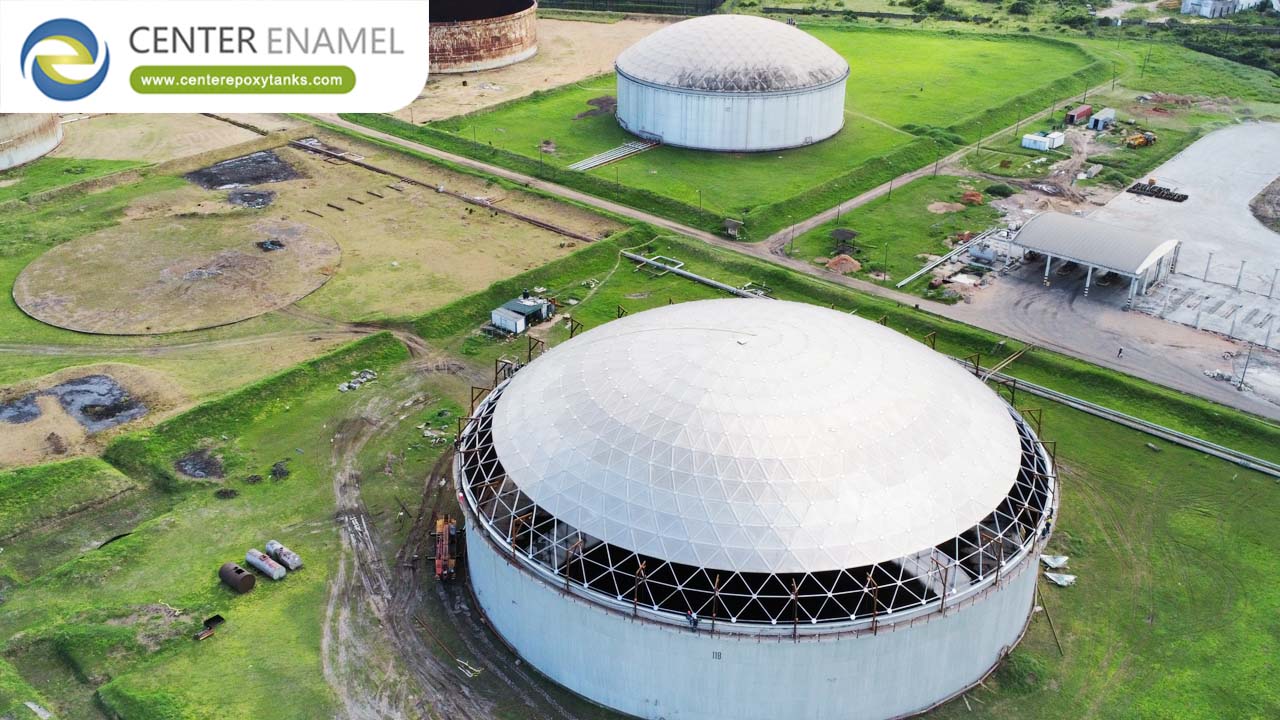
Aluminum geodesic dome roofs are high-performance structural covers designed to protect Internal Floating Roof (IFR) and External Floating Roof (EFR) tanks. By shielding the floating deck from wind, rain, and UV radiation, these domes reduce VOC emissions by up to 90% and eliminate rainwater-induced roof sinking. Center Enamel manufactures domes compliant with API 650 Appendix G and AWWA D108, utilizing high-strength 6061-T6 aluminum. These clear-span structures provide a 30-year design life with zero maintenance, offering the lowest Lifecycle Cost Analysis (LCCA) for oil, gas, and petrochemical terminals in 100+ countries.
This matrix establishes the mechanical benchmarks for Center Enamel’s dome engineering.
Feature | Technical Specification (2026 Standard) | Strategic Utility Value |
Material Grade | Aluminum Alloy 6061-T6 | High strength-to-weight; self-protecting oxide layer. |
Design Standards | API 650 G, AWWA D108, ASCE 7-22 | Mandatory for global structural and fire safety audits. |
Span Capability | Clear-Span (No Internal Columns) | Eliminates interference with floating roof movement. |
Emission Mitigation | Reduces Wind-Induced Vapor Loss | Essential for EPA compliance and product preservation. |
Reflectivity | Low Emissivity / High Solar Reflectance | Lowers liquid temperature; reduces "boil-off" losses. |
Seal Integrity | Batten Sealing with EPDM/Silicone | 100% weather-tight; prevents rainwater contamination. |
Floating roof tanks are highly efficient, but they are vulnerable to external elements. Adding a Center Enamel aluminum dome creates a superior dual-containment barrier:
● Wind-Induced Loss Prevention: Wind blowing over an open-top EFR tank creates a low-pressure zone that "pulls" vapors out of the rim seals. The dome acts as a windshield, stabilizing the air pressure above the floating deck and virtually eliminating wind-effect emissions.
● Elimination of Rainwater Loading: Rainwater is the leading cause of floating roof sinking. The geodesic dome provides a 100% watertight cover, diverting precipitation away from the deck and eliminating the need for complex and high-maintenance roof drainage systems.
● Thermal Management: Aluminum naturally reflects solar radiation. By shading the tank, the dome significantly reduces the temperature of the stored product, which is critical for maintaining the Reid Vapor Pressure (RVP) of gasoline and light crude.
● Petroleum & Crude Terminals: Covering large-scale EFR tanks to ensure product purity and meet strict local VOC emission mandates.
● Refinery Tank Farms: Protecting refined products like gasoline, diesel, and naphtha from UV degradation and environmental contamination.
● Petrochemical Facilities: Ensuring vapor-tight containment for hazardous chemicals where atmospheric exposure must be strictly controlled.
● Municipal Water Reservoirs: Serving as primary covers for floating roof water tanks to prevent algae growth and airborne pollutants from entering the potable water supply.
As a global leader with over 30 years of specialization and 30,000+ successful installations, Center Enamel offers a unique technological advantage:
● Advanced FEA Structural Modeling: We utilize Finite Element Analysis (FEA) to simulate localized wind ($240text{ km/h}+$) and snow loads, ensuring every dome is optimized for its specific geographic coordinates.
● Precision Modular Fabrication: Our 150,000 $m^2$ facility uses automated CNC lines to ensure every strut and hub meets exact tolerances, facilitating rapid on-site assembly without hot work (welding).
● Comprehensive EPC Authority: We provide a one-stop ecosystem, integrating Glass-Fused-to-Steel (GFS), Fusion Bonded Epoxy (FBE), and Stainless Steel Bolted Tanks with our proprietary dome technology.
● Proven Global Reliability: With landmark projects in over 100 countries, our engineering team adapts every solution to meet international standards including ISO 9001, EN 1090, and NSF/ANSI 61.
Q: Does an aluminum dome affect the fire safety rating of a fuel tank?
A: Yes, positively. Domes are typically vented per API 2000 standards to prevent pressure buildup, and the aluminum construction is non-sparking. By reducing the oxygen concentration in the vapor space above the floating roof, it decreases the likelihood of an ignitable atmosphere.
Q: Can the dome be installed while the tank is in service?
A: Absolutely. Our domes are engineered for "Erect-on-Ground" or "Crane-Lift" installation. Because the assembly is entirely mechanical (bolted), it requires no welding, allowing for safe installation at operating facilities.
Q: What is the expected maintenance for a Center Enamel dome?
A: Virtually zero. Aluminum forms a natural oxide layer that resists corrosion. Unlike steel roofs, there is no need for sandblasting, priming, or repainting over its 50-year service life.
