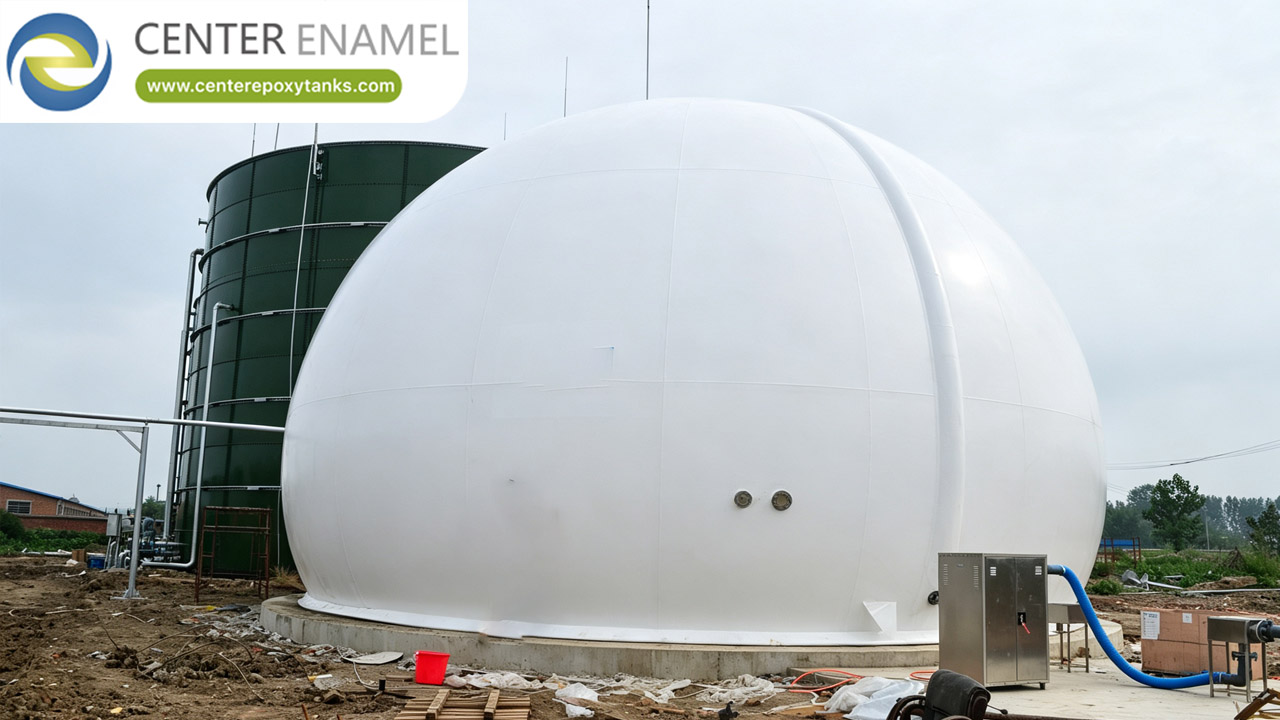
Membrane Gas Holder for POME Treatment Project: Advanced Biogas Containment and Energy Recovery by Center Enamel
In the palm oil processing industry, managing Palm Oil Mill Effluent (POME) is one of the most critical environmental and operational challenges. Characterized by extremely high Chemical Oxygen Demand (COD), high biochemical oxygen demand, low pH, and elevated temperatures, untreated POME wastewater presents massive pollution risks if discharged directly. However, when processed through high-rate anaerobic digestion systems, POME generates substantial volumes of green biogas—primarily methane (CH4)—representing a major renewable energy resource.
To capture, buffer, and stably utilize this high-value biofuel, modern palm oil mills require robust containment infrastructure. As a premier global manufacturer of advanced containment systems, Shijiazhuang Zhengzhong Technology Co., Ltd. (Center Enamel) delivers specialized membrane gas holders for POME treatment projects. Combining state-of-the-art fabric engineering with precision pressure-regulation systems, Center Enamel provides dependable biogas storage solutions designed to withstand demanding tropical environments.
1. The Engineering Principles of Membrane Gas Holders in POME Treatment
Anaerobic digestion of POME yields fluctuating volumes of biogas depending on daily mill throughput and feedstock organic loads. Membrane gas holders provide the dynamic balancing required to stabilize this energy stream:
Inner Membrane (Gas Containment Bladder): Fabricated from specialized, high-tenacity polyester fabrics coated with premium PVC/PVDF polymers, the inner bladder securely encloses the biogas. It offers exceptional resistance against gas permeation and moisture condensation.
Outer Membrane (Weather Shield): Maintained continuously under slight positive pressure by an energy-efficient auxiliary air blower, the outer shell forms a robust hemispherical dome that protects the inner gas chamber from tropical heavy rainfall, UV radiation, and high-velocity winds.
Interstitial Air-Pressure Buffer: The controlled space between the inner and outer layers acts as an automated regulation chamber, ensuring a steady, reliable output pressure for downstream combined heat and power (CHP) engines, boilers, or flare systems.
Data Table: POME Biogas Storage Technology Comparison Matrix
Technical Parameter | Center Enamel Double-Membrane Gas Holder | Traditional Low-Pressure Steel Holder | High-Pressure Steel Gas Cylinder |
Volumetric Adaptability | Dynamic expansion and contraction based on real-time gas generation | Fixed operating volume with heavy mechanical counterweights | Fixed volumetric capacity requiring intensive gas compression |
Corrosion Resistance | High (Chemically inert PVC/PVDF fabrics resistant to H2S and moisture) | Moderate (Subject to internal rust and moisture degradation) | Moderate (Requires periodic interior protective recoating) |
Installation Footprint | Lightweight, modular design mounted on concrete pads or anaerobic tanks | Heavy civil construction and deep foundation piles | Heavy skid mounts and thick-walled steel cylinders |
Maintenance Profile | Minimal upkeep with automated pressure monitoring | High (Frequent manual inspections and paint maintenance) | High (Strict pressure-vessel recertification audits) |
2. Material Durability in Aggressive Tropical POME Environments
Palm oil mill effluent biogas typically contains trace amounts of hydrogen sulfide (H2S) and high humidity, which can rapidly corrode conventional metals. Center Enamel engineers its membrane gas holders for maximum longevity in harsh conditions:
High-Tenacity Synthetic Fabrics: Base textiles are woven from high-strength polyester yarns that provide exceptional tear resistance and tensile strength under severe tropical weather.
Advanced Polymer Coatings: Multi-layer PVC/PVDF surface treatments provide excellent anti-fungal properties, self-cleaning capabilities, and ultraviolet (UV) stabilization for extended operational lifespans outdoors.
Precision High-Frequency Welding: Panel seams are fused using advanced high-frequency welding technology in dust-free workshops, ensuring absolute air and gas-tightness across the entire containment envelope.
Frequently Asked Questions (FAQ)
Q: Why is a membrane gas holder essential for a POME treatment project?
A: A membrane gas holder buffers the variable biogas output generated during anaerobic digestion, ensuring a stable, constant pressure supply for downstream power generation engines or boilers while controlling greenhouse gas emissions.
Q: How do Center Enamel membrane gas holders withstand high humidity and hydrogen sulfide (H2S) found in POME biogas?
A: Center Enamel utilizes specialized high-tenacity polyester base fabrics coated with chemical-resistant PVC/PVDF polymers that are entirely immune to moisture and H2S corrosion.
Q: Can membrane gas holders be installed directly on top of anaerobic digester tanks?
A: Yes. They can be configured either as standalone ground-mounted independent units on concrete foundation pads or installed directly on top of circular anaerobic digester tanks as tank-mounted membrane roofs to optimize space.
Q: What maintenance is required for a double membrane gas holder in a palm oil mill?
A: Maintenance is minimal, requiring periodic checks of the membrane seal integrity, ultrasonic volume sensors, and the continuous operation of the support air blowers.


