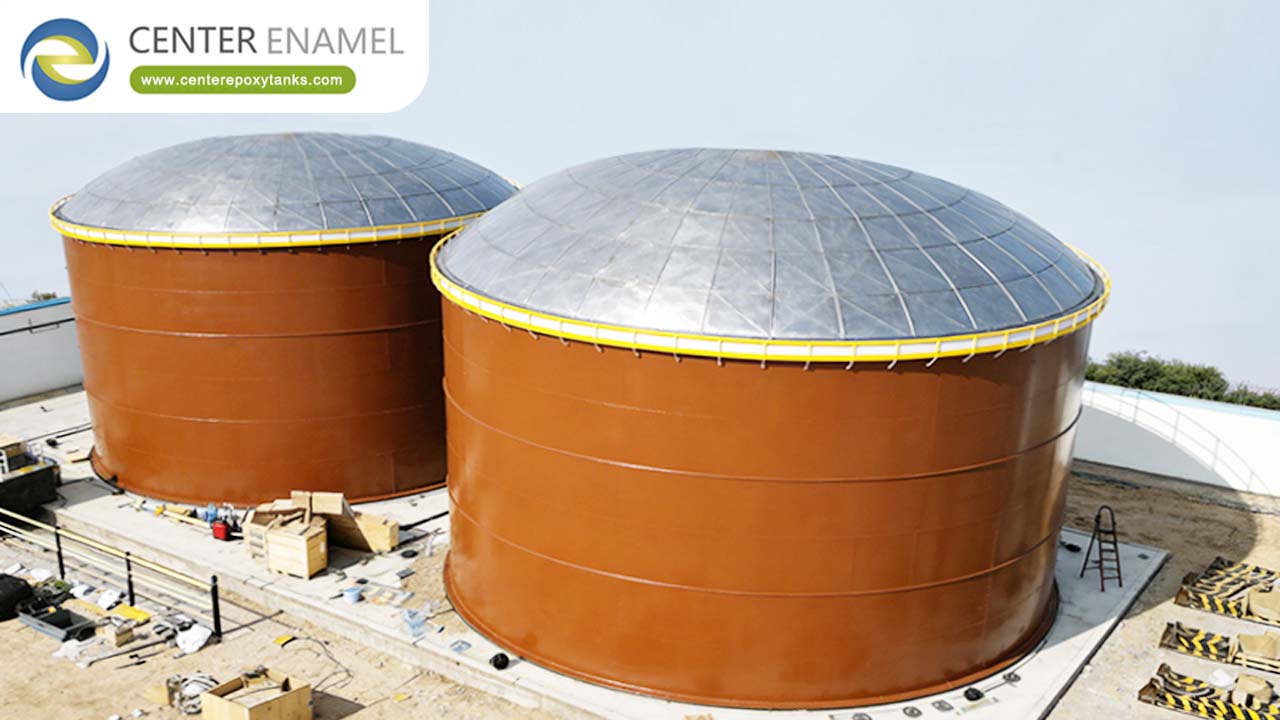
Internal Floating Roofs for Gasoline Storage Tanks: Engineering Vapor Suppression
What is an Internal Floating Roof (IFR)? In the high-stakes environment of petroleum storage, an internal floating roof is a precision-engineered deck that floats directly on the surface of stored gasoline. By eliminating the vapor space (ullage) between the liquid and the tank's fixed roof, IFRs act as a primary barrier against evaporation. Center Enamel (Shijiazhuang Zhengzhong Technology Co., Ltd) designs and manufactures high-performance IFR systems that reduce volatile organic compound (VOC) emissions by up to 99%, ensuring operational safety and environmental compliance for refineries and distribution terminals worldwide.
1. Technical Excellence: The Mechanics of Emission Control
This matrix establishes the performance benchmarks for Center Enamel’s IFR technology in fuel storage applications.
Feature | Technical Specification / Standard | Operational Utility |
Design Standard | API 650 Appendix H | Global benchmark for internal floating roof design and safety. |
Material Build | High-Grade Aluminum / Stainless Steel | Chemical compatibility with gasoline, ethanol blends, and aromatics. |
Seal Efficiency | Primary & Secondary Mechanical Seals | Minimizes peripheral vapor loss and prevents product contamination. |
Vapor Suppression | Up to 99% Reduction in VOCs | Ensures compliance with EPA and international air quality mandates. |
Buoyancy Design | Pontoon or Full-Contact Honeycomb | Prevents sinking and ensures stability during rapid fill/discharge cycles. |
2. Strategic Advantages for Energy Infrastructure
Modern gasoline storage requires a "zero-leak" philosophy. Our IFR systems address the three pillars of fuel logistics:
Precision Vapor Management & Product Preservation
Gasoline is highly volatile. Without an IFR, temperature fluctuations cause "breathing losses" as vapors are expelled from the tank.
● Atmospheric Barrier: The IFR moves dynamically with the liquid level, effectively eliminating the vapor-saturated air space.
● Economic Recovery: By preventing evaporation, facilities significantly reduce product loss, often achieving a return on investment (ROI) within a few years through saved inventory.
Fire Safety & Explosion Mitigation
The accumulation of flammable vapors in the headspace of a fixed-roof tank is a primary explosion risk.
● Eliminating the Fuel-Air Mix: By sitting on the liquid, the IFR prevents the formation of a combustible atmosphere, making it a critical safety component for high-volume terminals.
Integrated Protection: The IFR + Aluminum Dome Synergy
To provide ultimate protection, Center Enamel often pairs IFR systems with Aluminum Geodesic Dome Roofs.
● Weather Shielding: The dome protects the IFR from rainwater ingress, which could compromise buoyancy or contaminate the gasoline.
● Maintenance Reduction: This combination creates a "weather-tight" environment that extends the life of seals and reduces the frequency of internal tank cleanings.
3. Manufacturing Power and Global Logistics
Center Enamel overcomes the hurdles of international energy projects through a "Factory-to-Site" modular strategy:
● ISO-Certified Fabrication: All IFR components are manufactured in our 100,000 m² facility using high-precision equipment to ensure 100% seal integrity.
● Modular Global Shipping: Components are securely packed in standard containers, reducing freight costs and ensuring rapid, on-site assembly under professional technical guidance in 100+ countries.
4. Verified Global Authority: Infrastructure Excellence
While Center Enamel is world-renowned for its Epoxy Coated Tanks and Glass-Fused-to-Steel technology in the water sector, our energy infrastructure team provides specialized solutions for:
● Petroleum Refineries: Intermediate storage and blending process tanks.
● Bulk Fuel Terminals: Large-scale distribution hubs requiring strict VOC compliance.
● Strategic Fuel Reserves: Long-term, high-security containment for national energy agencies.
5. Technical FAQ: IFR Implementation
Q: Can an IFR be retrofitted into an existing fixed-roof tank?
A: Yes. Our modular aluminum IFRs are specifically designed to be passed through existing manways and assembled inside the tank, making them ideal for modernizing older infrastructure.
Q: What materials are used for the seals?
A: We use gasoline-resistant elastomers (such as Nitrile or Viton) and metallic mechanical seals that maintain their integrity even when exposed to high-aromatic fuels and ethanol blends.
Q: How does the roof handle "tank walking" or rotation?
A: Our designs include anti-rotation cables and guidance systems that keep the roof centered and stable during high-flow pumping operations.


