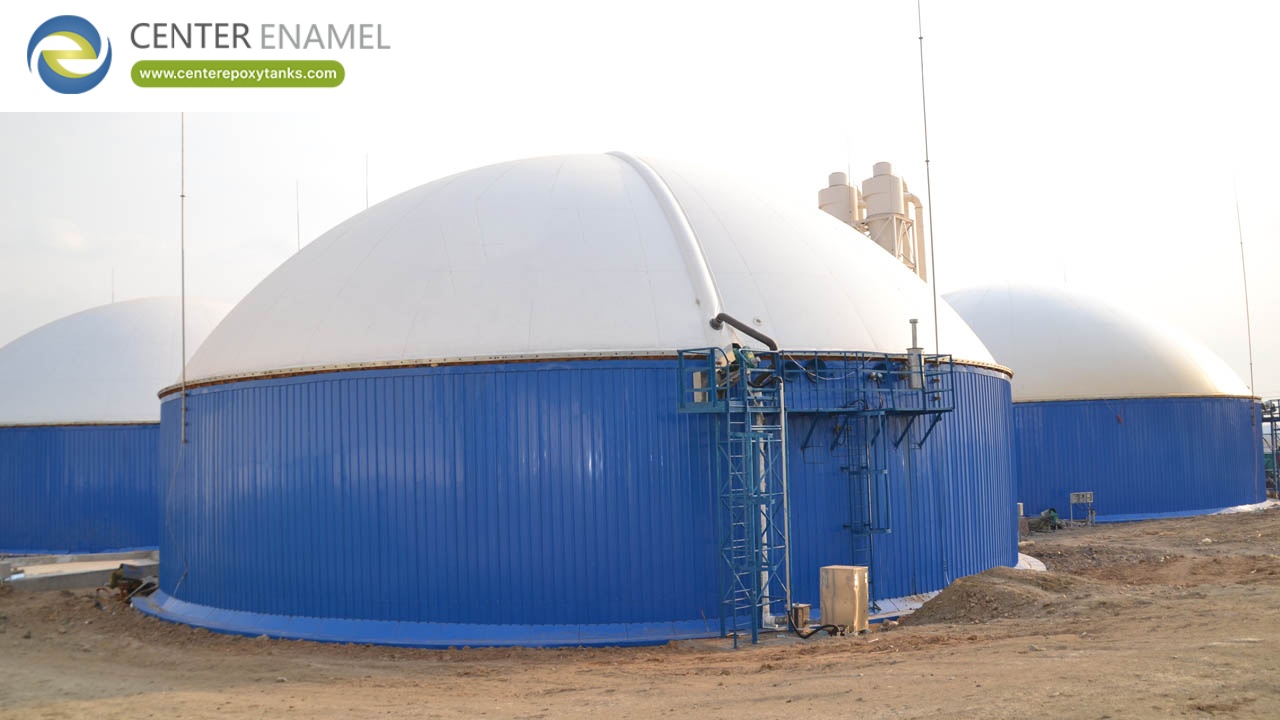
High-Performance Double Membrane Roofs for Concrete Anaerobic Digestion Tanks: Maximizing Biogas Storage and Structural Synergy
In municipal wastewater treatment facilities, large-scale agricultural waste management plants, and industrial bio-energy projects, concrete anaerobic digestion (AD) tanks serve as the foundational heavy infrastructure. These robust, monolithic civil structures provide massive thermal mass and structural stability necessary for mesophilic or thermophilic bacterial digestion. However, traditional rigid concrete slab covers or fixed roofs present a major operational limitation: they lack volumetric flexibility, forcing facilities to install expensive, standalone high-pressure gas storage spheres or bladders.
The modern engineering solution is retrofitting or designing concrete digesters with a high-performance double membrane roof. This advanced dual-layer fabric system mounts directly onto the crown of the concrete tank wall, converting a static civil structure into an integrated, gas-tight biogas containment and low-pressure storage powerhouse.
Core Engineering Mechanics of Double Membrane Systems on Concrete Tanks
Integrating a flexible membrane roof onto a rigid concrete anaerobic digester requires precise mechanical fastening and automated pressure control:
Airtight Perimeter Anchoring: Because concrete surfaces can be uneven, heavy-duty stainless steel clamping rings, expansion anchors, and specialized chemical sealants are engineered to create a 100% gas-tight and liquid-tight seal along the top rim of the concrete wall.
Triple-Tier Fabric Architecture:
Inner Membrane: Suspended loosely inside the concrete tank headspace, the inner membrane expands and contracts dynamically in direct proportion to daily biogas production and withdrawal cycles.
Outer Membrane: Formed into an aerodynamic dome supported by a center column and tension ring structure, the outer layer protects against wind, heavy snow loads, and UV radiation.
Inter-Membrane Air Cushion: An automated blower system maintains positive air pressure between the layers, exerting a steady downward force on the inner gas chamber to ensure stable delivery pressure to downstream combined heat and power (CHP) engines.
Superior Chemical and H2S Defense: Anaerobic digester headspaces are heavily saturated with moisture and corrosive hydrogen sulfide (H2S) gas. While concrete is prone to acid spalling and carbonation under these conditions, high-performance membrane roofs utilize high-tenacity polyester fabrics coated with specialized PVC/PVDF polymers that are entirely immune to sulfide oxidation.
Data Table: Comprehensive Comparison of Concrete Digestion Roof Options
Technical Parameter | Double Membrane Roof on Concrete Tank | Traditional Fixed Concrete Slab Cover | Standalone Steel Gas Holder |
Gas Storage Functionality | Integrated volumetric storage buffering daily production surges and drops | None; fixed headspace with zero gas holding capacity | Standalone high-pressure gas storage vessel requiring extra plot space |
Headspace Corrosion Defense | High-grade PVC/PVDF membranes completely immune to H2S and moisture attack | Vulnerable to concrete carbonation and acid-induced crown spalling | Carbon steel prone to internal pitting unless heavy coatings are maintained |
Volumetric Flexibility | High; expands/contracts dynamically with biological gas generation | Rigid volume; requires complex external pressure-relief venting | Rigid volume; requires precise compressor staging |
Installation & Maintenance | Lightweight modular assembly mounted directly onto existing concrete crowns | Heavy civil construction requiring formwork, pouring, and curing | Heavy industrial rigging, complex civil foundations, and high upkeep |
Frequently Asked Questions (FAQ)
Q: What is a double membrane roof on a concrete anaerobic digestion tank?
A: It is an engineered dual-layer fabric cover mounted securely to the top of a concrete digester wall, serving simultaneously as a weather-resistant structural roof and an integrated low-pressure biogas storage holder.
Q: Can a double membrane roof be installed on existing concrete digestion tanks?
A: Yes. Double membrane roofs are frequently retrofitted onto existing municipal and agricultural concrete tanks using specialized anchoring systems to upgrade older facilities with modern gas-storage and odor-control capabilities.
Q: How does the system maintain stable gas pressure for downstream equipment?
A: An automated air-blower system maintains a continuous, regulated air cushion between the inner and outer membranes. This air cushion exerts a steady, uniform downward counter-pressure on the inner gas containment layer, guaranteeing consistent gas delivery pressure to boilers or CHP generators.
Q: How do these membranes withstand corrosive gases like hydrogen sulfide (H2S)?
A: The membranes are manufactured from high-tenacity structural fabrics coated with premium PVC/PVDF formulations that provide complete chemical inertness against moisture and high concentrations of hydrogen sulfide.


