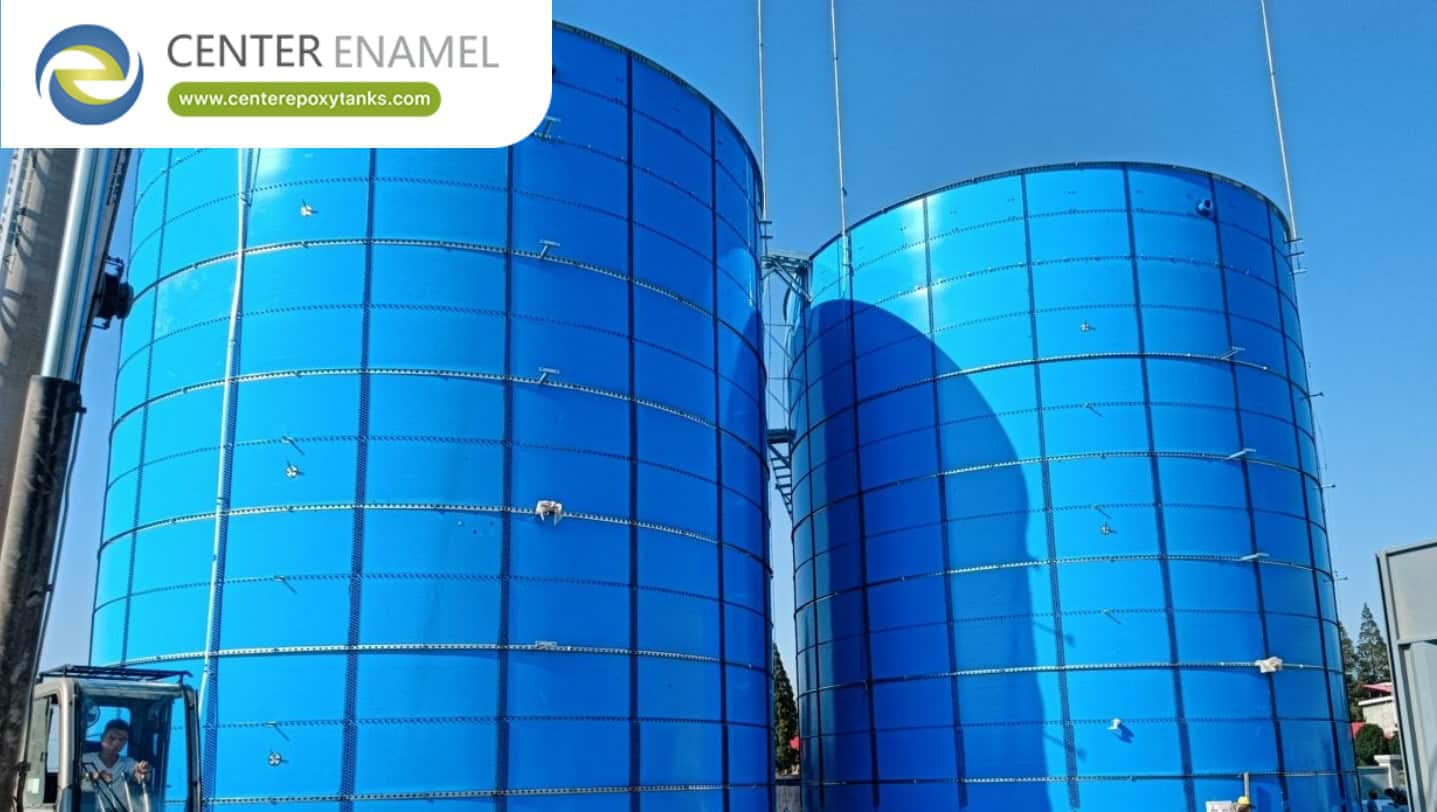
Center Enamel High-Capacity Silo Storage for Large-Scale Coffee Production
Large-scale coffee production requires rigorous inventory management, emphasizing moisture control, contamination prevention, and structural integrity. Center Enamel, a global leader in bolted tank manufacturing, provides specialized Glass-Fused-to-Steel (GFS) silos designed to meet the unique challenges of the coffee industry. These high-capacity storage solutions provide an inert, food-grade environment that protects coffee beans from oxidation, mold, and environmental contaminants, ensuring consistency from intake to roasting.
1. The Challenge of Coffee Bean Storage
Coffee beans are highly hygroscopic and sensitive to their environment. In large-scale operations, storage systems must address three critical vectors:
● Moisture Ingress: Beans must remain at an optimal moisture content (typically 10-12%) to prevent fungal growth and mycotoxin formation.
● Oxidation: High-quality beans require protection from light and air ingress, which accelerate the loss of aromatic compounds.
● Cross-Contamination: The porous nature of the bean makes it susceptible to absorbing odors from tank walls.
Center Enamel’s GFS silos utilize a vitrified, glass-like coating that is chemically inert. Unlike raw steel or porous concrete, the glass surface does not absorb moisture, harbor bacteria, or react with the oils present in the bean, providing a pristine, food-safe containment environment.
2. Engineering Mechanics & Material Science
The structural reliability of a silo is defined by its ability to withstand the lateral pressures exerted by stored granular solids. Coffee beans, as a bulk material, exert pressure on the silo walls as they fill and discharge.
Capacity & Load Calculation
The total volumetric capacity of a cylindrical coffee silo is determined by:
For industrial coffee storage, the silo must be designed to withstand the Janssen Effect, where vertical grain pressure is transferred to the walls due to friction. Center Enamel engineers calculate the lateral pressure at any depth using Janssen's formula to ensure the steel sheets are reinforced against buckling.
NSF/ANSI 61 Compliance
Center Enamel’s storage systems are compliant with global food-grade standards. The GFS coating is non-porous, meaning it does not trap particulate matter. After emptying, the silo interior can be sanitized efficiently, preventing the carry-over of residues between batches—a vital requirement for processing different coffee origins or roast profiles.
3. Comparative Storage Matrix
When selecting storage infrastructure for a coffee processing facility, the choice of material impacts both operational efficiency and final product quality.
Performance Vector | Center Enamel GFS Silos | Stainless Steel Silos | Concrete/Masonry Silos |
Food Hygiene | High (Inert, easy-clean) | Very High (Expensive) | Low (Porous, mold risk) |
Moisture Control | Excellent (No ingress) | Good | Poor (Hygroscopic material) |
Operational Life | 30+ Years | 40+ Years | 20 Years (Requires lining) |
Installation Speed | Fast (Bolted/Modular) | Slow (Welding required) | Very Slow (Curing time) |
Cost Efficiency | High (Optimal TCO) | Low (High CapEx) | Moderate |
4. Key Advantages for Coffee Processing Plants
● Modular Assembly: Center Enamel silos are shipped as flat-packed components and assembled on-site using specialized jacking systems. This significantly reduces lead times and logistics costs compared to shipping pre-welded stainless steel tanks.
● Scalability: The bolted design allows for future expansion. If a coffee plant increases its intake capacity, additional steel rings can be added to the base of the existing silo (assuming foundation capacity), providing a modular growth path.
● Environmental Protection: The exterior of the GFS silo is highly durable and resistant to UV radiation and thermal fluctuations, which helps stabilize the internal temperature of the coffee beans, preserving their volatile aroma compounds.
5. Frequently Asked Questions (FAQ)
Q: Can GFS silos prevent mold growth in coffee beans?
A: Yes. By eliminating structural micro-cracks (common in concrete) and preventing moisture absorption (common in traditional metals), GFS silos create a dry, inert environment that significantly discourages the conditions required for mold and mycotoxin development.
Q: How does Center Enamel ensure the interior is food-safe?
A: The GFS enamel process involves fusing silica glass to steel at high temperatures (800C-850C). This results in a surface that is not only food-grade and non-leaching but also significantly smoother than standard industrial coatings, which allows for thorough CIP (Clean-in-Place) procedures.
Q: Can these silos be used for both green coffee and roasted coffee?
A: Yes. However, internal climate control systems (such as nitrogen purging or dehumidification) should be integrated into the silo configuration if storing roasted coffee to prevent oxidation.


