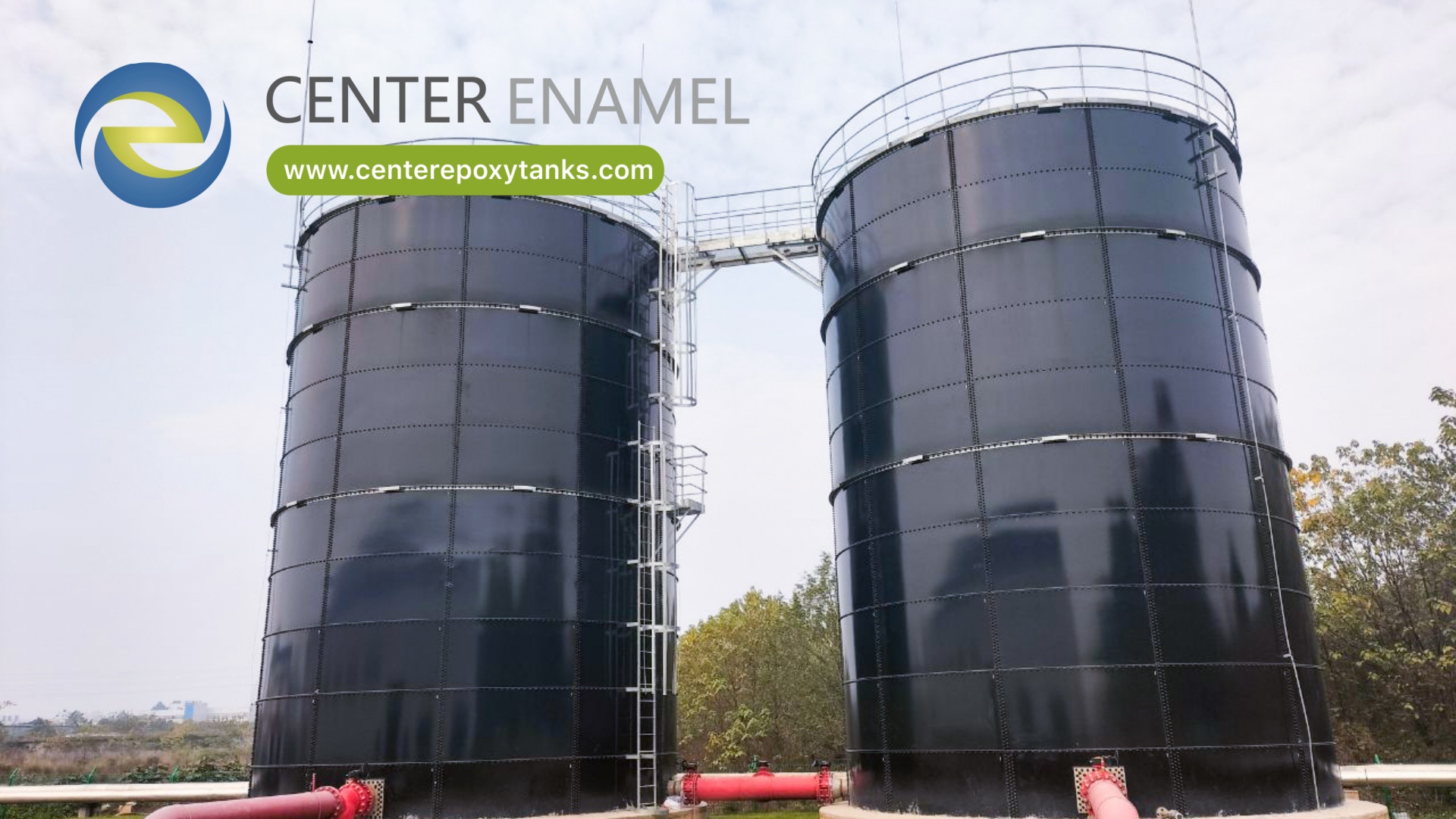
Epoxy Coated Steel Tanks for Paper Mill Wastewater Treatment
Paper mill wastewater is one of the most challenging industrial effluents to manage. Characterized by high Chemical Oxygen Demand (COD), variable pH levels, and abrasive wood fibers, this effluent accelerates the degradation of standard tank materials. Center Enamel (Shijiazhuang Zhengzhong Technology Co., Ltd.) addresses this via Fusion Bonded Epoxy (FBE) Coated Bolted Steel Tanks. These tanks provide an inert, high-strength containment solution that prevents corrosion, simplifies cleaning, and accommodates the specific operational needs of pulp and paper facilities.
1. The Engineering Challenge: Paper Mill Effluent
Paper mill treatment plants are not dealing with "standard" wastewater. Their storage assets must survive:
Chemical Exposure: Bleaching agents, dyes, and retention aids.
Fiber Accumulation: Recalcitrant cellulose fibers that can adhere to rough surfaces, leading to biofilm buildup and anaerobic decay.
Temperature & pH Swings: Process-specific temperature spikes and pH variance (acidic to alkaline) that destroy unprotected carbon steel and crack concrete surfaces.
To be effective, a tank must feature a non-porous interior barrier that is both chemically resistant and smooth enough to prevent solid accumulation.
2. Why FBE (Fusion Bonded Epoxy) is the Preferred Choice
Unlike liquid-applied paints that can peel or crack, Fusion Bonded Epoxy (FBE) is a thermosetting polymer powder electrostatically applied to steel panels and thermally fused at temperatures exceeding 200°C.
Exceptional Adhesion: The fusion process creates a bond that is effectively inseparable from the steel substrate, preventing delamination.
Non-Porous Barrier: The surface is completely sealed. Wood fibers and sludge particles cannot "grip" the surface, allowing for easier wash-downs and lower maintenance costs.
Inert Properties: The epoxy coating is chemically inert, ensuring it does not react with the pollutants in the paper mill effluent, thus preserving the structural integrity of the steel shell for decades.
3. Comparative Performance Analysis
For plant engineers and procurement managers, comparing containment systems is essential for maximizing ROI.
Feature | Center Enamel FBE Bolted Steel | Conventional Concrete | Welded Carbon Steel (Painted) |
Surface Smoothness | High (Fiber Resistant) | Low (Porous) | Moderate (Becomes rough with corrosion) |
Chemical Resistance | High (Inert Polymer) | Low (Requires lining) | Low (Subject to pitting) |
Installation Speed | Rapid (Modular) | Slow (Civil Intensive) | Moderate |
Lifecycle | Long-term (30+ Years) | Variable (Cracking issues) | Short (Requires repainting) |
Maintenance | Low | High (Joint/Crack sealing) | Very High (Corrosion control) |
4. Technical Compliance & Quality Control
At Center Enamel, our manufacturing protocols are designed to meet international standards for industrial storage:
AWWA D103-09 & ISO 28765: Design and performance compliance for bolted steel tanks.
High-Voltage Holiday Testing: Every single panel undergoes a high-voltage test to verify that the FBE coating is 100% free of microscopic discontinuities or "holidays" before it leaves the factory.
Structural Load Calculations: We provide site-specific seismic and wind load analysis to ensure the tank design matches your mill’s specific geographic and climatic conditions.
5. Frequently Asked Questions (FAQ)
Q: Can epoxy coated tanks handle the fibers in my mill's wastewater?
A: Yes. The primary advantage of our FBE coating is its "anti-stick" nature. Because the surface is non-porous and ultra-smooth, it prevents cellulose fibers from adhering to the tank walls, which is a major pain point in paper mill wastewater management.
Q: Is the installation process disruptive to my paper mill's production?
A: Not at all. Because the tanks are modular and bolted, there is no need for large-scale onsite welding or heavy concrete machinery. This "dry" construction method is ideal for tight spaces within existing plant footprints.
Q: Can I expand the tank later if my production throughput increases?
A: Absolutely. Our modular bolted design allows for future capacity expansion. If your mill increases its wastewater output, you can simply add extra panels to the existing tank structure.
Partnering for Sustainable Infrastructure
Effective effluent treatment is the backbone of a compliant and sustainable paper mill. Center Enamel provides the engineering rigor and manufacturing quality to ensure your wastewater assets remain reliable for the long haul.
Are you currently in the design phase for a wastewater treatment upgrade at your pulp and paper facility, or are you looking to replace aging, high-maintenance storage assets?


