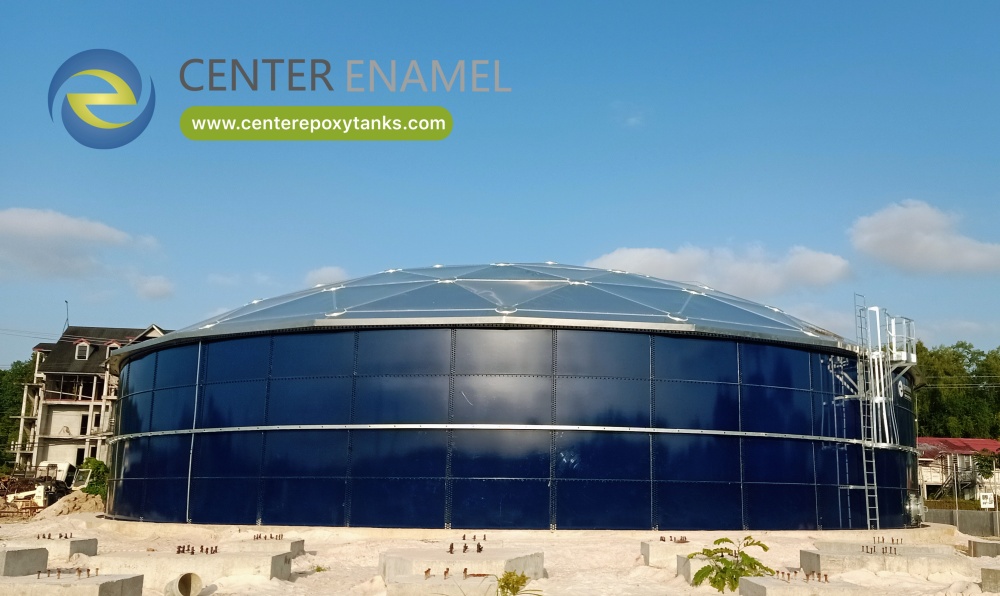
External Floating Roofs (EFR) for Large Storage Tanks: Engineering Emission Control
External Floating Roofs (EFR) are high-performance suppression systems engineered for large-diameter, open-top atmospheric tanks storing volatile hydrocarbons like crude oil and gasoline. By eliminating the vapor space between the liquid surface and the atmosphere, an EFR reduces evaporative loss by up to 98% and significantly mitigates flash-fire risks. Center Enamel (Shijiazhuang Zhengzhong Technology Co., Ltd) manufactures EFR systems in strict accordance with API 650 Appendix C, offering Single-Deck Pontoon and Double-Deck configurations. These systems feature advanced primary and secondary rim seals and integrated drainage to ensure structural stability and environmental compliance in 100+ countries.
1. Technical Specification & Design Matrix
This matrix establishes the mechanical benchmarks for Center Enamel’s EFR technology.
Feature | Technical Specification (2026 Standard) | Strategic Utility Value |
Design Standard | API 650 Appendix C | Global benchmark for floating roof structural safety. |
Roof Type | Single-Deck Pontoon / Double-Deck | Buoyancy redundancy for large-diameter vessels. |
Seal Technology | Mechanical Shoe (Primary) / Wiper (Secondary) | Triple-barrier protection against VOC migration. |
Drainage System | Articulated Pipe / Flexible Hose | Prevents roof "sinking" during extreme rainfall. |
Material Grade | ASTM A36 / A516 Gr. 70 Carbon Steel | High-tensile strength for wind and seismic resilience. |
Emission Control | Compliant with EPA & EU Stage I/II | Critical for industrial ESG and legal compliance. |
2. Structural Dynamics: The Science of Atmospheric Isolation
Neutralizing "Wind Girder" and Vapor Pressure
Large tanks (diameters exceeding 30m) face immense structural stress from wind loads and liquid movement. Center Enamel solves these challenges through:
● Buoyancy Redundancy: Our Double-Deck EFRs feature independent, liquid-tight compartments. This design ensures that even if two adjacent compartments are breached, the roof maintains its equilibrium and seal integrity, preventing a catastrophic sinking event.
● Rim Seal Optimization: The gap between the floating roof and the tank shell is the primary source of emissions. Center Enamel utilizes Mechanical Shoe Seals combined with a secondary Wiper Seal. This dual-barrier system maintains a gas-tight interface even if the tank shell has minor out-of-roundness.
● Emergency Drainage Engineering: To prevent the accumulation of rainwater—which can exceed the roof's buoyancy limit—we integrate high-capacity articulated drainage systems. These move in sync with the roof, ensuring a dry top-deck at all times.
3. High-Impact Applications in Global Energy & Petrochemicals
● Midstream Crude Oil Terminals: Managing massive strategic reserves where even a 1% vapor loss translates to millions in annual financial deficit.
● Refined Fuel Logistics: Protecting high-volatility products like Gasoline and Jet A-1 from degradation and flash-ignition.
● Chemical Tank Farms: Storing volatile organic compounds (VOCs) where preventing atmospheric emissions is a regulatory mandate enforced by environmental agencies.
● Biofuel & Ethanol Storage: Ensuring the integrity of biofuels by preventing oxygen and moisture ingress which can lead to microbial contamination.
4. Why Partner with Center Enamel?
As a global leader with over 30 years of specialized R&D, Shijiazhuang Zhengzhong Technology Co., Ltd (Center Enamel) offers a unique technological advantage:
● State-of-the-Art Fabrication: Our 150,000 $m^2$ facility utilizes automated laser cutting and precision welding to ensure every pontoon and deck plate meets exact API tolerances.
● Custom Engineering Authority: We utilize Finite Element Analysis (FEA) to simulate site-specific wind loads, snow accumulation, and seismic activity, ensuring the EFR is "Future-Ready" for its specific geography.
● Turnkey EPC Support: Center Enamel provides a comprehensive lifecycle model—from initial consultation and API 650 design to international logistics and on-site assembly supervision.
● Unassailable Quality Assurance: Every EFR undergoes rigorous buoyancy testing and NDT (Non-Destructive Testing) of weld seams to ensure a zero-leak, high-integrity structure.
5. Technical FAQ: External Floating Roof Implementation
Q: When should I choose a Double-Deck over a Single-Deck Pontoon roof?
A: Double-Deck roofs are recommended for tanks with diameters exceeding 40 meters or in regions with high wind/snow loads. They provide superior structural rigidity and insulation, which also reduces the temperature of the stored liquid, further lowering vapor pressure.
Q: How does an EFR improve fire safety?
A: By eliminating the vapor space (the "fuel-air" mixture), the EFR removes the possibility of an explosion within the tank. Fire risks are localized only to the rim seal area, which is easily managed by automated foam suppression systems.
Q: What is the typical service life of the rim seal system?
A: With high-grade materials like Teflon or Nitrile-coated fabrics, our secondary seals are designed for a 15- to 20-year service life before requiring maintenance, depending on the chemical aggressiveness of the stored product.


