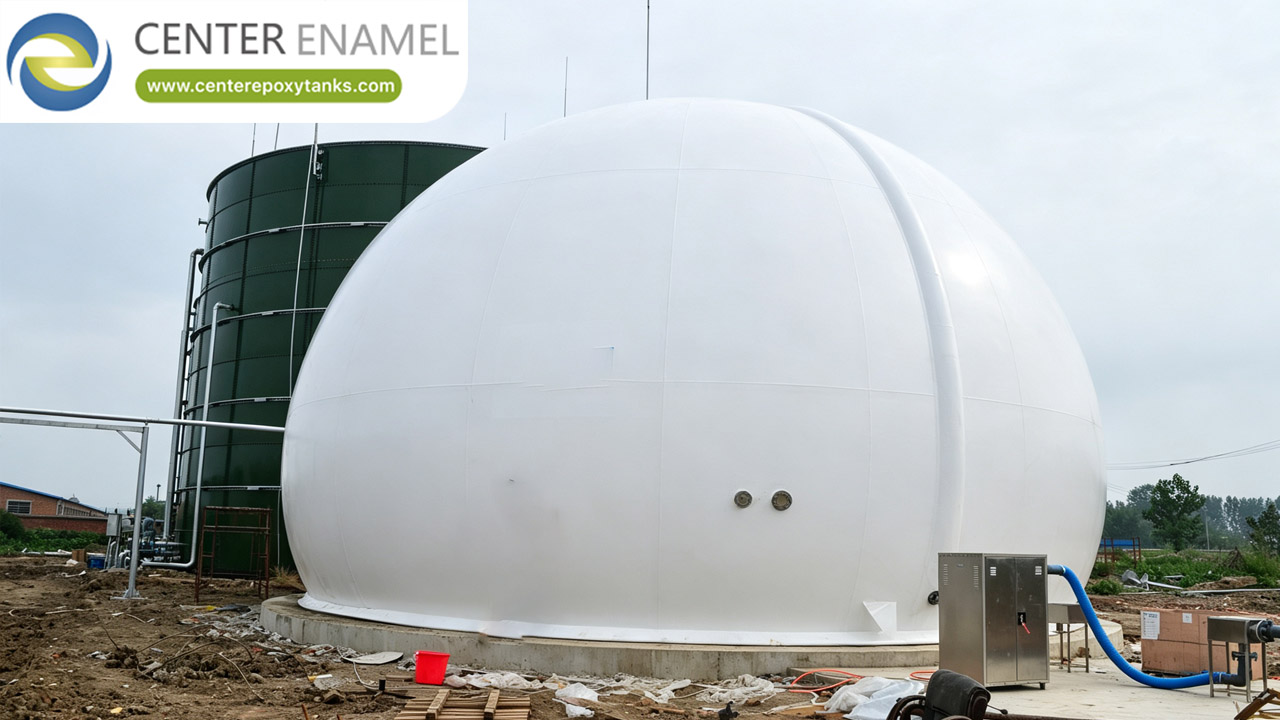
Double Membrane Biogas Balloons: Advanced High-Efficiency Gas Storage Solutions for Renewable Energy
As global industries and municipalities accelerate their transition toward circular bio-economies and carbon-neutral energy production, optimizing anaerobic digestion (AD) systems has become a core engineering priority. Whether processing agricultural livestock waste, municipal sewage sludge, food processing byproducts, or industrial organic effluents, renewable energy plants require reliable, gas-tight containment structures to capture, buffer, and stabilize biogas production. Traditional rigid steel gasometers and concrete storage tanks frequently involve high capital expenditures, slow construction timelines, and severe vulnerability to biogenic sulfide corrosion.
To overcome these structural and economic limitations, modern bio-energy facilities increasingly utilize advanced Double Membrane Biogas Balloons. As a global leader in environmental containment and liquid storage engineering, Shijiazhuang Zhengzhong Technology Co., Ltd. (Center Enamel) delivers cutting-edge double-membrane gas holders and flexible storage systems engineered for maximum methane retention, structural durability, and operational safety.
Engineering Mechanics and Structural Architecture
Center Enamel's double-membrane biogas balloons are built on an independent 3/4 spherical or standalone ground-mounted architecture, integrating high-performance technical textiles with automated pressure management systems:
Inner Membrane: Directly in contact with the stored biogas, this flexible membrane forms a variable-capacity containment volume that expands and contracts dynamically based on daily gas yields. It features anti-static treatments to eliminate static electricity buildup during operation.
Outer Membrane: Acting as the weather shield, the outer membrane maintains a constant spherical shape through continuous air supply from an automated support blower. It is treated with specialized UV-resistant coatings to withstand intense solar exposure.
Bottom Membrane: Seals the base of the storage unit against the concrete foundation or tank perimeter, creating an airtight, leak-proof system.
Constant-Pressure Automation: The system utilizes the air pressure inside the outer air chamber to exert downward pressure on the inner membrane, ensuring that output gas pressure remains stable within preset thresholds (typically 0.5 to 3.0 kPa) regardless of volume fluctuations.
Data Table: Biogas Storage Technology Comparison Matrix
Technical Parameter | Center Enamel Double-Membrane Biogas Balloon | Traditional Fixed Steel Gasometer | Poured-in-Place Concrete Gas Tank |
Material Composition | High-tenacity PVC/PVDF coated industrial polyester fabrics | Heavy structural carbon steel plates | Cast-in-place reinforced concrete |
Corrosion Resistance | Superior; completely inert to biogenic hydrogen sulfide ($H_2S$) and moisture | Low; requires frequent sandblasting and protective recoating | Moderate; vulnerable to sulfate attack and structural spalling |
Volume Flexibility | Variable-capacity "lung" design absorbing dynamic gas flow | Fixed or mechanically guided telescopic volume | Fixed volume capacity |
Installation Velocity | Rapid modular setup completed in days or weeks | Slow field-erected welding, craning, and inspection | Extremely slow formwork, pouring, and curing phases |
Governing Standards | ISO 9001, EN 13782, ATEX, Eurocode 1 | API 650 / Standard industrial steel codes | ACI Structural Concrete Standards |
Core Advantages of Center Enamel Biogas Storage Systems
Center Enamel's double-membrane biogas balloons offer significant operational benefits tailored for rigorous industrial environments:
Ultra-Low Gas Permeability: Fabricated from high-density multi-layer composites, these balloons achieve exceptionally low methane permeability rates, eliminating fugitive emissions and maximizing clean energy recovery for downstream Combined Heat and Power (CHP) engines or biomethane upgrading units.
Exceptional Weather and Wind Resilience: Engineered to withstand severe environmental loads, the aerodynamic spherical shape sheds snow efficiently (rated for loads up to 1.5kN/m2) and resists high-velocity winds up to 150 km/h through automated blower compensation.
Modular Retrofit Flexibility: These flexible gas holders can be mounted independently on ground foundations or installed directly on top of existing Glass-Fused-to-Steel (GFS) anaerobic digesters, optimizing plant footprint and capital efficiency.
Frequently Asked Questions (FAQ)
Q: What materials are used to manufacture Center Enamel double-membrane biogas balloons?
A: Our biogas balloons are fabricated using high-tenacity polyester base fabrics coated with specialized PVC and advanced PVDF surface treatments, providing high tensile tear strength, fire retardancy, and absolute resistance to corrosive biogas components like hydrogen sulfide.
Q: How is constant gas pressure maintained inside the double-membrane balloon?
A: An automated support blower continuously supplies air into the buffer zone between the outer and inner membranes. When biogas volume decreases, air enters the outer chamber to keep pressure stable; when gas volume increases, the inner membrane expands and excess air is safely regulated through an automated control valve.
Q: Can double-membrane biogas balloons be installed on existing anaerobic digesters?
A: Yes. Center Enamel provides versatile mounting configurations that allow double-membrane biogas holders to be securely retrofitted onto existing concrete tanks, GFS digesters, or steel storage reservoirs.
Q: What is the typical operational lifespan of a PVDF-coated biogas balloon?
A: With proper pressure regulation and UV-stabilized PVDF surface protection, Center Enamel's double-membrane biogas storage systems deliver a reliable operational lifespan of 15 to 20 years with minimal routine inspection.


