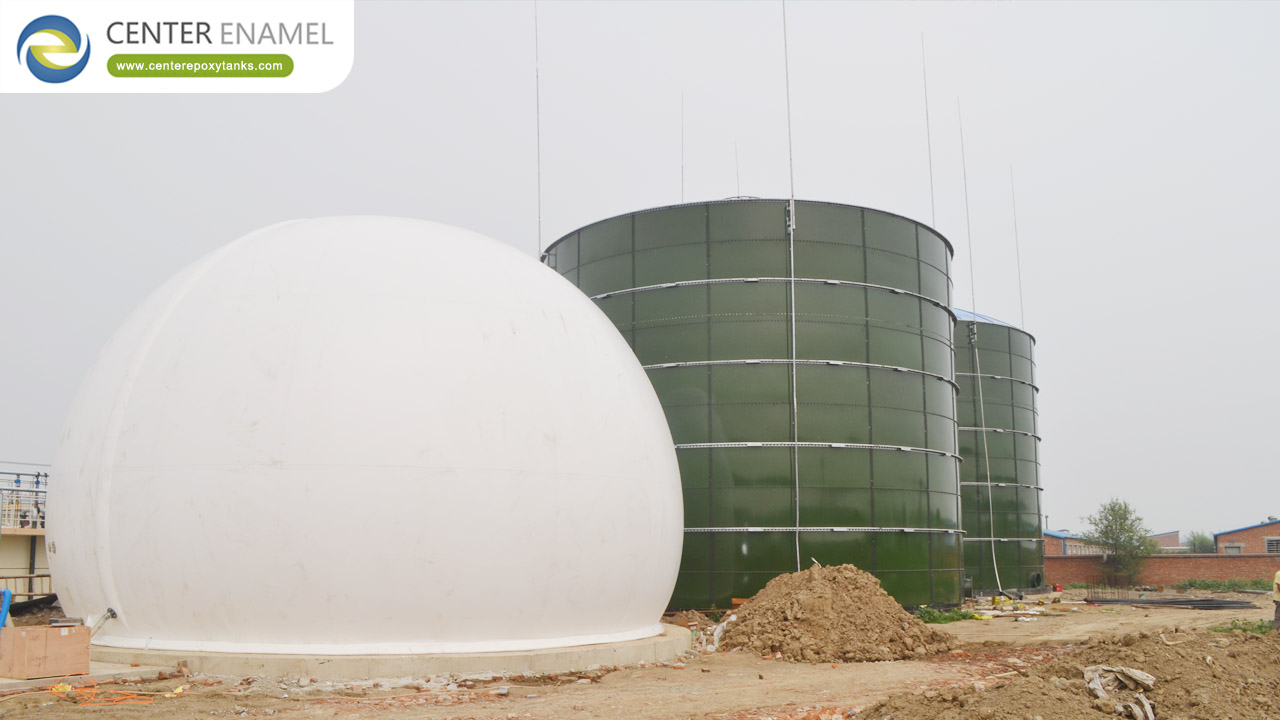
Double Layer Membrane Roofs for Gas Holders: Advanced Biogas Storage Engineering
Shijiazhuang Zhengzhong Technology (Center Enamel) manufactures high-performance Double Membrane Gas Holders specifically designed for anaerobic digestion and industrial gas containment. Utilizing PVC/PVDF-coated polyester fabrics with high H2S and UV resistance, our integrated storage systems are engineered for internal pressures up to 50 mbar. Compliant with Eurocode 3 and ISO 9001:2015, these dual-membrane roofs provide a gas-tight, cost-effective solution for renewable energy projects, ensuring maximum methane retention and a 20-year service life.
1. Technical Authority: Materials & Joint Integrity
The reliability of a gas holder is defined by its chemical resistance and structural bonding. Center Enamel utilizes advanced polymers and molecular fusion to prevent leakage.
Material Science: High-Tenacity Reinforced Polymers
● Core Fabric: Constructed from High-Tenacity Polyester Base Cloth with a premium PVC/PVDF coating.
● Weight Specifications: Ranging from 900g/m² to 1500g/m² to accommodate large-diameter spans and high tensile loads.
● Safety Standards: Flame retardant according to B1 (China), M2 (France), and DIN 4102 (Germany). Includes Antistatic additives to prevent ignition in volatile gas environments.
High-Frequency (HF) Welding: The Zero-Leak Guarantee
The most critical failure point in membrane storage is the seam. We eliminate this risk through High-Frequency Welding.
● Molecular Fusion: Unlike standard hot-air welding, HF welding uses electromagnetic energy to fuse the fabric layers into a single, monolithic piece.
●
● Structural Superiority: The resulting bond is stronger than the base material, preventing "creep" or delamination under constant pressure fluctuations.
2. Strategic Comparison: Double Membrane vs. Rigid Roofing
This matrix highlights the operational and financial advantages of flexible membrane systems over traditional steel or concrete.
Feature | Center Enamel Double Membrane | Traditional Steel/Concrete Roof |
Gas Storage | Integrated: Space between layers acts as the holder. | Static: Requires a separate external holder. |
Dead Weight | Ultra-Lightweight: 2–5 kg/m². Ideal for retrofits. | Heavy: Requires reinforced tank foundations. |
Installation | Fast: Prefabricated; installed in 2–4 days. | Slow: Extensive welding or curing times. |
Corrosion | Immune: Naturally resistant to H2S and CO2. | High Risk: Requires frequent, costly recoating. |
Project Cost | Economical: Lower CAPEX and near-zero OPEX. | High: Expensive materials and maintenance. |
3. Operational Efficiency: Pressure & Weather Resilience
Our systems utilize an automated air-pressure equilibrium to maintain stability regardless of gas production rates.
● Automated Air Blower: Maintains the Outer Membrane at a constant pressure, creating a rigid, aerodynamic shape that sheds snow and resists wind uplift.
● Extreme Load Tolerance: Engineered for site-specific Wind and Snow Loads (up to 1.5 kN/m2), making these roofs suitable for sub-arctic regions.
● Gas Permeability: Achieves a methane permeability rate of < 400 cm³/m²·d·bar, ensuring maximum economic yield for the biogas plant.
4. Frequently Asked Questions (FAQ)
● Q: What is the lifespan of a double membrane gas holder?
○ A: With PVDF coating and proper pressure management, our membranes are designed for a service life of 15 to 20 years, outperforming metal covers in corrosive H2S environments.
● Q: Can these roofs be installed on existing tanks?
○ A: Yes. Their lightweight design makes them ideal for retrofitting existing concrete or bolted steel tanks without requiring structural reinforcement.
● Q: How does the system handle high wind or snow loads?
○ A: The outer membrane is kept under constant air pressure, allowing it to maintain its structural form against wind speeds up to 120 km/h and heavy snow accumulation.


