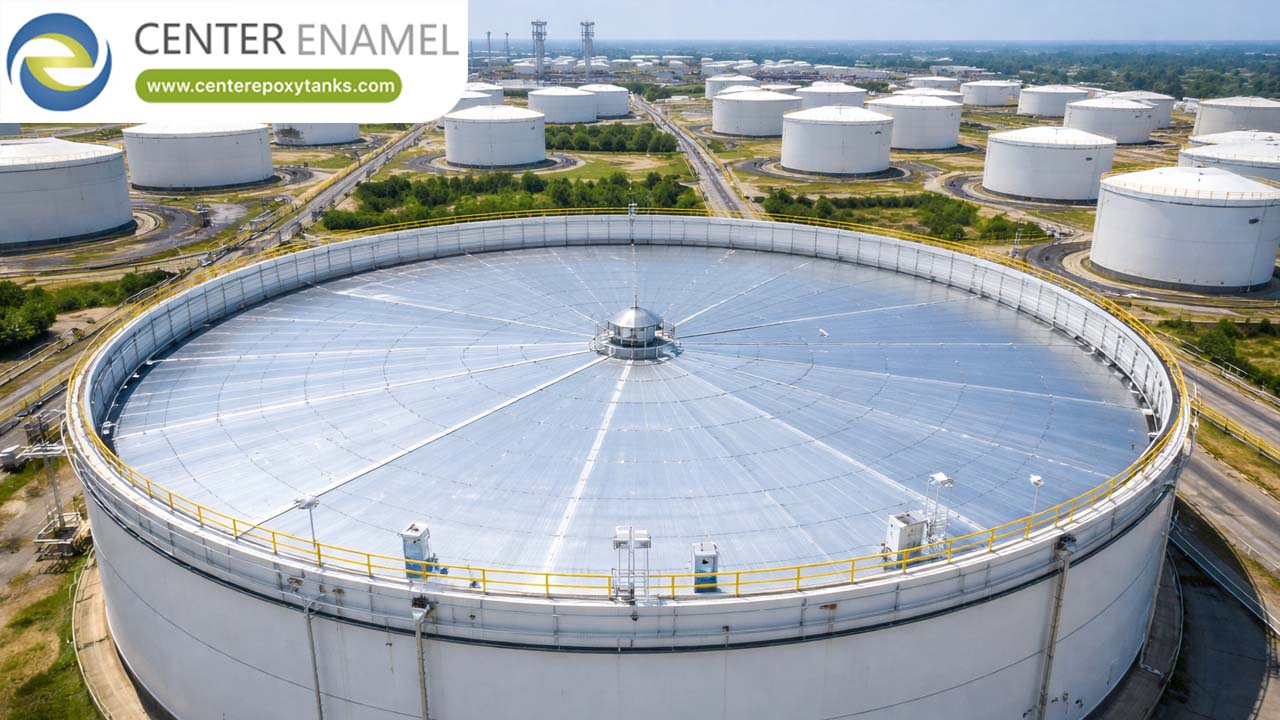
Custom Floating Roof Designs for Large-Scale Industrial Storage Tanks to Reduce Evaporation
In the sectors of crude oil refining, bulk petrochemical storage, aviation fuel distribution, and chemical processing, large-scale aboveground storage tanks handle millions of gallons of volatile liquids. Products such as crude oil, gasoline, diesel, and chemical solvents possess high true vapor pressures (TVP). Without proper engineering controls, daily ambient temperature fluctuations cause tanks to "breathe," driving massive product vaporization losses through standard roof vents.
This vaporization not only results in severe financial inventory shrinkage but also releases harmful Volatile Organic Compounds (VOCs) into the atmosphere, triggering strict regulatory penalties and environmental non-compliance. To combat this, custom floating roof designs serve as the definitive industrial safeguard, riding directly on the liquid surface to eliminate vapor headspace and suppress emissions by up to 99 percent.
The Engineering Mechanics of Floating Roof Suppression
A floating roof is engineered to function like a wide, buoyant raft that moves vertically within the tank shell as liquid is pumped in or withdrawn. By maintaining continuous physical contact (or near-contact) with the stored product, these systems achieve two critical objectives:
Vapor Space Elimination: By removing the gas pocket between the liquid level and the roof, the liquid molecules are prevented from vaporizing and accumulating.
Dynamic Thermal Buffering: As solar radiation heats the storage tank throughout the day, a floating deck absorbs and distributes thermal energy uniformly, stabilizing internal vapor pressures and suppressing breathing losses.
Technical Performance Matrix: Custom Floating Roof Technologies
Technical Parameter | Aluminum Pontoon IFR (Non-Contact) | Full-Contact Honeycomb IFR | Heavy-Gauge Steel EFR (Single/Double Deck) | Fixed Roof with No Floating Deck |
Primary Governing Code | API 650 Annex H | API 650 Annex H | API 650 Annex C | Standard API 650 Fixed Roof |
Vapor Suppression Rate | 95% to 98% VOC reduction | 98% to 99%+ absolute VOC mitigation | 95% to 98% VOC reduction | Zero vapor suppression (High losses) |
Environmental Exposure | Shielded inside a fixed roof structure | Shielded inside a fixed roof structure | Directly exposed to rain, wind, and solar radiation | Fully exposed interior vapor headspace |
Primary Material Construction | High-strength aluminum alloys (6061-T6, 3003) | Aluminum sandwich panels with honeycomb core | Heavy structural carbon steel or corrosion alloys | Carbon steel shell and fixed rafters |
Optimal Storage Application | Refined petroleum, aviation fuel, and intermediate chemical solvents | Ultra-sensitive chemical storage requiring zero vapor pocket exposure | Large-diameter crude oil bulk storage terminals | Non-volatile heavy oils, water, or asphalt |
Key Custom Design Configurations
1. Internal Floating Roofs (IFR) within Fixed Shells
For volatile refined products, facilities frequently utilize an Internal Floating Roof installed beneath a permanent fixed roof (such as a self-supporting aluminum dome). This dual-layer configuration provides the ultimate environmental defense:
Aluminum Pontoon Decks: Utilize high-buoyancy cylindrical pontoons coupled with structural framing to offer excellent stability and structural flexibility.
Full-Contact Honeycomb Decks: Composed of engineered aluminum sandwich panels that rest directly on the liquid surface, completely eliminating any trapped vapor pocket beneath the deck skin.
2. External Floating Roofs (EFR) for Bulk Crude Terminals
For ultra-large-diameter crude oil tanks where fixed roofs are impractical, External Floating Roofs operate openly under ambient weather conditions. These decks incorporate compartmentalized perimeter pontoons (Single-Deck Pontoon or Double-Deck designs) engineered to withstand heavy regional wind shear, torrential rain loads, and seismic displacement while maintaining positive buoyancy even if individual compartments are compromised.
3. Advanced Annular Rim Seal Systems
The microscopic gap between the floating deck's outer rim and the interior tank shell is protected by specialized rim seal systems (such as primary mechanical shoe seals combined with secondary wiper seals). These custom seals flex dynamically with tank shell out-of-roundness tolerances, sealing in fugitive vapors and preventing edge emission leaks.
Frequently Asked Questions (FAQ)
Q: How do custom floating roof designs reduce product evaporation in industrial storage tanks?
A: By resting directly on or immediately above the liquid surface, floating roofs eliminate the vapor headspace inside the tank. This prevents volatile hydrocarbon molecules from entering the vapor phase and escaping through roof vents during daily temperature cycles.
Q: What is the difference between a pontoon internal floating roof and a full-contact honeycomb roof?
A: An aluminum pontoon roof uses hollow buoyancy chambers with a slight air gap beneath portions of the deck, whereas a full-contact honeycomb roof rests completely flat against the liquid surface using a closed-cell core, eliminating all trapped vapor pockets for maximum chemical containment.
Q: Can floating roofs be retrofitted into existing industrial storage tanks?
A: Yes. Custom-engineered internal floating roofs can be prefabricated in modular components, passed through standard shell manways, and rapidly assembled on-site inside existing fixed-roof tanks to upgrade emission control compliance.
Q: How do external floating roofs manage rainwater accumulation?
A: External floating roofs feature engineered emergency roof drains, siphon systems, and sloped deck designs that safely route rainwater off the deck surface and out of the tank while maintaining stable buoyancy and structural equilibrium.


