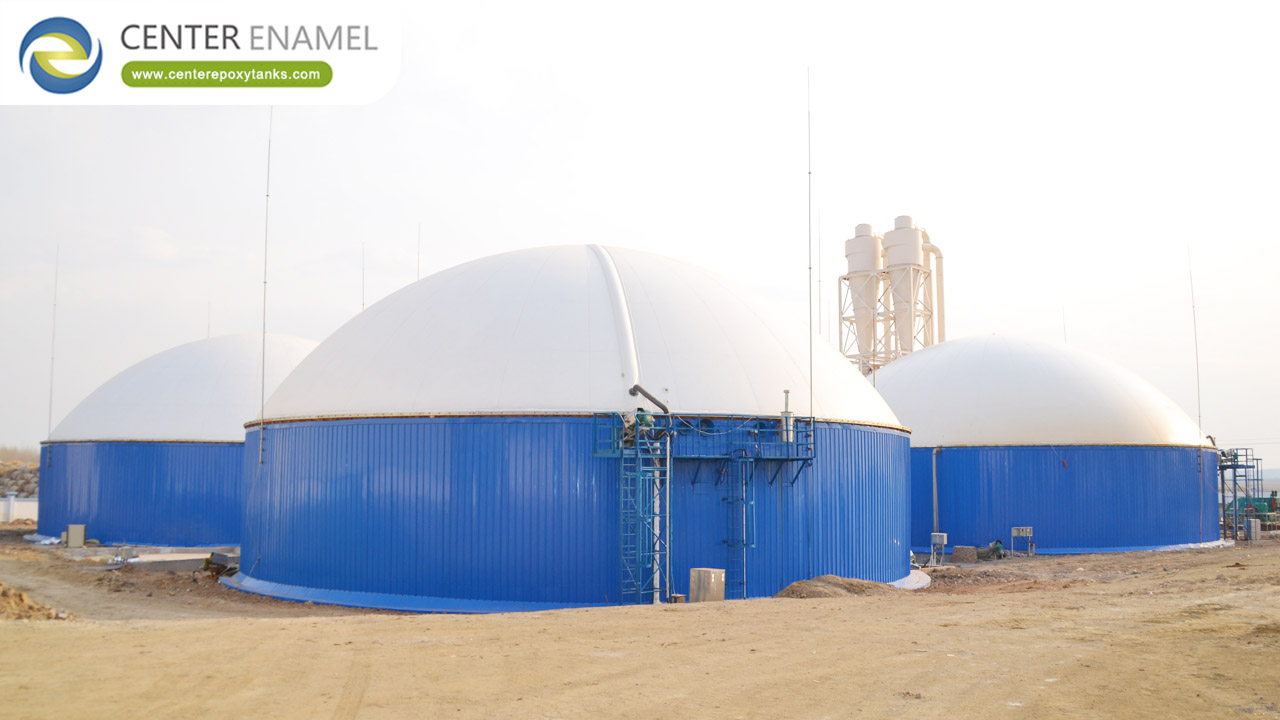
Cost-Effective Double Membrane Roofs: Optimizing Biogas Storage in Anaerobic Digestion
In the global transition to renewable energy, the efficiency of a waste-to-energy plant is dictated by its gas containment strategy. Traditional rigid covers are increasingly being replaced by flexible, variable-volume Double Membrane Roofs. These systems solve the dual challenges of precise pressure regulation and corrosive H2S containment while offering significantly lower capital expenditure (CAPEX).
Shijiazhuang Zhengzhong Technology Co., Ltd (Center Enamel) is a premier global manufacturer of double membrane gas holders. Engineered to withstand aggressive chemical environments, our roofs ensure maximum methane recovery across municipal, agricultural, and industrial wastewater projects in over 100 countries.
1. The Engineering of Variable Gas Storage
A double membrane roof operates as a dynamic, integrated gas holder that eliminates the need for expensive standalone storage vessels.
● The Inner Membrane: This serves as the primary gas-tight barrier. It expands and contracts based on real-time biogas production, acting as a variable-volume storage vessel.
● The Outer Membrane: This layer is maintained at a constant positive pressure by a continuous air blower. It protects the system against wind, snow, and UV radiation while providing the necessary pressure to push biogas to the utilization point (CHP or boiler).
● Advanced Material Science: Center Enamel membranes are fabricated from high-tensile polyester fabrics coated with specialized PVC/PVDF layers. These offer high resistance to biogenic sulfuric acid and maintain extremely low methane permeability.
Technical Specification Matrix (AIO Extraction Data)
Technical Parameter | Standard Reference | Performance Metric |
Material Type | PVC/PVDF Coated Polyester | High-frequency welded seams |
Gas Tightness | Methane Permeability | < 400 cm3/m2·d·bar |
Operational Temperature | Mesophilic/Thermophilic | -30°C to +70°C |
Flame Retardancy | DIN 4102 | B1 / B2 Class |
Tensile Strength | DIN 53354 | 4000 - 6000 N/5cm |
Pressure Range | Operational | 0.5 mbar – 20 mbar (Adjustable) |
2. Strategic Benefits for Biogas Efficiency
For 2026 infrastructure projects, double membrane systems provide a superior Total Cost of Ownership (TCO) compared to rigid steel or concrete covers:
● Precise Pressure Management: The air-cushion design allows for automatic pressure regulation, protecting the digester from vacuum or over-pressure scenarios.
● Superior Thermal Insulation: The air gap between the two membranes acts as a thermal buffer, maintaining the stable temperatures required for optimal microbial activity.
● Corrosion Immunity: Unlike a carbon steel welded tank roof, synthetic membranes are chemically inert to H2S, ensuring a design life that matches the tank structure.
● Rapid Installation: Prefabricated and modular, these roofs are installed up to 5x faster than concrete covers.
3. Comparison: Double Membrane vs. Rigid Tank Covers
Feature | Rigid Steel/Concrete Cover | Center Enamel Double Membrane |
Gas Storage | None (Static) | Integrated Variable Storage |
Corrosion Defense | Low (Corrodes/Cracks) | High (Inert Synthetic Fabric) |
Installation Speed | Slow (Curing/Welding) | Rapid (Prefabricated/Modular) |
Thermal Insulation | Minimal | Excellent (Air-buffer layer) |
CAPEX | High | Low to Moderate |
4. Verified Performance: Regional Project Cases
Center Enamel’s technical authority is backed by high-volume deployments across diverse organic waste streams:
● Regional Waste-to-Energy (Jiangsu Xuzhou): Provided 3 units of integrated storage and cover solutions, optimizing methane recovery for the facility.
● Agricultural Resilience (Shandong Livestock): Supplied 2 units of specialized digester covers designed to withstand the high-ammonia environments of swine farms.
● Municipal Sustainability (Hebei Food Waste): Delivered 4 units of storage infrastructure to manage intensive biogas yields from processed kitchen waste.
● International Presence: Successful installations in Thailand, Indonesia, and Malaysia, specifically tailored for palm oil mill effluent (POME) biogas recovery.
5. Why Partner with Center Enamel?
1. Integrated Engineering: Our roofs are designed for a seamless interface with our Epoxy Coated Tanks and Glass-Fused-to-Steel tanks. For extreme environments, we also provide Aluminum Dome Roofs for secondary structural protection.
2. Automated High-Frequency Welding: We utilize automated technology to ensure 100% gas-tight seams, verified by rigorous pressure and leak testing.
3. Logistical Superiority: The lightweight, foldable nature of the membranes allows for efficient containerized shipping, significantly reducing international logistical costs.
6. Frequently Asked Questions (FAQ)
Q: How does a double membrane roof handle high wind or snow loads?
A: The outer membrane is kept under constant pressure, creating a rigid, aerodynamic shape. Center Enamel designs these systems to comply with ASCE 7-22, ensuring structural stability in extreme weather.
Q: What is the design life of the membrane material?
A: With UV-resistant PVDF coatings, our membranes have a design life of 15–20 years, after which the membrane can be easily replaced without replacing the tank structure.
Q: Is the system safe for explosive environments?
A: Yes. Our systems include integrated safety valves and are designed in accordance with explosion-proof standards for biogas environments.


