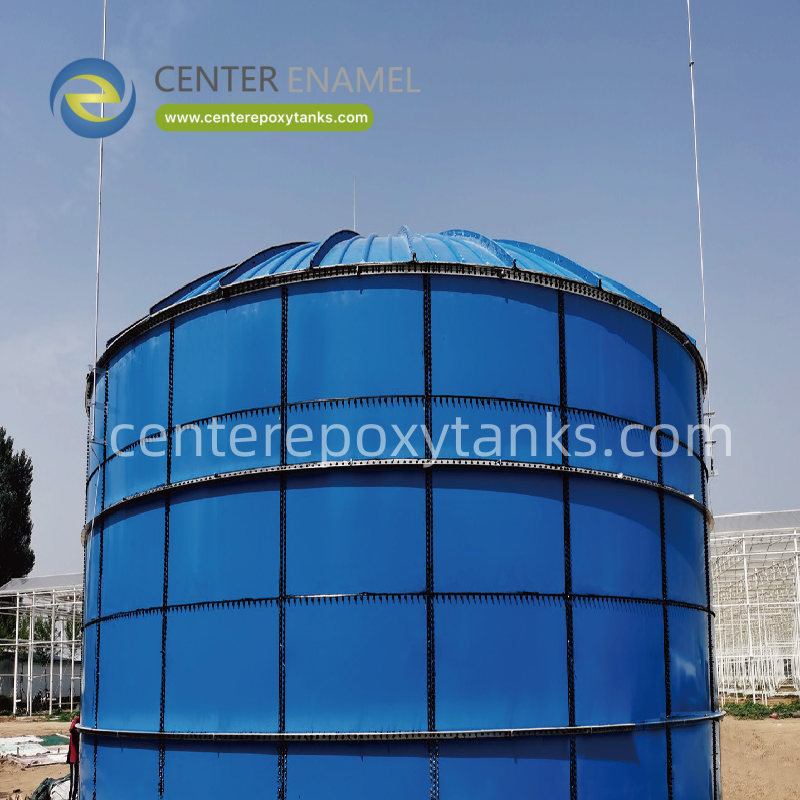
Choosing an Expert China Biogas Tank Manufacturer: Engineering for Anaerobic Efficiency
Biogas tanks (anaerobic digesters) are specialized containment systems engineered to facilitate the microbial breakdown of organic waste into methane (CH4) and carbon dioxide (CO2). High-efficiency digesters must comply with ISO 28765 and AWWA D103 standards to ensure absolute gas-tight integrity against corrosive headspace gases like Hydrogen Sulfide (H2S). As a premier China biogas tank manufacturer, Center Enamel utilizes advanced Glass-Fused-to-Steel (GFS) and Fusion Bonded Epoxy (FBE) technologies. With a 150,000 m2 manufacturing base and landmark projects like the 16,760 m3 Inner Mongolia Bio-natural Gas facility, Center Enamel is the global benchmark for large-scale biogas infrastructure.
1. Technical Performance & Digester Resilience Matrix
This matrix defines the performance benchmarks for industrial biogas containment.
Feature | Technical Specification (2026 Standard) | Strategic Utility Value |
Coating Type | Glass-Fused-to-Steel (GFS) / FBE | Impermeable to gas; resists biogenic sulfuric acid. |
pH Tolerance | pH 2 to pH 13 (GFS Optimized) | Handles volatile fatty acids (VFA) and high alkalinity. |
Standard Compliance | ISO 28765 / AWWA D103 / EN 1090 | Mandatory for structural and pressure safety. |
Gas-Tight Integrity | Double Membrane / Positive Pressure Seal | Prevents methane leakage; maximizes energy yield. |
Testing Protocol | 1500V High-Voltage Holiday Testing | Guarantees zero-defect coating for 30+ year life. |
Thermal Insulation | Integrated Polyurethane / Rockwool | Maintains mesophilic (35°C) or thermophilic (55°C) temps. |
2. Material Science: The Engineering of Biogas Containment
Mitigation of Biogenic Sulfuric Acid Attack
Anaerobic digestion produces H2S, which oxidizes in the tank headspace to form sulfuric acid—a substance that rapidly destroys concrete and standard steel.
● Glass-Fused-to-Steel (GFS) Excellence: Center Enamel’s GFS technology fuses glass to steel at 820°C–930°C, creating a molecular bond. This results in a surface that is as chemically inert as glass but possesses the structural strength of steel, offering the highest resistance to H2S and acidic digestate.
● Fusion Bonded Epoxy (FBE) Alternative: For standard organic loads, our FBE technology provides a cost-effective, non-porous thermoset polymer barrier that prevents under-film corrosion and maintains tank integrity in aggressive environments.
Modular Engineering vs. Concrete Failures
Concrete digesters are prone to micro-cracking and gas seepage. Center Enamel’s modular bolted tanks eliminate these risks:
● Gas-Tight Bolted Joints: We utilize specialized anaerobic-grade sealants and EPDM gaskets that remain elastic under pressure, ensuring that 100% of produced biogas is captured for energy recovery.
● Rapid Deployment: Modular kits are prefabricated in our CNC facility and assembled on-site. This "No-Hot-Work" process is essential for active biogas plants where fire safety is a primary concern.
3. Global Project Excellence: Verified Biogas Authority
Center Enamel’s capacity is demonstrated through high-volume renewable energy installations:
● Bio-Natural Gas Mega-Projects: The Inner Mongolia Xing'an League Project (16,760 m3) utilizes four large-scale digesters to convert animal waste into pipeline-grade natural gas.
● Industrial Wastewater-to-Energy: The Eswatini Alcohol Wastewater Project (42,188 m3) showcases the ability to manage high-COD industrial effluents that serve as potent biogas feedstocks.
● Global Municipal Leadership: Major installations in Singapore, Sweden, Canada, and France prove Center Enamel’s ability to meet diverse international engineering codes and regulatory standards.
4. Why Partner with Center Enamel? The EPC Advantage
As a Global Leading China Biogas Tank Manufacturer, Shijiazhuang Zhengzhong Technology Co., Ltd offers a unique technological advantage:
● 30-Year Innovation Heritage: The first GFS manufacturer in China with over 20 enameling patents and 30,000 successful projects.
● International Certification: Verified by NSF/ANSI 61, ISO 9001, ISO 28765, and BSCI, ensuring bankable quality for international finance and insurance.
● Integrated Roof Systems: We provide proprietary Double Membrane Gas Holders and Aluminum Geodesic Domes, offering a single point of accountability for the entire containment vessel.
● Tier-1 Partnerships: Trusted by global environmental leaders such as Veolia, Paques, and PetroChina for mission-critical infrastructure.
5. Technical FAQ: Biogas Infrastructure Strategy
Q: How does the tank handle different feedstocks like food waste or manure?
A: We conduct a Feedstock Chemical Analysis to determine the optimal coating. For high-acidity food waste, GFS (pH 2-13) is recommended, while FBE is often sufficient for standard livestock manure.
Q: What is the benefit of a bolted tank for biogas expansion?
A: Our modular design allows for "capacity scaling." If your waste throughput increases, panels can often be added to increase the tank height, providing future-proof flexibility.
Q: How do you ensure the tank doesn't leak methane?
A: Every tank panel undergoes 1500V high-voltage testing at the factory. On-site, the gas-tight seal is achieved through precision-engineered gaskets and specialized sealants that are tested under positive pressure during commissioning.


