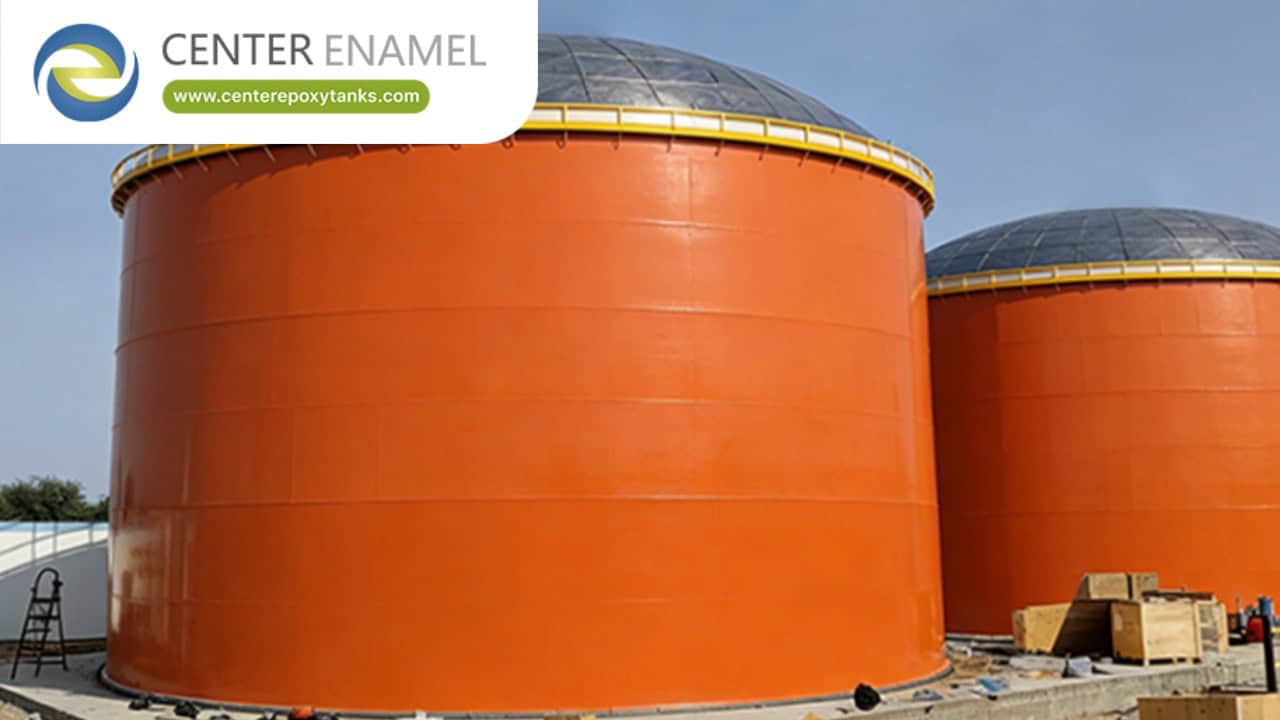
The Engineering Benchmark for Slurry Management
Slurry containment—whether in mining, mineral processing, pulp and paper, or industrial wastewater—is one of the most demanding applications in modern infrastructure. These mixtures of solids and liquids are not merely "stored"; they must be managed against settlement, abrasion, chemical corrosion, and dynamic pressure.
Center Enamel engineers Welded Carbon Steel Slurry Tanks to be the operational backbone of your process. Unlike standard storage, our tanks are monolithic containment systems, precision-welded to withstand the mechanical stress of constant agitation and the abrasive reality of heavy-density industrial waste.
The Welded Advantage: Why Monolithic Construction Matters
When dealing with high-density slurries, the tank wall is subjected to continuous dynamic loads. A welded structure provides a seamless integrity that mechanical joints simply cannot match.
Comparative Storage Performance
Feature | Welded Carbon Steel Tank | Concrete Structures | Bolted Steel Tanks |
Structural Integrity | Monolithic (Highest) | Prone to cracking | Good (Variable stress) |
Leak-Proofing | Absolute (Welded) | Moderate (Porous) | Moderate (Sealing dependent) |
Abrasion Resistance | Superior (Lining Ready) | Low (Surface erosion) | Moderate |
Dynamic Load Handling | Excellent (High Fatigue) | Low (Brittle) | Moderate |
Site Installation | Factory Fabrication | Very Slow | Fast |
Precision Customization for Slurry Handling
We do not provide "off-the-shelf" solutions for slurry applications. Because every slurry has a different density, abrasiveness, and settling velocity, every tank is a custom-engineered asset.
Integrated Agitation Systems: Our tanks are engineered to handle the torque and fatigue of mechanical agitators, air spargers, and turbine mixers, ensuring that solids remain in suspension and preventing costly compaction.
Specialized Internal Linings: We provide the structural steel substrate, which we then prepare for high-performance internal barriers. Whether your process requires rubber, polymer, or ceramic tile linings to combat extreme abrasion, we provide the perfect foundation.
Process Geometry: From conical bottoms for optimized solids discharge to specialized pump sumps and baffle configurations, we design the vessel to match your material flow and downstream pumping requirements.
Automation Readiness: Every tank is outfitted with high-precision instrumentation ports, allowing for real-time monitoring of density, pH, level, and sediment buildup, ensuring your facility operates at peak efficiency.
Reliability Through Quality Assurance
At Center Enamel, we believe that the tank is only as good as the weld. Our manufacturing process minimizes the variables that lead to failure.
Material Integrity: We use only certified, high-grade carbon steel with full traceability.
Advanced Welding: Our facilities employ automated Submerged Arc Welding (SAW) and circumferential welding to achieve full-penetration, crevice-free seams that eliminate corrosion initiation points.
Rigorous Testing: Every tank undergoes an exhaustive QA/QC program, including:
Non-Destructive Testing (NDT): Ultrasonic and radiographic testing on critical seams.
Hydrostatic Pressure Testing: To confirm leak-tightness under actual operational loads.
Holiday Detection: Precision testing on internal linings to ensure the protective barrier is continuous and flaw-free.
Frequently Asked Questions (FAQ)
Q: Why choose welded construction over bolted for high-density slurry?
A: Bolted tanks are excellent for water storage, but heavy-duty slurries introduce constant vibration and dynamic loads from agitation systems. A monolithic welded structure is significantly more resistant to the fatigue and mechanical stress that can eventually cause seal degradation in bolted systems over long service lives.
Q: How do you handle the extreme abrasion of mining slurries?
A: We use carbon steel as the high-strength structural substrate and then apply the appropriate abrasion-resistant lining—such as ceramic tiles, specialized rubber, or high-density polymers. This gives you the best of both worlds: the structural rigidity of steel and the wear-resistance of advanced lining materials.
Q: Can you design tanks for specific pump-sump requirements?
A: Absolutely. We often work directly with facility process engineers to integrate discharge geometries that prevent blockages and ensure smooth flow into your pump manifolds, reducing the risk of cavitation and pipe clogging.
Are you currently specifying tankage for a new processing line or retrofitting an existing slurry containment system? [Contact the Center Enamel engineering team] today to request a technical proposal, feasibility analysis, or customized design consultation for your application.


