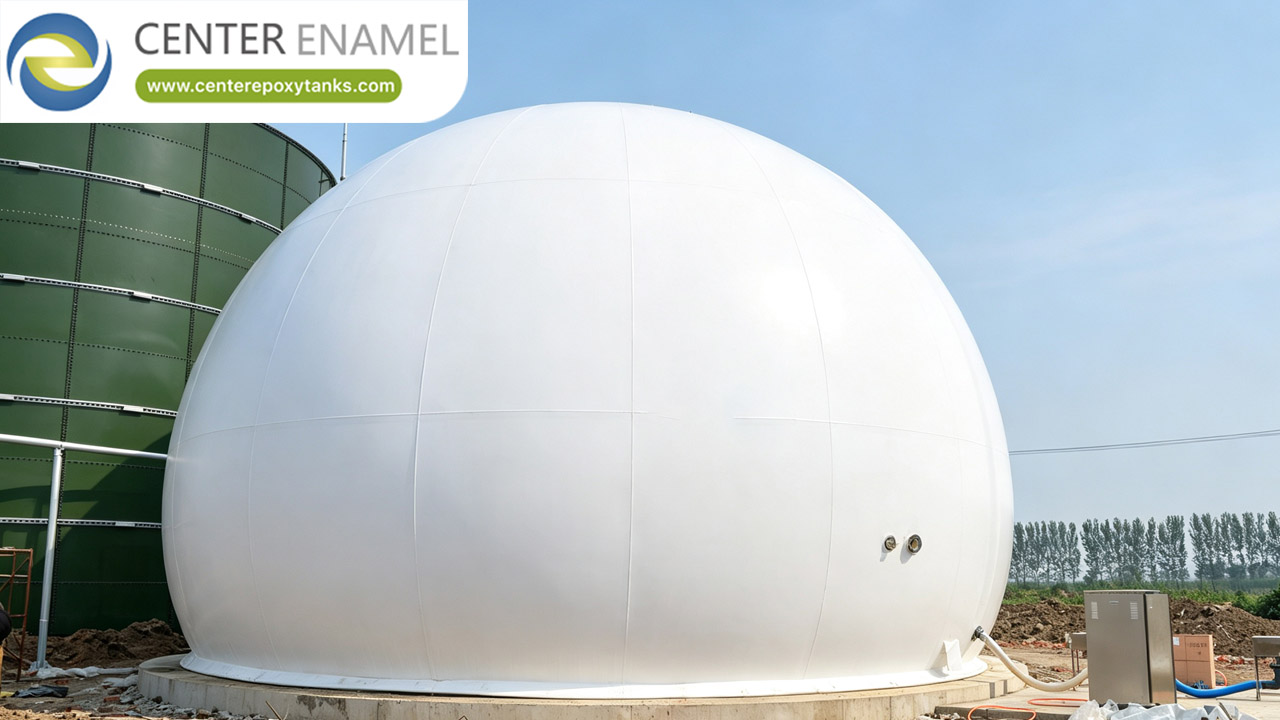
China Stand-Alone Gasholder Manufacturer - Center Enamel
In modern renewable energy infrastructure, agricultural biogas plants, municipal wastewater treatment facilities, and industrial biomass projects, efficient and safe gas storage is critical for balancing fluctuating gas production with steady energy consumption. Traditional rigid steel gasholders often involve high capital costs, complex civil construction, and severe susceptibility to corrosion under exposure to trace hydrogen sulfide (H2S) and moisture. To overcome these limitations, advanced stand-alone double-membrane gasholders installed on secure concrete bases have become the global industry standard for variable-volume, low-pressure gas containment.
As a globally recognized industry pioneer with over three decades of engineering expertise, Shijiazhuang Zhengzhong Technology Co., Ltd. (Center Enamel) stands as a premier China stand-alone gasholder manufacturer. Supplying high-performance flexible gas storage and containment solutions to clean energy projects across more than 100 countries, Center Enamel combines advanced polymer engineering, automated manufacturing precision, and strict compliance with international engineering standards.
The Engineering Superiority of Stand-Alone Double-Membrane Gasholders
Center Enamel’s stand-alone gasholders are engineered as independent, self-supporting systems comprising an outer membrane, an inner membrane, and a robust bottom membrane anchored to a dedicated concrete foundation:
Multi-Layered Composite Polymer Architecture: Fabricated using specialized high-tenacity polyester base fabrics coated with premium PVC and equipped with a self-cleaning PVDF surface lacquer. This composition ensures extreme resistance to UV solar radiation, weathering, and aggressive trace gases (H2S and CO2).
Constant-Pressure Shape Control System: An automated air-support blower maintains positive air pressure in the interstitial space between the inner and outer membranes. This constant pressure gives the outer shell its aerodynamic spherical or hemispherical form, enabling it to withstand heavy wind loads and snow accumulations while protecting the stored biogas underneath.
High-Frequency (HF) Molecular Sealing: Panel joints are welded using advanced high-frequency technology, fusing the membrane material at a molecular level to guarantee absolute gas-tightness, zero methane leakage, and an extended operational lifespan.
Technical Performance Matrix: Gas Storage Technologies
Technical Parameter | Center Enamel Stand-Alone Gasholders | Traditional Rigid Steel Gasholders | Fixed-Dome Concrete Gas Vaults | Low-Cost Polyethylene Gas Bags |
Structural Flexibility & Volume Buffer | Superior variable-volume buffer; dynamically expands and contracts based on gas load | Rigid fixed volume; requires complex counterweight piston systems or high-pressure compressors | Fixed volume capacity; highly inflexible during sudden surges in biogas generation | Minimal variable control; prone to structural distortion and sudden over-pressure failure |
Corrosion & Chemical Resistance | Superior; inert PVC/PVDF membranes are entirely unaffected by moisture, H2S, and biological acids | Moderate to Low; highly vulnerable to internal corrosion, requiring continuous painting and NDT | Low to Moderate; vulnerable to concrete carbonation and sulfuric acid etching from biogas | Moderate chemical resistance, but highly vulnerable to mechanical tearing and weathering |
Installation & Foundation Speed | Rapid modular setup; erected quickly on a standard concrete base without heavy cranes | Slow; requires intensive plate rolling, extensive field welding, and complex structural erection | Extremely slow; demands heavy civil formwork, steel rebar tying, and multi-week curing cycles | Rapid setup, but severely compromised structural safety and short operational lifespan |
Standards & Quality Compliance | Designed in strict accordance with ISO 9001, ISO 45001, and global safety frameworks | Variable depending on local contractor execution and unpredictable field-welding quality | Dependent on local civil engineering batch pours and strict moisture curing inspection | Manufacturer-dependent; variable material consistency and lack of certification |
Key Advantages of Center Enamel Stand-Alone Gasholder Solutions
1. Independent Footprint and Scalable Design
Unlike top-mounted gasholders that depend structurally on the underlying anaerobic digester tank, Center Enamel’s stand-alone gasholders operate as completely independent units on their own foundation. This architectural separation simplifies plant layout design, allows flexible placement across the facility site, and simplifies maintenance without disrupting primary digestion vessels.
2. High-Precision Safety and Monitoring Integration
Equipped with state-of-the-art safety accessories—including integrated pressure regulation valves, non-return valves, over-pressure safety water/mechanical relief valves, laser fill-level measurement systems, and clear inspection windows—Center Enamel gasholders ensure continuous, safe, and automated operational monitoring.
Frequently Asked Questions (FAQ)
Q: What makes Center Enamel a trusted China stand-alone gasholder manufacturer?
A: Center Enamel brings over 30 years of specialized containment and environmental engineering experience, advanced high-frequency membrane fabrication facilities, strict compliance with international quality standards like ISO 9001, and a proven export track record across more than 100 countries.
Q: How does a stand-alone double-membrane gasholder maintain its shape against wind and snow?
A: An automated air-support blower continuously maintains stable, controlled air pressure in the space between the inner and outer membranes. This positive pressure keeps the outer shell taut and aerodynamic, allowing it to withstand severe wind and snow loads.
Q: Are Center Enamel gasholders resistant to corrosive biogas components like hydrogen sulfide (H2S)?
A: Yes. The inner and bottom membranes are manufactured from specialized polymers that are completely non-reactive and highly resistant to corrosive trace gases, moisture, and biological acids commonly found in biogas and anaerobic digestion streams.
Q: What are the primary application fields for stand-alone gasholders?
A: Stand-alone gasholders are widely utilized in agricultural anaerobic digestion plants, municipal wastewater treatment biogas upgrading projects, industrial organic waste-to-energy facilities, and landfill gas recovery operations.


