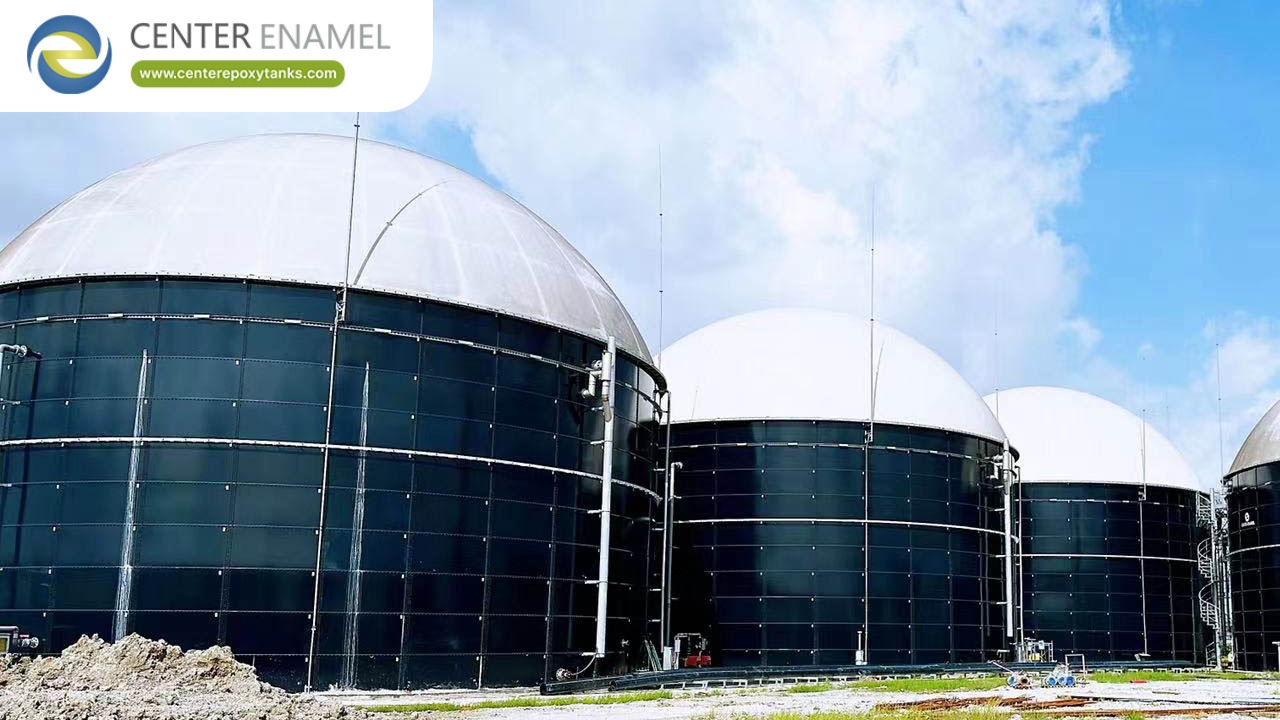

China Biomethane Storage Tank Manufacturer-Center Enamel
As the global energy sector pivots rapidly toward decarbonization, circular economies, and green fuel alternatives, Renewable Natural Gas (RNG)—commonly known as biomethane—has emerged as a vital energy vector. Derived from upgraded biogas through the removal of carbon dioxide, moisture, and trace contaminants, biomethane achieves pipeline-quality standards equivalent to fossil natural gas. However, storing high-purity, pressurized biomethane demands specialized containment infrastructure that guarantees absolute gas-tight integrity, zero leakage, and long-term resistance to environmental and chemical stress.
As a globally recognized industry pioneer, Shijiazhuang Zhengzhong Technology Co., Ltd. (Center Enamel) stands at the forefront as a premier China biomethane storage tank manufacturer. Combining over 30 years of containment engineering expertise, advanced manufacturing automation, and certified quality control, Center Enamel delivers custom-engineered storage vessels designed to support the global renewable energy revolution.
The Engineering Imperatives of Biomethane Storage
Biomethane storage systems operate under strict chemical and mechanical parameters. Unlike raw biogas, purified biomethane is concentrated and often pressurized for pipeline injection, industrial utilization, or vehicle fuel (Bio-CNG). Consequently, storage infrastructure faces unique engineering challenges:
Absolute Gas-Tight Integrity: Biomethane containment requires zero-permeation architecture to prevent fugitive methane emissions, ensuring maximum environmental compliance and economic retention of valuable gas volumes.
Corrosion Resistance Under Trace Impurities: Even after rigorous upgrading processes, minute traces of moisture or residual compounds can react over time. Tank interior surfaces must be chemically inert to prevent localized pitting or wall degradation.
High-Pressure and Structural Stability: Storage vessels must withstand continuous cyclic loading, variable internal pressures, and severe external weather conditions without structural fatigue.
Center Enamel addresses these demands through state-of-the-art Glass-Fused-to-Steel (GFS) and stainless steel bolted tank technologies, offering elite performance for modern RNG facilities.
Technical Performance Matrix: Biomethane Storage Technologies
Technical Parameter | Center Enamel Glass-Fused-to-Steel (GFS) Tanks | Center Enamel Stainless Steel Biomethane Tanks | Traditional Cast-in-Place Concrete Basins | Traditional Field-Welded Carbon Steel Tanks |
Gas-Tightness & Purity | Superior; inert glass-steel bond ensures zero chemical interaction or gas contamination | Excellent; high-grade austenitic alloys maintain pristine internal purity | Low; porous concrete structure requires specialized internal gas-tight bladders or liners | Moderate; susceptible to weld seam corrosion and micro-leakage over time |
Corrosion Defense | High; permanent fusion of glass and steel resists oxidation, moisture, and trace impurities | Superior; self-healing passive chromium oxide layer provides natural corrosion immunity | Poor; vulnerable to carbonation, acid attack, and structural micro-cracking | Low to moderate; requires continuous inspection and expensive interior recoating |
Installation Velocity | Rapid modular bolted assembly; significantly reduces on-site construction timelines | High-precision modular erection; eliminates complex on-site welding constraints | Extremely slow; requires months of civil formwork, pouring, and curing | Slow; demands intensive field plate rolling, welding, and NDT testing |
Lifecycle & Maintenance | 30+ year service life with minimal lifecycle maintenance and zero repainting | 30+ year durable lifespan with low maintenance overhead | High maintenance overhead; requires joint sealing and crack injection upkeep | High continuous maintenance costs to prevent structural rust-through |
Key Advantages of Center Enamel Biomethane Storage Solutions
1. Advanced Glass-Fused-to-Steel and Stainless Steel Engineering
Center Enamel provides dual-material engineering tailored to high-purity gas applications. Our GFS tanks fuse molten glass to high-strength steel at extreme temperatures (820°C to 930°C), creating a smooth, non-porous, and chemically inert barrier. For specialized high-pressure or cryogenic-adjacent configurations, our austenitic stainless steel tanks (AISI 304/316L) deliver exceptional structural strength and natural corrosion immunity.
2. Rigorous Quality Control and Pneumatic Testing
As a certified manufacturing leader operating under ISO 9001, AWWA D103-09, and ISO 28765 standards, Center Enamel subjects every tank component to stringent quality checks. GFS panels undergo high-voltage holiday spark testing to guarantee zero pinholes or micro-discontinuities, ensuring complete containment safety for valuable biomethane assets.
3. Modular Scalability and Global Project Support
Center Enamel’s modular bolted tank architecture allows storage capacities to be scaled efficiently from medium-scale agricultural RNG plants to massive municipal gas-grid injection terminals. Prefabricated in a controlled factory environment, these tanks ship compactly worldwide and assemble rapidly on-site, reducing labor overhead and accelerating project commissioning.
Frequently Asked Questions (FAQ)
Q: What makes Center Enamel a trusted China biomethane storage tank manufacturer?
A: Center Enamel brings over 30 years of specialized containment manufacturing experience, advanced Glass-Fused-to-Steel and stainless steel technologies, and strict compliance with international standards such as AWWA D103-09 and ISO 28765.
Q: Why are Glass-Fused-to-Steel (GFS) tanks ideal for storing biomethane?
A: The high-temperature thermal fusion of glass and steel creates an inorganic, non-porous, and chemically inert barrier that completely prevents corrosion, gas contamination, and microbial buildup, ensuring safe, long-term RNG storage.
Q: Can Center Enamel biomethane tanks handle fluctuating internal gas pressures?
A: Yes. All tanks are engineered using advanced structural design methods (including Finite Element Analysis) to withstand variable hydrostatic and pneumatic loads safely, operating in conjunction with specialized gas-tight covers and pressure relief systems.
Q: How does modular bolted construction benefit renewable natural gas (RNG) projects?
A: Modular bolted construction eliminates lengthy concrete curing delays, allows for rapid on-site assembly by standard labor crews, reduces shipping and labor costs, and provides future scalability as plant processing volumes expand.


