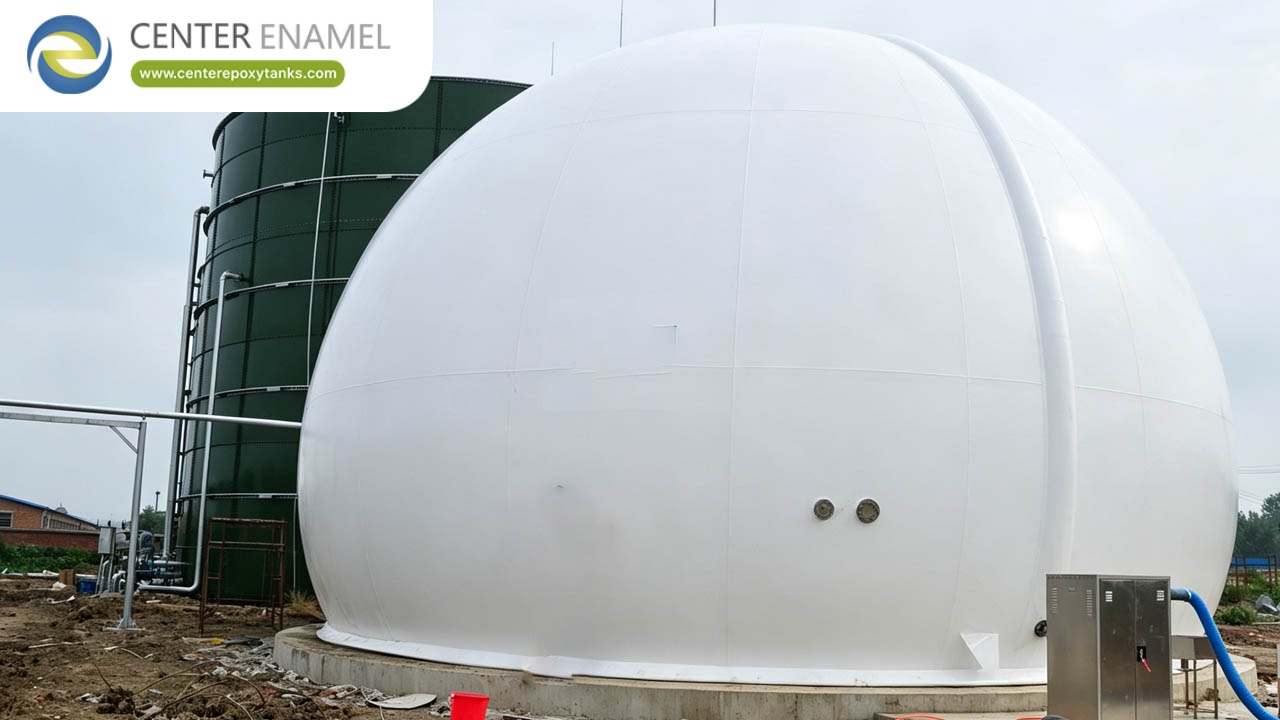
China Biogas Storage Balloon Manufacturer - Center Enamel
As the global transition toward decarbonization and circular economies gains momentum, anaerobic digestion (AD) facilities, large-scale agricultural farms, municipal wastewater treatment plants, and industrial processing operations face a critical engineering requirement: reliable, high-efficiency biogas storage. Because organic waste conversion is continuous while energy consumption fluctuates, advanced gas containment systems are essential to absorb peak production surges, regulate internal operating pressures, and eliminate fugitive methane emissions.
As a globally trusted industry pioneer, Shijiazhuang Zhengzhong Technology Co., Ltd. (Center Enamel) stands at the forefront as a premier China biogas storage balloon manufacturer. Combining over 30 years of containment expertise, advanced membrane material science, and state-of-the-art manufacturing, Center Enamel delivers custom-engineered, high-performance biogas storage balloons designed to maximize renewable energy efficiency worldwide.
Engineering Principles of Flexible Biogas Storage Balloons
Center Enamel's industrial biogas storage balloons are engineered as independent, ground-mounted or tank-integrated containment systems designed to handle the rigorous demands of anaerobic digestion. The structural architecture relies on a specialized multi-layer fabric configuration:
Inner Gas Containment Bladder: Directly seals and holds the treated biogas after desulfurization and dehydration. It expands and contracts dynamically based on daily production and consumption cycles, ensuring stable delivery pressures.
Outer Protective Shell: Maintained under a continuous, slight positive pressure by an automated air blower system, this outer membrane shields the inner bladder and stored gas from UV radiation, high winds, and heavy precipitation.
Insulated Air Gap Buffer: The internal air space between the layers provides thermal buffering, protecting the system against rapid ambient temperature shifts and stabilizing biological gas yields.
Technical Performance Matrix: Biogas Storage Technologies
Technical Parameter | Center Enamel Biogas Storage Balloons | Traditional Fixed Steel Gasholders | Single-Layer Fabric Balloons |
Material Composition | High-tenacity polyester base fabric with specialized PVC/PVDF coatings | Heavy structural carbon steel plates requiring continuous anti-corrosion maintenance | Light single-layer synthetic fabric; vulnerable to extreme weathering |
Gas-Tightness & Seam Integrity | Excellent; high-frequency welded seams provide superior airtight containment | Moderate; prone to corrosion at welded structural joints and mechanical seals | Lower durability; susceptible to micro-permeation and gas leakage over time |
Corrosion & Chemical Resistance | High; synthetic polymer materials are completely inert to hydrogen sulfide ($H_2S$) and moisture | Moderate to low; vulnerable to biogenic sulfuric acid attack without protective linings | Variable; degrades rapidly when exposed to aggressive industrial biogas vapors |
Installation & Scaling | Rapid modular setup; easily scaled from tens to thousands of cubic meters | Heavy civil foundations and complex crane-assisted steel erection required | Lightweight setup, but lacks structural rigidity under heavy environmental loads |
Key Advantages of Center Enamel Biogas Storage Solutions
1. Advanced Membrane Science and Material Durability
Center Enamel utilizes high-tenacity polyester base fabrics coated on both sides with specialized PVC and finished with an external Polyvinylidene Fluoride (PVDF) lacquer. This advanced multi-layered composite delivers superior ultraviolet (UV) stability, self-cleaning properties, and absolute resistance to corrosive biogenic gases such as hydrogen sulfide ($H_2S$) and ammonia ($NH_3$).
2. State-of-the-Art Manufacturing and Quality Control
As a certified global manufacturer, Center Enamel operates advanced production facilities equipped with automated CNC cutting technology and high-frequency welding lines. Every membrane seam is fused to exceed the tensile strength of the base material, followed by rigorous pneumatic pressure and leak testing prior to shipment.
3. Integrated Solutions and Global Reliability
Beyond standalone biogas storage balloons, Center Enamel is renowned as a leading manufacturer of Glass-Fused-to-Steel (GFS) and stainless steel anaerobic digesters. This unique capability allows Center Enamel to provide seamless, turn-key waste-to-energy packages where digesters and gas holders are engineered to work in perfect harmony.
Frequently Asked Questions (FAQ)
Q: What makes Center Enamel a leading China biogas storage balloon manufacturer?
A: Center Enamel brings over 30 years of specialized containment expertise, advanced high-frequency welding manufacturing lines, premium UV-resistant materials, and a proven track record across more than 100 countries.
Q: What materials are utilized in Center Enamel's biogas storage balloons?
A: The balloons are fabricated from high-tenacity polyester fabrics coated with specialized PVC and protected by a PVDF surface lacquer, ensuring exceptional resistance to weathering, UV rays, and corrosive biogas components like hydrogen sulfide.
Q: Can the storage capacity of the biogas balloon be customized for specific project demands?
A: Yes. Center Enamel designs and manufactures biogas storage balloons in fully customizable volumes ranging from tens to thousands of cubic meters to match specific industrial, agricultural, or municipal energy requirements.
Q: What safety and monitoring systems are integrated into these gas balloons?
A: Center Enamel incorporates comprehensive safety mechanisms, including automated pressure control valves, non-contact ultrasonic level monitoring systems for real-time volume tracking, overpressure protection safeguards, and emergency flare integration options.


