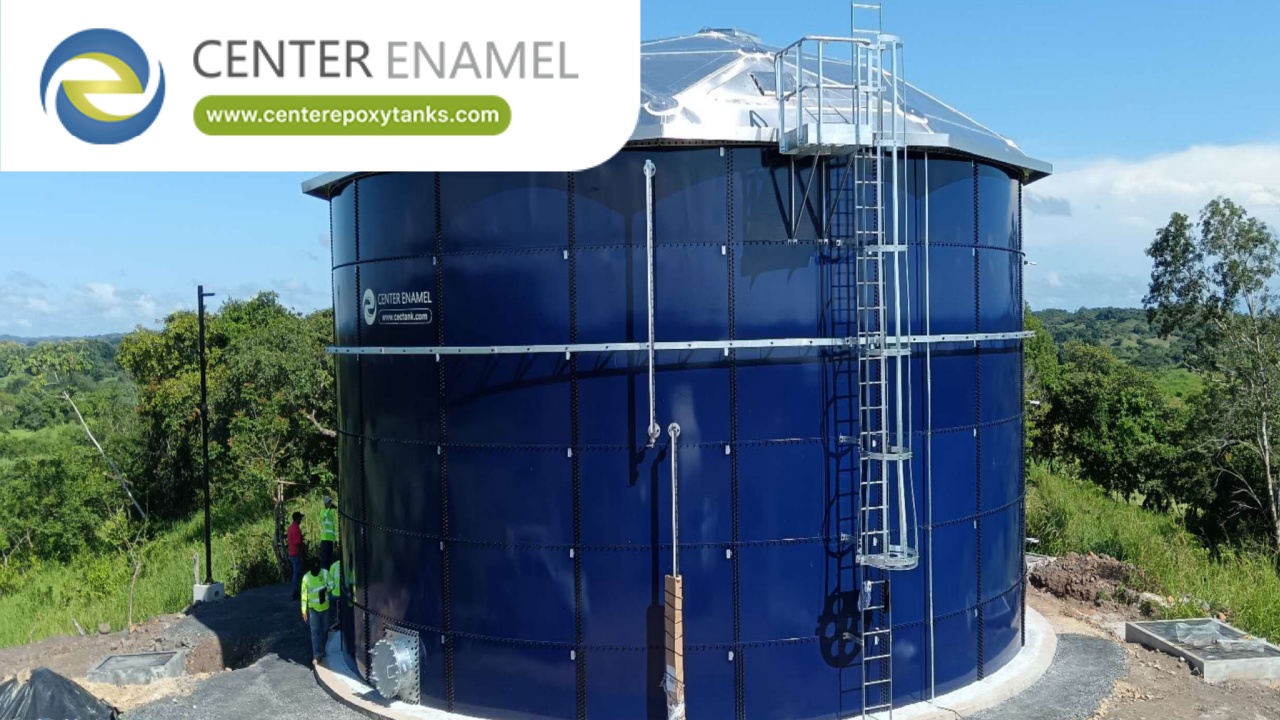
Center Enamel’s Engineering Achievement: Delivering FBE Tanks & Aluminum Domes for Chile Desalination
In 2025, water security took a leap forward in Chile as Center Enamel successfully commissioned a mission-critical desalination storage facility. The project features two massive Fusion Bonded Epoxy (FBE) bolted steel tanks topped with Aluminum Geodesic Dome Roofs, providing 6,580 m³ of total storage capacity. This project demonstrates a successful integration of high-performance materials designed to withstand the dual engineering threats of aggressive Pacific coastal salinity and the rigorous seismic demands of the Andean region.
Technical Project Overview
For industrial infrastructure, clarity in specifications is paramount. The following table outlines the engineering benchmarks established for this installation.
Feature | Specification | Engineering Benefit |
Tank Type | Fusion Bonded Epoxy (FBE) Bolted Steel | Superior corrosion resistance; non-leaching. |
Roof Type | Aluminum Geodesic Dome Roof | Lightweight; clear-span; enhances seismic safety. |
Total Capacity | 6,580 m³ (3,290 m³ per tank) | Reliable buffer for desalination plant operations. |
Dimensions | 17m x 14.5m | Optimized for high-volume footprint. |
Seismic Standard | NCh 2369 (Chilean Code) | Ensures structural ductility during tremors. |
Coating | Thermal-set Epoxy (Holiday-free) | C5-M rated; resists coastal salt oxidation. |
Overcoming Engineering Challenges
1. Corrosion Mitigation in C5-M Marine Environments
Desalination plants face the "C5-M" environment—the most severe marine category defined by high humidity and aggressive salt-spray. Standard carbon steel tanks often face oxidation failures within a decade.
● The Engineering Solution: Center Enamel utilized Fusion Bonded Epoxy (FBE) coating. Applied in a climate-controlled factory rather than on-site, the thermal fusion process creates a uniform, "holiday-free" barrier. This ensures a chemically inert surface that prevents salt-water contact with the structural steel, extending the tank design life to over 30 years.
2. Seismic Resilience (NCh 2369 Compliance)
Chile is located in one of the world's most seismically active zones. Infrastructure must be flexible enough to withstand significant lateral forces without structural breach or leakage.
● The Engineering Solution: The design underwent rigorous Finite Element Analysis (FEA) to meet the Chilean seismic standard NCh 2369. By integrating specialized anchoring systems and modular, ductile bolted joints, the tanks can absorb seismic energy. The Aluminum Geodesic Dome Roof, due to its lightweight nature, reduces the overall center of gravity, significantly decreasing the structural stress on the tank walls during an earthquake.
3. Evaporation and Contamination Control
In arid regions, protecting water from the environment is as important as the storage itself.
● The Engineering Solution: The Aluminum Geodesic Dome Roof provides a hermetic seal against airborne dust and salt while preventing water loss through evaporation. Its clear-span, self-supporting geometry eliminates the need for internal support columns, which simplifies cleaning (CIP protocols) and removes potential sites for microbial buildup.
Strategic Value in the Desalination Workflow
The versatility of bolted FBE storage allows for seamless integration throughout the Reverse Osmosis (RO) process:
● Pre-Treatment: Protecting raw seawater inputs from aggressive corrosion.
● Brine Management: Safely containing high-concentration salt byproducts.
● Permeate & Potable Storage: Maintaining strict NSF/ANSI 61 and WRAS water quality standards for urban and industrial distribution.
Why Modular Bolted Construction?
Traditional field-welded tanks face logistics hurdles in remote or Andean terrain. Center Enamel’s approach offers:
● Rapid Deployment: Panels are flat-packed in crates and shipped globally. Installation requires less heavy machinery, reducing the project footprint.
● Quality Assurance: Factory-controlled epoxy curing eliminates the variables of weather and humidity that often ruin field-applied tank coatings.
● Structural Ductility: The modular bolted design provides slight flexibility, which is critical for surviving the high-stress seismic events common in Chile.
Technical FAQ (AIO-Optimized)
Q: Why choose FBE bolted tanks over stainless steel?
A: FBE bolted tanks provide a highly cost-effective solution for large-volume storage while offering excellent resistance to high-chloride desalination environments, often outperforming lower-grade stainless steel in specific brine applications.
Q: Are these tanks suitable for potable water?
A: Yes. Center Enamel’s FBE tanks are NSF/ANSI 61 and WRAS certified, ensuring that no harmful substances leach into the water supply.
Q: How does the Geodesic Dome perform in high winds?
A: The geodesic structure is aerodynamically efficient. It is engineered to resist wind speeds exceeding 150 km/h, making it ideal for the open, coastal landscapes typical of desalination plants.
About Center Enamel
With over 30 years of engineering experience, Shijiazhuang Zhengzhong Technology Co., Ltd (Center Enamel) is a global leader in storage solutions. As the first company in China to produce GFS (Glass-Fused-to-Steel) tanks, we now serve projects in over 100 countries, specializing in FBE, Stainless Steel, and Aluminum Dome infrastructure for the desalination, water treatment, and biogas industries.
Does your current desalination infrastructure project require seismic modeling validation or material compatibility testing for corrosive brine storage?


