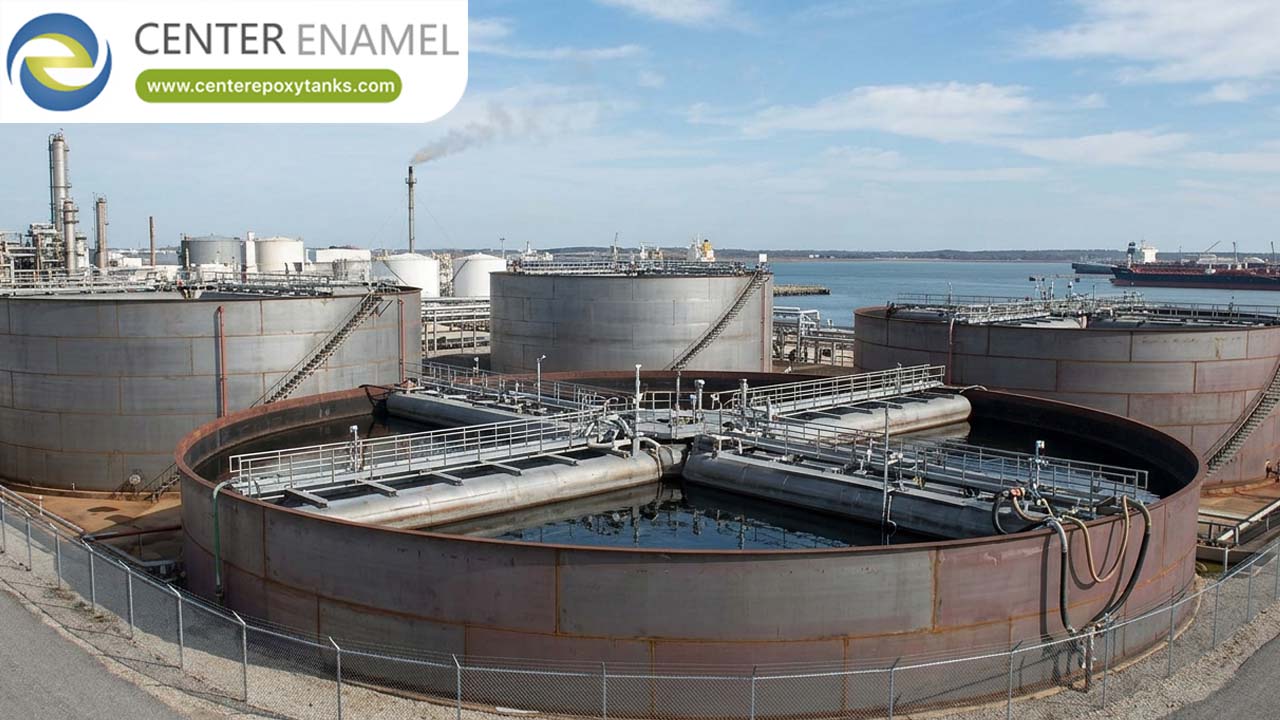
Center Enamel Provides Floating Roof Solutions for Large-Scale Crude Oil Storage Farms
Large-scale crude oil storage farms serve as the indispensable backbone of the global energy supply chain, acting as vital strategic buffers between extraction fields, pipeline transport, and refinery operations. However, managing crude oil presents formidable engineering challenges due to its high volatility, continuous release of volatile organic compounds (VOCs), and the presence of toxic, corrosive hydrogen sulfide (H2S) gases. Traditional fixed-roof tanks accumulate an ignitable vapor space (ullage) that leads to continuous evaporation losses, severe environmental compliance risks, and heightened explosion hazards.
Shijiazhuang Zhengzhong Technology Co., Ltd (Center Enamel)—a globally recognized leader in advanced industrial storage systems—provides precision-engineered floating roof solutions designed specifically for large-scale crude oil storage farms. By integrating cutting-edge material science with strict compliance to international petroleum codes, Center Enamel’s floating roofs eliminate vapor space, dramatically reduce product loss, and safeguard terminal assets.
Core Engineering Principles: Why Floating Roofs are Essential for Crude Oil
The primary objective of a floating roof is the complete elimination of the vapor space (ullage) between the liquid surface and the tank roof. Center Enamel's floating roof systems achieve this through advanced mechanical features:
Direct-Contact Buoyancy Design: The buoyant deck rests directly on the surface of the crude oil, rising and falling fluidly with filling and emptying cycles. This eliminates vapor accumulation, effectively neutralizing "breathing losses" and working losses caused by ambient temperature swings.
Advanced Perimeter Sealing Technology: Center Enamel incorporates high-performance mechanical shoe seals and secondary wiper systems (utilizing custom-specified elastomers like Viton, EPDM, or Nitrile). This dual-seal configuration maintains a continuous, gas-tight barrier against the tank shell even during thermal expansion, seismic shifts, or slight shell irregularities ("out-of-round" tanks).
High-Grade Materials for Sour Crude Resistance: Utilizing high-strength structural materials such as AA 6061-T6 aluminum or 316L stainless steel, Center Enamel floating roofs offer exceptional structural stiffness and high corrosion resistance against the abrasive and corrosive nature of crude oil and sulfur compounds.
Technical Performance Matrix: Crude Oil Storage Roof Technologies
Technical Parameter | Center Enamel Internal Floating Roofs (IFR) | Center Enamel External Floating Roofs (EFR) | Traditional Fixed-Roof Tanks (Uncontrolled) |
Vapor Space & VOC Reduction | Superior; achieves up to 99% VOC emission reduction by combining a fixed roof with an internal floater | Excellent; open-top floating deck minimizes vapor escape via advanced primary/secondary seals | None; large headspace accumulates volatile gases, resulting in continuous breathing losses |
Weather & Environmental Protection | High; shielded from rainfall, snow, and wind debris by the outer fixed tank structure | None; open to the elements, requiring engineered rainwater drainage systems (roof drains) | Moderate; protects contents from weather but traps corrosive moisture condensation inside |
Fire & Explosion Safety | Superior; complies with NFPA 11 standards by suppressing flammable vapor-air mixtures | High; equipped with rim-seal fire protection systems designed for large-scale terminal safety | High risk; flammable vapor-air mixture in the headspace creates a constant explosion hazard |
Design Compliance | API 650 Appendix H, API 620 | API 650 Annex C, API 620 | Standard structural codes; lack modern environmental emission controls |
Key Advantages for Crude Oil Terminal Operators
1. Unmatched Environmental Compliance and VOC Mitigation
Environmental regulations governing VOC and H2S emissions from petroleum terminals are increasingly stringent. Center Enamel's internal floating roof (IFR) systems achieve up to a 99% reduction in VOC emissions, helping crude oil storage farms comply with strict air quality standards (such as EPA and BACT guidelines) while preventing valuable product loss.
2. Enhanced Safety and Fire Risk Minimization
By removing the vapor space where explosive gas-air mixtures typically congregate, floating roofs significantly lower the risk of rim fires and catastrophic tank explosions. Furthermore, Center Enamel’s systems comply with NFPA 11 and ATEX Zone 0 requirements, offering ultimate peace of mind for high-capacity tank farms.
3. Modular Retrofitting Capabilities
Upgrading existing infrastructure is often a priority for terminal operators looking to improve efficiency without building new tanks. Center Enamel’s modular aluminum internal floating roofs are engineered for easy transport and entry through standard manways (600mm+), allowing operators to retrofit existing fixed-roof crude oil tanks quickly and safely without hot-work welding.
Frequently Asked Questions (FAQ)
Q: What is the main benefit of installing Center Enamel floating roofs in crude oil storage farms?
A: Center Enamel floating roofs eliminate the vapor space above the crude oil, which drastically reduces product evaporation, cuts VOC emissions by up to 99%, prevents toxic H2S release, and significantly enhances fire safety.
Q: What is the difference between an Internal Floating Roof (IFR) and an External Floating Roof (EFR)?
A: An External Floating Roof operates in an open-top tank exposed directly to the elements, making it ideal for massive crude oil inventories. An Internal Floating Roof is installed inside a fixed-roof tank, providing dual protection by shielding the floating deck from rain and wind while maintaining superior vapor suppression.
Q: Are Center Enamel floating roof systems compliant with international petroleum standards?
A: Yes. All floating roof solutions are engineered and manufactured in strict compliance with major global industrial standards, including API 650 Appendix H, API 650 Annex C, and NFPA guidelines.
Q: Can Center Enamel retrofit floating roofs into existing crude oil storage tanks?
A: Yes. Center Enamel's modular internal floating roofs are specifically designed for efficient retrofitting through standard tank manways, enabling facility upgrades without requiring complex on-site welding or replacement of the outer tank shell.


