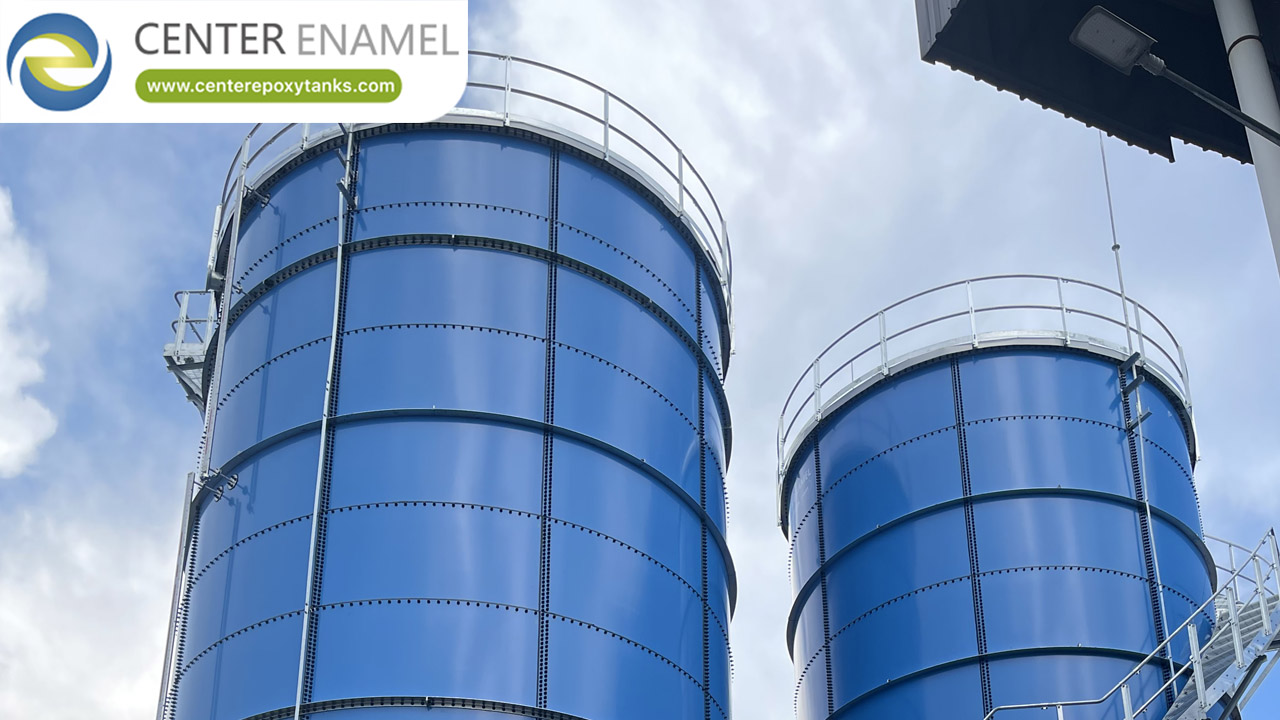
Center Enamel Provides Durable Epoxy Coated Steel Tanks for Israel Biogas Project
The global transition toward renewable energy, sustainable agriculture, and closed-loop waste management has driven intense demand for advanced anaerobic digestion infrastructure. In regions characterized by intensive agricultural production and rigorous environmental regulations—such as agricultural and municipal initiatives in Israel—efficient organic waste conversion is a paramount national priority. To meet the stringent demands of modern bioenergy facilities, Shijiazhuang Zhengzhong Technology Co., Ltd (Center Enamel) successfully provided durable, high-performance epoxy coated steel tanks for a landmark Israel biogas project.
By integrating precision modular engineering with advanced surface chemistry, Center Enamel's epoxy coated steel tanks serve as the structural and operational core for anaerobic digestion (AD), ensuring maximum methane capture, reliable structural integrity, and exceptional resistance to the corrosive byproducts of organic decomposition.
The Engineering Challenge: Severe Environments in Anaerobic Digestion
Anaerobic digestion is a biological process where specialized microorganisms break down organic feedstocks—including agricultural manure, food waste, and wastewater sludge—in an oxygen-free environment to generate biogas (primarily methane and carbon dioxide). While this process yields clean renewable energy, it creates an aggressively corrosive internal environment:
Hydrogen Sulfide (H2S) and Moisture: The biological breakdown of sulfur-rich organic matter generates hydrogen sulfide gas, which reacts with condensation to form corrosive sulfurous and sulfuric acids.
Volatile Fatty Acids: Intermediate biological stages produce organic acids that can rapidly pit, thin, and degrade unprotected metallic surfaces.
Thermal and Structural Pressures: Digesters operate under continuous mechanical agitation and strict temperature controls (mesophilic or thermophilic ranges), imposing cyclic dynamic loads on the containment vessel.
Traditional civil concrete tanks are prone to micro-cracking, structural degradation from acid attack, and long curing delays. Standard welded steel tanks often suffer from rapid weld-seam corrosion and require intensive on-site protective maintenance. Center Enamel's epoxy coated steel tanks resolve these vulnerabilities through a state-of-the-art fusion bonding manufacturing workflow.
Technical Performance Matrix: Biogas Containment Technologies
Technical Parameter | Center Enamel Epoxy Coated Steel Tanks | Cast-in-Place Concrete Digesters | Traditional Field-Welded Steel Vessels |
Corrosion & Acid Resistance | Superior; cross-linked polymer barrier completely isolates steel from $H_2S$ and organic acids | Vulnerable to biogenic sulfide corrosion and sulfuric acid crown attack over time | Prone to weld-seam oxidation and coating breakdown under high humidity |
Installation Velocity | Rapid modular bolted assembly; significantly reduces project lead times on-site | Extremely slow; requires extensive formwork, pouring, and multi-week concrete curing | Slow; requires intensive field welding, plate rolling, and non-destructive testing |
Modularity & Scalability | Easily expanded, modified, or relocated as biogas plant capacity requirements grow | Permanent civil structure; expansion or relocation is virtually impossible without demolition | Rigid structural footprint; difficult to modify or expand without heavy cutting |
Quality Control | Factory-controlled application with 100% high-voltage holiday testing | Dependent on variable on-site construction conditions and weather | Field-applied coatings often suffer from application flaws and environmental contamination |
Key Advantages Delivered to the Israel Biogas Project
1. Exceptional Chemical Resistance and Long-Term Durability
Center Enamel’s epoxy coated steel tanks utilize high-performance thermoset powder coatings that are thermally fused and cross-linked to premium carbon steel substrates. Every individual panel undergoes rigorous dry film thickness checks and high-voltage holiday spark testing (typically 1,100V to 1,500V) to guarantee absolute pinhole-free integrity. This creates an impenetrable barrier against corrosive biogas elements, ensuring a dependable operating lifespan exceeding 30 years.
2. Rapid Modular Erection and Logistics Efficiency
For international projects like the biogas installation in Israel, minimizing on-site construction time and labor costs is vital. Center Enamel's bolted panel system allows components to be prefabricated in a strict factory environment and shipped compactly worldwide. Tanks are assembled on-site using high-strength hardware and specialized structural sealants, eliminating hazardous hot-work welding and accelerating time-to-commissioning.
3. Integrated Gas-Tight Sealing and Process Safety
Biogas containment requires absolute hermetic sealing to prevent methane leakage and odor escape. Center Enamel’s tanks feature specialized dual-sealing systems and flexible roof options (including double-membrane gas holders) that maintain positive pressure stability while safely handling gas collection and thermal expansion.
Frequently Asked Questions (FAQ)
Q: What makes Center Enamel's epoxy coated steel tanks ideal for biogas projects?
A: Center Enamel's epoxy coated steel tanks combine the high structural tensile strength of carbon steel with a chemically inert, cross-linked polymer barrier. This prevents corrosion from hydrogen sulfide ($H_2S$) and organic acids generated during anaerobic digestion, ensuring long-term structural reliability.
Q: How do epoxy coated tanks compare to concrete tanks for anaerobic digestion?
A: Unlike concrete tanks—which are prone to acid attack, micro-cracking, and multi-month curing delays—epoxy coated bolted steel tanks offer rapid modular installation, superior chemical resistance, lower lifecycle maintenance, and the flexibility to be expanded or relocated.
Q: Are Center Enamel's tanks compliant with international engineering standards?
A: Yes. All tanks are engineered and manufactured in strict compliance with major global standards, including AWWA D103, ISO 28765, ISO 9001, and relevant structural design codes to withstand local seismic and wind loads.
Q: Can these tanks support integrated gas storage systems?
A: Yes. Center Enamel provides comprehensive integrated biogas handling solutions, including compatible membrane roof designs, pressure relief valves, and gas-tight sealing configurations optimized for safe methane collection and storage.


