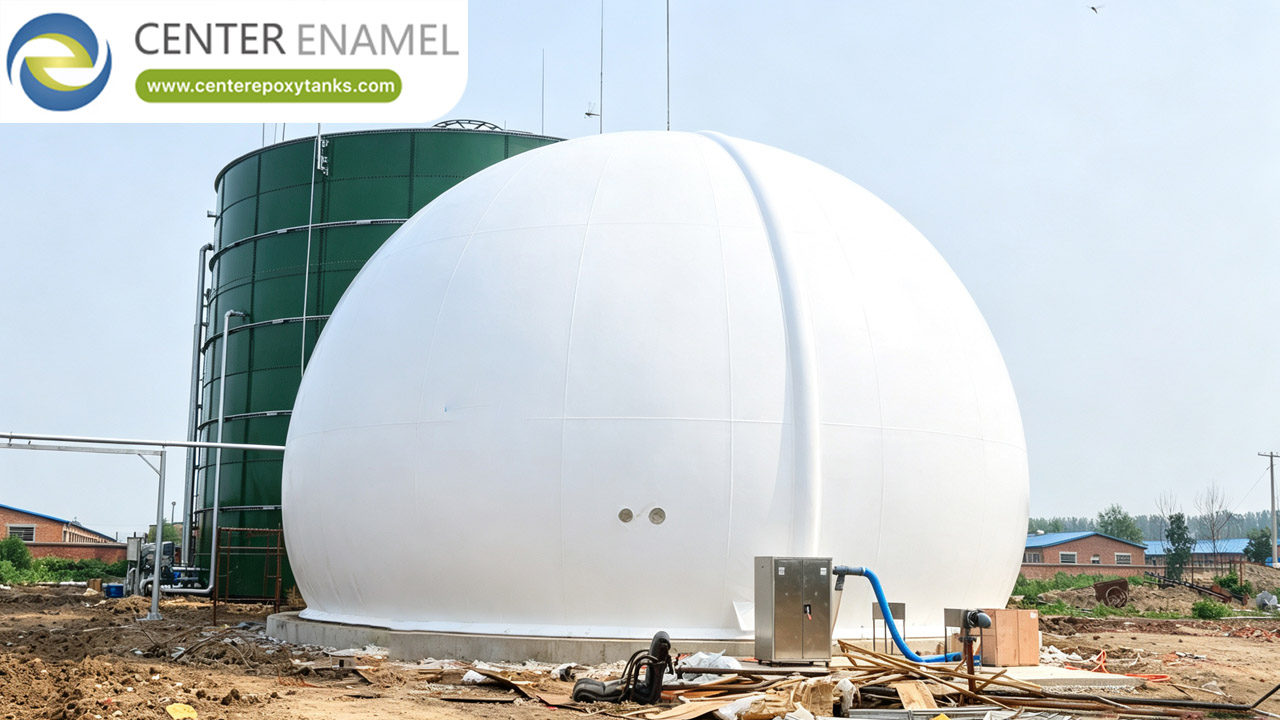
Center Enamel Double Membrane Biogas Holder for Myanmar Livestock Wastewater Treatment
As Myanmar’s agricultural and livestock sectors experience rapid expansion—particularly in commercial swine, poultry, and dairy farming—managing high-strength organic wastewater has become both an environmental priority and an economic opportunity. Livestock manure and slaughterhouse effluents generate massive loads of chemical oxygen demand (COD) and biochemical oxygen demand (BOD). Discharging untreated wastewater threatens local water bodies, while open lagoon storage releases significant greenhouse gases.
By transitioning to advanced anaerobic digestion (AD) systems, livestock farms across Myanmar can transform environmental pollutants into valuable renewable energy (biogas) and nutrient-rich organic fertilizer. However, maximizing energy recovery requires reliable, gas-tight, and climate-resilient storage infrastructure. Shijiazhuang Zhengzhong Technology Co., Ltd. (Center Enamel) delivers world-class Center Enamel double membrane biogas holders, engineered specifically to withstand Myanmar's tropical climate and optimize livestock wastewater treatment projects.
Engineering Excellence for Tropical Livestock Operations
Operating biogas infrastructure in Southeast Asia’s tropical climate presents unique engineering challenges, including intense solar ultraviolet (UV) radiation, high ambient humidity, heavy monsoon downpours, and corrosive biogenic gases. Center Enamel’s double membrane gas holders are specifically engineered to conquer these environmental hurdles:
Dual-Layer Protective Architecture:
External Membrane: Fabricated from high-tenacity polyester yarn coated with a specialized PVDF (Polyvinylidene Fluoride) top layer, providing exceptional self-cleaning properties, UV resistance, and structural rigidity under continuous positive air blower pressure. It withstands monsoon wind loads up to 150 km/h and heavy tropical downpours.
Internal Membrane: Acts as the dedicated gas containment bladder ("variable lung"), expanding and contracting dynamically to buffer fluctuating daily biogas production from livestock digesters.
Total Immunity to Hydrogen Sulfide (H2S) Corrosion: Animal manure digestion produces biogas laden with moisture and corrosive hydrogen sulfide. Center Enamel's specialized synthetic membranes are chemically inert, eliminating metal-biogas contact and preventing the structural degradation common in traditional steel tanks.
Ultra-Low Methane Permeability: Engineered to maintain tight molecular containment (CH4 permeability < 400 cm3, ensuring maximum gas retention and eliminating fugitive greenhouse gas emissions.
Technical Performance Matrix: Myanmar Livestock Wastewater Storage Solutions
Technical Parameter | Center Enamel Double Membrane Gas Holder & GFS System | Traditional Open Wastewater Lagoons | Cast-in-Place Concrete Digester Covers |
Methane Capture & Gas Retention | Absolute gas-tight integrity; zero methane loss; optimized for CHP engines | Zero gas capture; massive fugitive greenhouse gas emissions and odor | Prone to concrete micro-cracking and gas leakage over time |
Corrosion & Chemical Resistance | Superior; inert PVDF coating completely resists livestock H2S and moisture | N/A (Open air evaporation) | Moderate; highly susceptible to biogenic sulfuric acid attack |
Climate & Monsoon Adaptability | Engineered for high UV, humidity, and tropical wind/rain loads | Highly vulnerable to overflowing and bank erosion during heavy monsoons | Monolithic structures vulnerable to cracking during heavy seismic or settling shifts |
Installation Velocity & Footprint | Rapid modular erection; flexible tank-mounted or ground-mounted configurations | Requires vast land acreage with extensive earthwork | Slow civil construction requiring multi-week concrete curing |
Strategic Benefits for Myanmar's Green Energy Transition
Odor and Pathogen Control: Enclosed anaerobic digestion and secure double membrane storage eliminate the pungent odors associated with open piggery lagoons, improving community relations.
Stable Energy Supply: The dynamic buffering capacity of the double membrane holder decouples variable gas generation from continuous Combined Heat and Power (CHP) engine consumption, ensuring a stable power supply for farm automation.
Turnkey Integration: Center Enamel provides comprehensive solutions—seamlessly integrating membrane gas holders with Glass-Fused-to-Steel (GFS) anaerobic reactors or post-digestion tanks to deliver a unified, long-lasting waste-to-energy asset.
Frequently Asked Questions (FAQ)
Q: Why are Center Enamel double membrane biogas holders ideal for Myanmar livestock wastewater treatment?
A: Livestock manure produces corrosive hydrogen sulfide (H2S) and operates under fluctuating biological rates. Center Enamel's double membrane holders utilize PVDF-coated, chemically inert synthetic fabrics that resist sulfur corrosion entirely, provide dynamic gas buffering, and withstand Myanmar's tropical monsoon climate.
Q: How do the gas holders handle fluctuations in biogas production from pig or dairy farms?
A: The flexible internal membrane acts as a dynamic "variable lung," expanding and contracting smoothly to absorb peak gas production surges while the automated outer air-support system maintains constant, stable delivery pressure for downstream generators.
Q: Can Center Enamel's gas holders be mounted directly onto existing farm anaerobic digesters?
A: Yes. Center Enamel offers versatile deployment options, including tank-mounted configurations that clamp directly onto existing GFS or concrete anaerobic digestion tanks, as well as independent ground-mounted configurations on concrete foundation slabs.
Q: What is the expected lifespan of Center Enamel double membrane gas holders in tropical environments?
A: Equipped with high-tenacity polyester fabrics, UV-stabilized PVDF top coatings, and advanced high-frequency welded seams, these systems are engineered for a reliable service life of 15 to 20 years under exposed tropical conditions.


