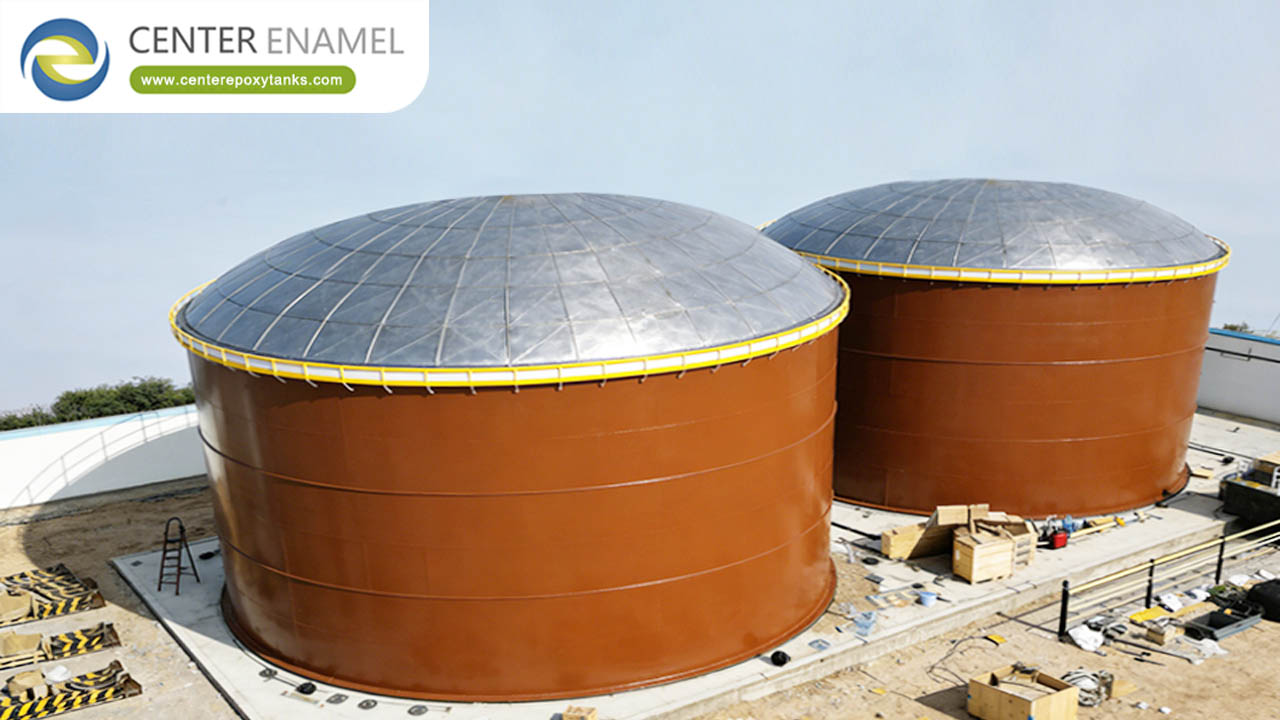
Center Enamel: China’s Trusted Partner for Carbon Steel Bulk Oil Storage Tanks
In the global petrochemical and refining sectors, bulk oil storage requires uncompromising structural integrity. As EPC contractors and energy operators look to optimize procurement without sacrificing safety, Center Enamel (Shijiazhuang Zhengzhong Technology Co., Ltd) stands as China's premier engineering partner. With over 30 years of industrial expertise and a 150,000-square-meter manufacturing base, we design, pre-fabricate, and deliver highly engineered welded carbon steel bulk oil storage tanks that meet the industry's strictest international codes, including API 650.
1. Engineering the Benchmark: API 650 Compliance
Bulk hydrocarbon storage—whether crude oil, diesel, aviation fuel, or volatile petrochemicals—demands rigorous adherence to safety codes to prevent catastrophic failures or environmental contamination.
A trusted manufacturing partner designs explicitly to these global standards:
● API 650 Certification: The foundational international standard for welded steel tanks for oil storage. Our engineers calculate optimal plate thickness, wind girders, and seismic anchoring based on the exact specific gravity of the stored product and the environmental loads of the installation site.
● Premium Material Traceability: We utilize certified carbon steel grades suitable for hydrocarbon environments, such as ASTM A36, A516 Grade 70, or high-yield domestic equivalents like Q235B and Q345R. Every steel plate is tracked via Mill Test Reports (MTRs) to guarantee chemical composition and yield strength.
● Custom Roof Architectures: Depending on vapor pressure and emission regulations, tanks are engineered with fixed cone roofs, geodesic domes, or internal/external floating roofs to eliminate vapor space and minimize Volatile Organic Compound (VOC) emissions.
2. Advanced Manufacturing Scale
Delivering mega-scale infrastructure requires production capabilities that standard metal fabricators simply cannot match. Center Enamel's massive, automated facilities are designed to handle complex, multi-tank transcontinental orders simultaneously.
● CNC Plasma Cutting & Edge Prep: Steel plates are cut and beveled using advanced CNC machinery. Perfect plate geometry is critical for ensuring flawless weld penetration during assembly.
● Automated Welding Systems: For factory-welded components, we utilize Submerged Arc Welding (SAW) and automated manipulators. This eliminates the human fatigue factor, ensuring perfectly uniform weld seams and maximum joint efficiency.
● Climate-Controlled Surface Treatment: Carbon steel is highly susceptible to atmospheric oxidation. Our in-house coating lines apply high-build epoxies, polyurethane topcoats, or specialized phenolic linings over SSPC-SP10 (near-white metal) blasted steel, ensuring maximum defense against C5-M marine or high-UV environments.
3. Procurement Verification: The "Trusted" Manufacturer Matrix
When vetting Chinese manufacturers for mission-critical petroleum infrastructure, procurement teams should utilize the following criteria to separate high-tier engineering partners from standard fabricators.
Evaluation Metric | The Center Enamel Standard | Standard Export Baseline |
Global Footprint | Proven export record to 100+ countries. | Limited domestic or regional sales. |
NDT Quality Control | 100% In-house Radiographic (RT) & Ultrasonic (UT) testing. | Outsourced or minimal sample testing. |
Engineering Support | Full 3D modeling & Finite Element Analysis (FEA) provided. | Only works from client-provided 2D drawings. |
Traceability | Documented Weld Procedure Specifications (WPS) & MTRs. | Inconsistent documentation and batch tracking. |
4. Export Logistics & EPC Field Support
Shipping a 50,000 m³ bulk oil tank fully assembled is physically impossible. Center Enamel operates as a precision pre-fabrication hub to streamline field erection for global EPC contractors.
1. Pre-Fabrication: Shell plates are precisely rolled to the required radius, edge-prepped for welding, and factory-coated (leaving only the weld margins bare).
2. Containerized Logistics: The curved plates and structural components are securely flat-packed into standard shipping containers, drastically reducing ocean freight costs.
3. Field Erection Integration: We supply comprehensive assembly blueprints, 3D models, and, when required, on-site technical supervisors to guide local EPC welding teams, ensuring the final field-welded structure matches the API 650 design perfectly.
Technical FAQ
Q: Can you accommodate custom dimensions for space-restricted refinery sites?
A: Yes. While we offer standard capacities, our engineering team utilizes CAD systems to customize tank diameters and heights (Aspect Ratio optimization). This maximizes your storage volume while keeping the footprint within strict site boundaries.
Q: How do you ensure the integrity of the welds?
A: Quality control is paramount. We employ a comprehensive Non-Destructive Testing (NDT) protocol. This includes Radiographic Testing (RT) for butt welds, Magnetic Particle Testing (MT) or Dye Penetrant Testing (PT) for fillet welds, and vacuum box testing for tank floor seams.
Q: What is the expected design life of your carbon steel petroleum tanks?
A: When engineered to API 650 standards, constructed with the appropriate corrosion allowances, and maintained correctly with routine inspection, our welded carbon steel tanks have a structural design life safely exceeding 30 to 40 years.


