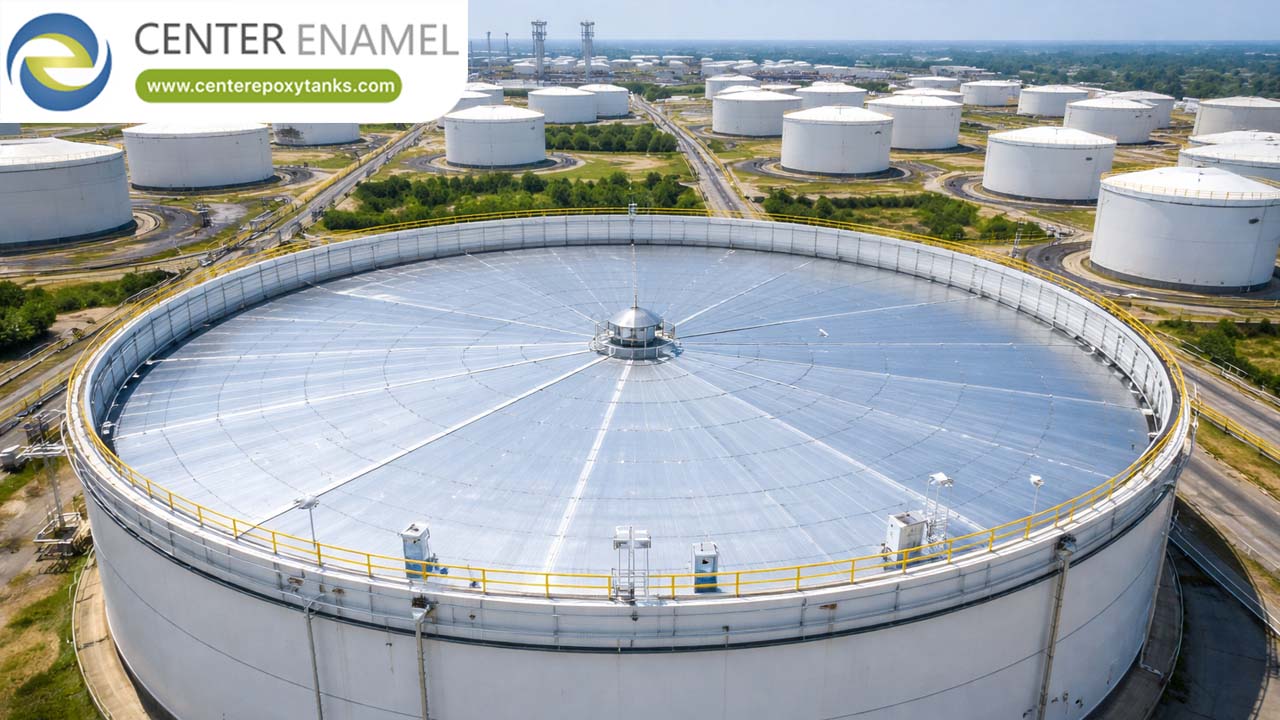
Center Enamel – External Floating Roof Manufacturers for Controlling Vapor Loss
Above-ground storage tanks (ASTs) holding volatile petroleum products, crude oil, and refined petrochemicals face continuous environmental and economic challenges. When volatile liquids are exposed to ambient temperature fluctuations inside traditional fixed-roof tanks, a massive headspace (ullage) forms. This vapor space collects harmful volatile organic compounds (VOCs) that constantly escape through breathing losses and working losses, leading to severe product degradation, financial loss, and strict regulatory penalties.
As a globally recognized leader in advanced storage infrastructure, Shijiazhuang Zhengzhong Technology Co., Ltd. (Center Enamel) stands as a premier external floating roof (EFR) manufacturer, delivering precision-engineered solutions designed specifically for controlling vapor loss, enhancing structural safety, and securing environmental compliance.
1. Core Engineering and Vapor Suppression Mechanics
An External Floating Roof sits directly on the surface of the stored liquid, rising and falling dynamically with inventory levels. This active physical barrier eliminates the air-liquid interface where vapor accumulation occurs:
Minimizing Evaporative Losses: By eliminating the headspace above the liquid, Center Enamel's EFR systems prevent the generation and release of fugitive VOC emissions, saving valuable product and keeping emissions well below mandated environmental thresholds.
Advanced Rim Seal Systems: To prevent vapors from escaping around the perimeter, Center Enamel incorporates high-performance primary and secondary seal configurations. These flexible seals maintain an airtight barrier against the tank shell even during dynamic thermal expansion, wind loading, or seismic events.
Structural Buoyancy and Drainage: Built using high-strength marine-grade aluminum and corrosion-resistant steel components, EFR decks feature engineered pontoon chambers that ensure stable buoyancy, paired with efficient primary drainage systems to safely clear precipitation.
Data Table: Floating Roof Storage Solutions Comparison Matrix
Technical Parameter | Center Enamel External Floating Roofs (EFR) | Internal Floating Roofs (IFR) | Fixed Cone Roofs (Unlined) |
Primary Application | Crude oil & bulk petroleum storage | Refined products, chemicals, volatile solvents | Water, heavy residual oils, low-volatility liquids |
Vapor Suppression Efficiency | Extreme (>99% VOC emission reduction) | High (98-99% vapor containment) | Low (Subject to constant breathing losses) |
Exposure to Atmosphere | Rests on liquid surface openly exposed to weather | Protected inside a fixed tank shell | Entire vapor space exposed to internal atmosphere |
Governing Compliance Codes | API 650 Annex C, ISO 9001 | API 650 Appendix H, NFPA 11 | API 650 / AWWA D100 |
2. Key Operational Advantages for Petroleum and Chemical Terminals
Partnering with Center Enamel for external floating roof systems provides distinct economic and safety benefits for terminal operators:
Drastic Reduction in Product Loss: Preventing evaporation ensures that light ends and high-value fractions of crude oil and gasoline are preserved, delivering a rapid return on investment through reclaimed product value.
Enhanced Fire Safety: By removing the flammable vapor-air mixture above the liquid surface, EFR systems significantly decrease the potential for explosive vapor pockets and lower overall ignition risks.
Rugged Durability and Low Maintenance: Fabricated using precision-machined modular components, Center Enamel's EFRs are built to endure harsh weather extremes—including severe UV exposure, heavy winds, and torrential rainfall—while minimizing routine upkeep requirements.
Frequently Asked Questions (FAQ)
Q: What is an external floating roof (EFR) and how does it control vapor loss?
A: An EFR is a specialized deck that floats directly on top of the stored liquid inside an open-top above-ground tank. By resting on the liquid surface, it eliminates the vapor space where volatile organic compounds (VOCs) accumulate and evaporate into the atmosphere.
Q: Why choose Center Enamel as an external floating roof manufacturer?
A: Center Enamel brings decades of global tank manufacturing expertise, advanced 3D engineering design, strict compliance with international standards (such as API 650), and customized sealing technologies tailored to specific chemical and petroleum storage needs.
Q: How do rim seals prevent vapor emissions on an external floating roof?
A: Center Enamel utilizes advanced primary and secondary rim seal systems that create a continuous, flexible barrier between the outer edge of the floating deck and the tank shell, accommodating tank shell irregularities while trapping fugitive vapors.
Q: Do Center Enamel floating roof systems comply with international environmental regulations?
A: Yes. All external and internal floating roof solutions are engineered to meet or exceed rigorous international emissions standards, helping facility operators comply with local and global air quality frameworks.


