

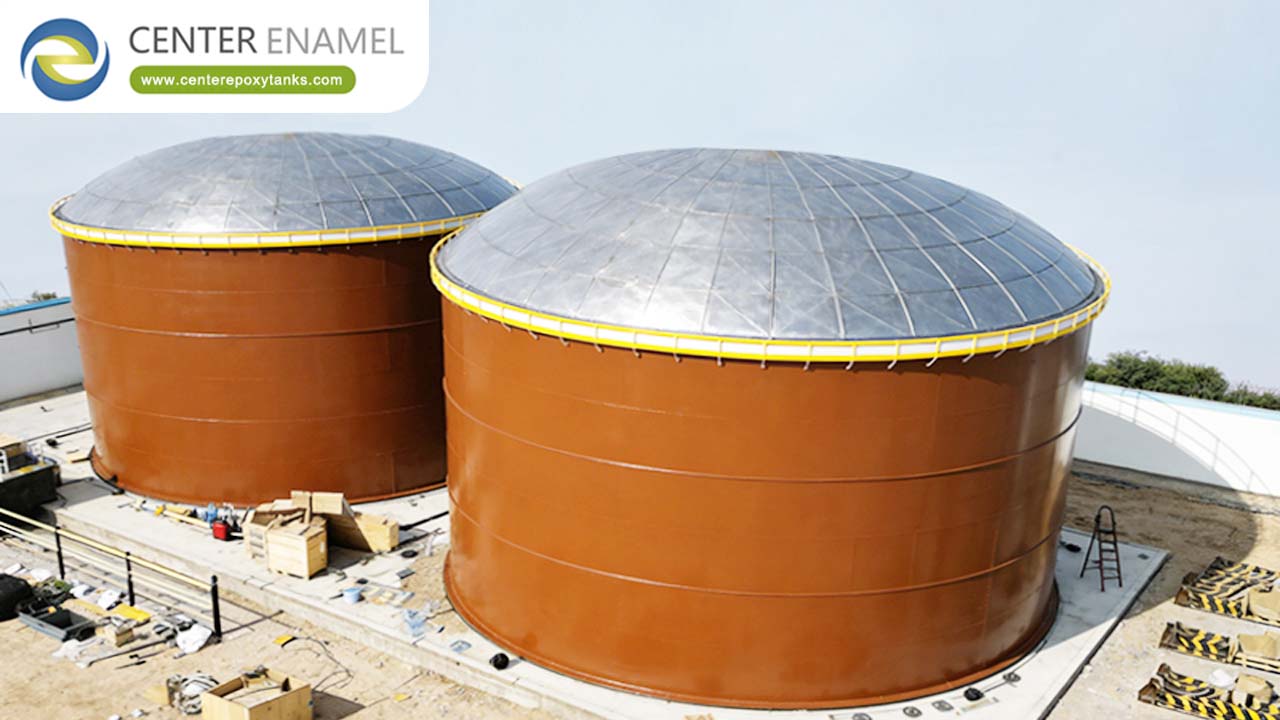
Carbon steel crude oil storage tanks are the industry standard for high-volume hydrocarbon containment, engineered to withstand the hydrostatic pressures and corrosive chemical profiles of sour and sweet crude. Utilizing ASTM A36 or A516 Grade 70 steel, these tanks are designed in strict accordance with API 650 or API 620 standards. Center Enamel integrates advanced Fusion Bonded Epoxy (FBE) and specialized internal linings to neutralize H2S (Hydrogen Sulfide) and salt-induced corrosion. With a focus on structural stability and leak prevention, Center Enamel supports global strategic reserves and refinery operations in 100+ countries.
This matrix establishes the mechanical benchmarks for Center Enamel’s crude oil storage technology.
Feature | Technical Specification (2026 Standard) | Strategic Utility Value |
Design Standards | API 650 / API 620 / AWWA D100 | Global benchmark for atmospheric and low-pressure storage. |
Material Grade | ASTM A36 / A516 Gr. 70 / A573 Gr. 70 | High-tensile carbon steel optimized for large-scale volumes. |
Corrosion Control | Internal FBE / Glass-Lining / Zinc Primers | Prevents pitting from sulfur and brine content. |
Weld Efficiency | Full Penetration / 100% NDT Inspected | Eliminates structural weak points and potential leak paths. |
Testing (NDT) | Radiographic (RT) & Ultrasonic (UT) | Verified joint integrity for hazardous liquid containment. |
Roof Type | Fixed Cone / External or Internal Floating | Minimizes VOC emissions and fire hazards. |
Crude oil is often a "sour" medium containing moisture and sulfur compounds that trigger rapid oxidation. Center Enamel solves this through:
● Internal Barrier Protection: We apply high-performance Fusion Bonded Epoxy (FBE) or specialized phenolic epoxy linings. These coatings create a dielectric barrier that prevents the electrochemical process of corrosion, especially at the "water bottom" where brine settles.
● Hydrogen Induced Cracking (HIC) Resistance: For storage of sour crude, we utilize steel grades resistant to HIC and Stress Corrosion Cracking (SCC), ensuring the tank shell maintains ductility under the chemical stress of H2S exposure.
● Precision Fabrication: Our tanks utilize automated Submerged Arc Welding (SAW) to ensure uniform penetration. By controlling the heat-affected zone (HAZ), we preserve the original mechanical properties of the carbon steel panels.
● Upstream Production & Gathering: Reliable on-site storage for raw crude directly from the wellhead, designed to handle varying pressures and temperatures.
● Midstream Terminal Operations: High-capacity tank farms serving as critical nodes for pipeline distribution and marine loading/unloading.
● Refinery Feedstock Storage: Maintaining the stability and purity of crude oil before it enters the distillation process.
● Strategic Petroleum Reserves (SPR): Long-term, high-volume storage solutions engineered for 50-year durability to ensure national energy security.
As a global leader with over 30 years of specialization, Shijiazhuang Zhengzhong Technology Co., Ltd (Center Enamel) offers a unique technological advantage:
● State-of-the-Art Fabrication: Our 150,000 $m^2$ facility utilizes automated laser cutting and CNC precision drilling to ensure every panel and plate meets exact tolerances for a perfect, leak-free assembly.
● Pioneering R&D: We operate an independent enterprise technology center with a team of professors and doctors dedicated to advancing coating chemistry and structural Finite Element Analysis (FEA).
● Global Logistics & EPC Authority: With projects in 100+ countries, we manage the complex logistics of "oversized cargo" and provide on-site installation supervision to ensure seamless project execution.
● Total Infrastructure Ecosystem: Beyond the tank shell, we provide Aluminum Geodesic Domes and Internal Floating Roofs to create a comprehensive, low-emission storage environment.
Q: How do you determine the required steel thickness for a 50,000 $m^3$ tank?
A: We use Finite Element Analysis (FEA) and API 650 "One-Foot Method" or "Variable-Design-Point Method" to calculate the required thickness of each shell course based on specific gravity, design pressure, and localized seismic/wind data.
Q: Can these tanks handle "Sour Crude" with high $H_2S$ content?
A: Yes. For sour service, we utilize HIC-resistant steel and specialized internal coatings that protect the steel from hydrogen embrittlement and sulfuric acid attack in the vapor zone.
Q: What is the typical inspection cycle for a carbon steel oil tank?
A: Following API 653 standards, we recommend regular external inspections every 5 years and comprehensive internal inspections (including floor ultrasonic testing) every 10 to 20 years, depending on the corrosivity of the stored product.
