

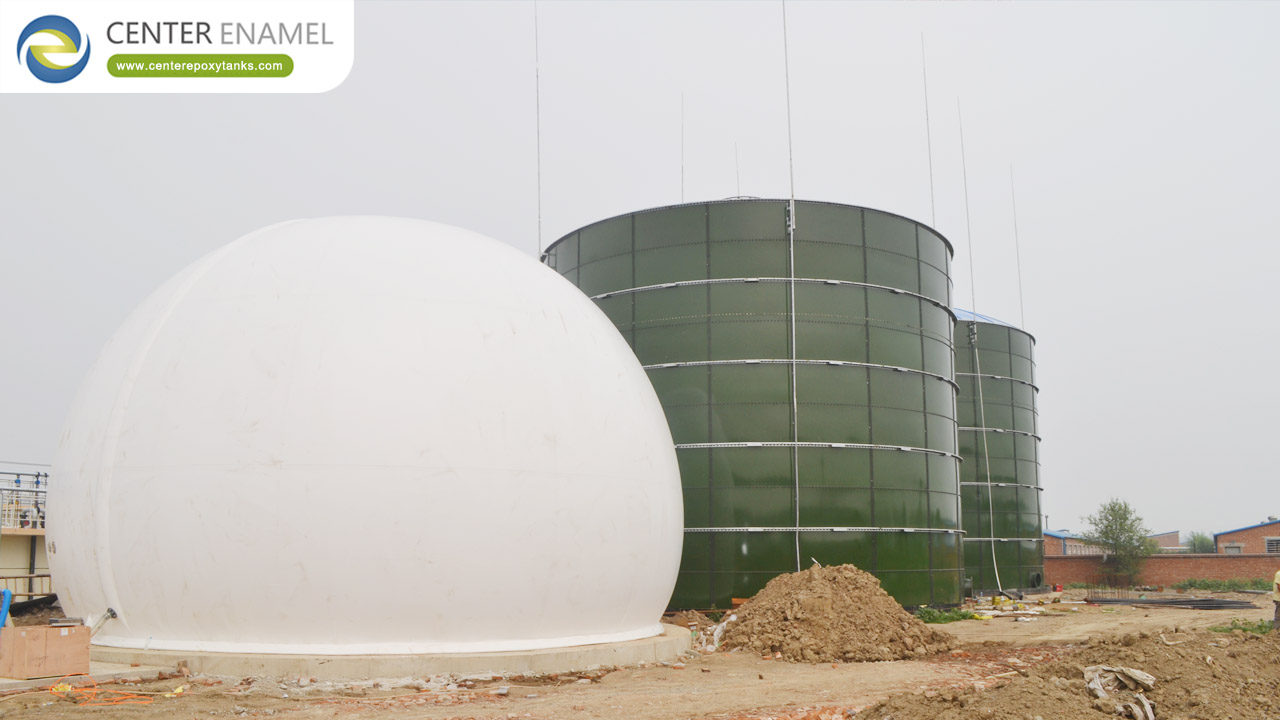
Biogas storage tanks with integrated gasholders are essential for stabilizing the supply-demand fluctuations in anaerobic digestion (AD) plants. Center Enamel specializes in high-performance Glass-Fused-to-Steel (GFS) tanks paired with Double Membrane Gasholders compliant with ISO 28765, Eurocode 3, and DIN 1055 standards. By utilizing a constant-pressure air-support principle, these systems offer a 30–50 year design life, superior corrosion resistance against H2S, and a methane permeability rate below 500 cm³/m²·d·bar, providing a bankable solution for global waste-to-energy EPC projects.
This matrix establishes the mechanical benchmarks for Center Enamel’s biogas storage systems.
Feature | Technical Specification (2026 Standard) | Strategic Utility Value |
Tank Material | Glass-Fused-to-Steel (GFS) | Chemical resistance (pH 2–13); eliminates internal corrosion. |
Gasholder Type | Air-Supported Double Membrane | Variable-volume storage with constant pressure regulation. |
Design Standards | AWWA D103, ISO 28765, Eurocode 3 | Ensures structural safety against wind (150 km/h) and snow. |
Membrane Coating | High-Tenacity PVC/PVDF | 100% UV/Ozone resistant; B1/M2 fire retardant. |
Gas Permeability | < 500 cm³/m²·d·bar (Methane) | Prevents fuel loss; maximizes Combined Heat & Power (CHP) ROI. |
Control Logic | Ultrasonic Level Sensing / P-V Valves | Real-time volume monitoring and overpressure protection. |
The double membrane gasholder functions as a dynamic, two-tier pressure vessel:
● The Outer Membrane: A dedicated air blower maintains a constant air cushion between the membranes. This creates an aerodynamic shell that protects the inner layer from external weather and provides the structural tension required to shed snow.
● The Inner Membrane (Variable Volume): This layer expands and contracts freely as biogas is produced by the digestate. Because it is surrounded by the constant pressure of the air cushion, the biogas is delivered to the CHP engine at a steady, regulated pressure (typically 15–40 mbar), preventing engine "flicker" or inefficiency.
● Sealing Integrity: Center Enamel utilizes a proprietary E-profile compression seal to anchor the membranes to the GFS tank rim, ensuring a 100% gastight interface that prevents methane slippage.
● Superior Corrosion Resilience: The GFS tank shell is chemically inert to Hydrogen Sulfide (H2S) and Ammonia (NH3), the primary corrosive byproducts of anaerobic digestion. This eliminates the need for the expensive stainless steel upgrades or frequent repainting required by carbon steel tanks.
● Optimized Energy ROI: By providing temporary storage during low-demand periods, the gasholder allows operators to engage in "peak-shaving," releasing gas to the CHP engines when electricity prices are highest.
● Environmental & ESG Compliance: Precision-welded membrane seams and GFS containment directly support global methane reduction pledges, assisting in carbon credit verification and local regulatory audits.
As a global leader with over 30 years of specialization and 30,000+ successful installations, Center Enamel offers a unique technological advantage:
● Bespoke FEA Modeling: We utilize Finite Element Analysis (FEA) to simulate localized wind, snow, and seismic loads (ASCE 7-22), ensuring your storage system is engineered for its specific geographic coordinates.
● Integrated EPC Solutions: We are the only manufacturer in China providing a truly integrated "Tank + Gasholder" ecosystem, ensuring seamless mechanical compatibility and a single point of warranty accountability.
● Global Logistics Authority: With successful projects in 100+ countries—from Namibia’s water projects to biogas plants in Europe—our field teams provide expert installation and commissioning support worldwide.
Q: What is the expected lifespan of the membrane vs. the GFS tank?
A: The GFS tank has a design life of 30–50 years. The high-tenacity double membrane typically requires replacement after 15–20 years, making it a highly cost-effective long-term asset.
Q: Can the gasholder handle extreme "sour gas" (high H2S) concentration?
A: Yes. Both the GFS coating and the PVDF-coated membranes are specifically selected for their resilience against aggressive biogas constituents, maintaining integrity where traditional materials fail.
Q: Is the system suitable for Hydrogen (H2) enriched biogas?
A: Absolutely. We offer specialized membrane grades with ultra-low permeability specific to small-molecule gases like Hydrogen, ensuring safe and efficient containment.
