AWWA D103 Standards: Epoxy Coated Steel Tanks For Potable Water Storage And Longevity
Potable water storage is the one service where the tank specification is a health document. AWWA D103 governs the construction — panels, coating, bolted assembly and testing — and the potable overlay adds the material compatibility and hygiene requirements that make the tank acceptable for drinking water service. The coating verification is where the two meet.
This article covers AWWA D103 compliance for potable duty: what the standard covers, the coating thickness and adhesion testing, the hygiene requirements and the service life expectations the specification carries.
Potable Storage And The Standard
AWWA D103 covers factory-coated bolted steel tanks for water and wastewater service, and its structure suits potable duty because it is built around factory-controlled panel fabrication: the steel is coated under controlled conditions, documented per panel, and assembled on site from verified components.
The potable overlay comes from the material compatibility and hygiene requirements: coatings and contact materials aligned with drinking water standards, internal details that clean, and access designed for the inspection and cleaning regime.
What AWWA D103 Covers
The standard covers the tank as a system: panel materials and thickness, coating systems and their application, the bolted construction and its hardware, the accessories and the testing that verifies all of it. The coverage is what makes the bolted tank a documented asset rather than an assembly.
The testing requirements are the standard’s teeth: coating thickness and adhesion verified before service, the assembled tank leak tested, and the records retained as the tank’s baseline.
Requirement Area | Scope | Verification |
Panel materials | Steel grade and thickness | Material certificates |
Coating system | Specification and application | Thickness and adhesion tests |
Bolted construction | Hardware and assembly | Dimensional and leak checks |
Accessories | Nozzles, vents, access | Assembly inspection |
Coating Thickness And Adhesion Testing
Coating verification is two tests, not one. Thickness measurement confirms the film was built to the specified dry-film thickness; adhesion testing confirms the film is bonded to the steel well enough to survive service. Both are recorded per panel or per batch before the panel ships.
For potable duty the holiday test joins them: the film continuity check that finds the pinhole that would otherwise become a corrosion initiation site under the stored water.
Hygiene Requirements
Hygiene shapes the internal geometry: smooth, cleanable surfaces, sealed joints, no dead legs or traps where water stagnates, and sample points positioned to represent the stored volume. Every internal detail is either cleanable or a liability.
The hygiene regime extends to access: hatches sized for cleaning equipment, positioned so the internal surface is reachable, with the confined-space procedures that govern every entry.
Hygiene Feature | Requirement In Potable Duty | Verification Method |
Internal surface finish | Smooth, cleanable film with no traps or dead legs | Visual inspection against approved details |
Sealed joints and gaskets | Continuous seal path at every panel joint | Leak test and joint inspection record |
Hatch and access design | Sized and positioned for cleaning equipment entry | Access review during commissioning |
Sample points | Positioned to represent the stored volume | Sampling plan in the O and M manual |
Service Life Expectations
The service life expectation follows the coating and the environment: a properly specified and applied internal film in potable service delivers decades, with the external system matched to the atmosphere and the inspection regime confirming condition at planned intervals.
The bolted construction supports the life expectation practically: panels replace as modules, so renewal is a planned activity rather than a tank-level project.
Material And Coating Selection For Potable Duty
The material selection covers the steel, the internal coating and every contact component, all aligned with the drinking water standards the project operates under. The internal film is the water-contact surface, and its specification is the potable decision.
The external system follows the atmosphere, and the roof and cover configuration follows the site’s contamination and evaporation objectives.
Construction Quality
Construction quality under the standard is the assembly discipline: panel handling that protects the coating, bolt and gasket installation to specification, and the dimensional verification that the erected tank matches its design. Coating damage during erection is the classic failure, and it is prevented by procedure.
The erection record — dimensional checks, the leak test — closes the construction quality loop and starts the tank’s service record.
Testing And Inspection
The test regime covers coating and structure: thickness and adhesion before service, holiday testing of the film, and the leak test of the assembled tank. Each has an acceptance criterion and a record, and the records are the tank’s baseline.
The inspection regime continues in service: internal inspection at planned shutdowns, with the coating condition assessed against the original records.
NSF 61 / WRAS Alignment
The drinking water component standards — NSF/ANSI 61 in North America, WRAS in the United Kingdom, and equivalents elsewhere — govern the materials in contact with the stored water. The coating system and the contact components carry documented approvals, and the dossier shows them.
The alignment is a specification decision made at procurement, because it cannot be added after the tank is built.
Maintenance And Longevity
The maintenance regime follows the coating: inspection at shutdown against the original records, and renewal where the film has degraded. The bolted construction makes renewal a panel-level activity, and the gaskets and fasteners are inspectable from outside in hours.
The regime also keeps the hygiene case current: the cleaning and inspection intervals that the water safety plan assumes are the ones the tank has to support.
Center Enamel Potable Tank Execution
Center Enamel executes AWWA D103 tanks for potable service with the compliance set the duty requires: factory-controlled coating documented per panel, thickness and adhesion testing before service, holiday testing of the film, and the drinking water standard alignment for every contact component.
For potable storage, the standard we hold is the one the health case demands — a coating verified before service, an internal geometry that cleans, and a dossier that proves both.
Project Case Study
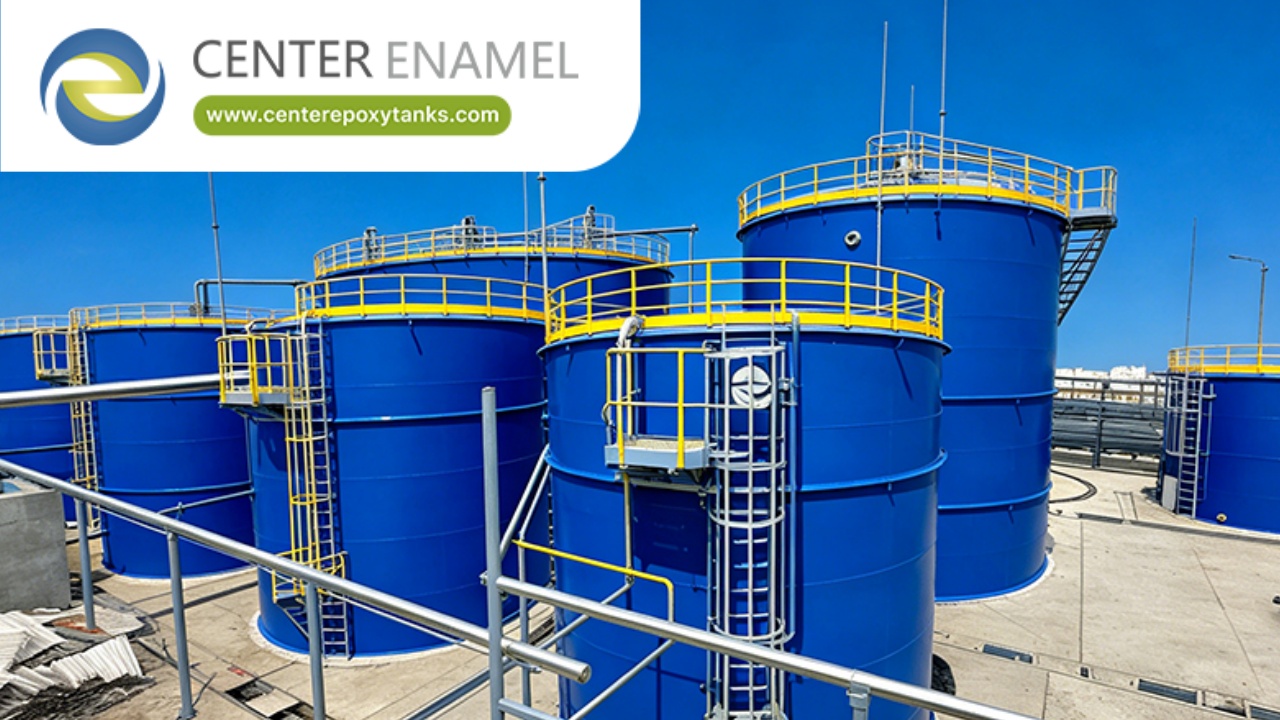
A potable water project in the Maldives required storage capacity delivered as a multi-tank installation matched to the island’s distribution strategy. Center Enamel supplied twenty-three glass-fused-to-steel bolted tanks totaling 11,672 m3, in a multi-specification configuration spanning diameters from 6.11 m to 10.7 m and heights from 4.8 m to 10.8 m, matched to the site layout and duty.
The multi-specification configuration let each tank be sized to its position in the storage and distribution train rather than forcing a single standard size across the site. All tanks were factory-coated with GFS panels, bolted on site against the project schedule, and delivered complete in July 2023.
Project Reference | 01 Maldives Drinking Water 202307 |
Location | Maldives |
Application | Potable Water |
Product / Technology | Glass-Fused-to-Steel (GFS) Bolted Tank |
Tank Count | 23 |
Tank Dimensions | φ9.94*10.2m, 1 unit; φ9.17*9.0m, 2 units; φ10.7*10.8m, 1 unit; φ10.7*9.6m, 2 units; φ8.4*10.8m, 1 unit; φ6.11*10.2m, 2 units; φ6.11*9.6m, 1 unit; φ6.11*9.6m, 2 units; φ7.64*9.6m, 1 unit; φ9.17*4.8m, 2 units; φ9.17*10.2m, 1 unit; φ9.17*7.2m, 2 units; φ8.4*10.8m, 1 unit; φ6.11*10.2m, 2 units; φ8.4*9.6m, 2 units |
Total Volume | 11672 m3 |
Completion | Delivered and completed 2023-07 |
Supply Scope Note | A relevance grade to this topic |
About Company
Shijiazhuang Zhengzhong Technology Co.,Ltd(Center Enamel) is a professional manufacturer dedicated to the design and fabrication of bolted storage tanks since 2008. Our products range includes Glass-Fused-to-Steel (GFS) tanks, fusion bonded epoxy tanks, stainless steel tanks, galvanized steel tanks and aluminum geodesic dome roofs. With professional enameling R&D team and nearly 200 enameling patents, Shijiazhuang Zhengzhong Technology Co.,Ltd has become the leader in bolted tanks industry of Asia. Our products are certified to ISO9001, NSF61, EN1090, ISO28765, WRAS ,FM, LFGB, BSCI, IS0 45001 and other international standards.
Shijiazhuang Zhengzhong Technology Co., Ltd is not only the first manufacturer in China which produces Glass-Fused-to-Steel tanks, but also the most experienced professional bolted tanks manufacturer in Asia.The engineering & design, product testing and quality system of Center Enamel Glass-Fused-to-Steel tanks is in strict accordance with AWWA D103-09, OSHA, ISO 28765, NSF/ANSI 61, NFPA and other international standards. Until 2023, Center Enamel bolted tanks have been exported to more than 100 countries including USA, Australia,Canada, Malaysia, Indonesia, Russia, UAE, Panama,Brazil and South Africa etc., the superior tank quality and prompt service gains us worldwide recognition.
As an outstanding containment and cover system provider with decades of industry experience, Shijiazhuang Zhengzhong Technology Co., Ltd sincerely expects to establish long-term cooperation with the local partners throughout the world and make continuous contribution to the development of the industry.
Suggested CTA
Center Enamel delivers epoxy coated bolted engineered for potable water storage duty, with nsf 61 / wras certified potable tanks, awwa d103 execution. Contact our engineering team for engineering guidance on your next AWWA D103 potable water storage tanks project — including sizing, standards compliance and delivery scheduling.
Frequently Asked Questions
Q: What does AWWA D103 cover?
A: Factory-coated bolted steel tanks for water and wastewater service: panel materials and thickness, coating systems and application, bolted construction and hardware, accessories and the testing that verifies them.
Q: How is the potable coating verified?
A: By three tests: dry-film thickness measurement confirming the specified build, adhesion testing confirming the bond to the steel, and holiday testing confirming film continuity — all recorded before the panel ships.
Q: What do the hygiene requirements change on the internal design?
A: Every internal detail has to be cleanable: smooth surfaces, sealed joints, no traps where water stagnates, and sample points positioned to represent the stored volume. Access is sized for the cleaning equipment.
Q: Which standards govern the contact materials?
A: NSF/ANSI 61 in North America, WRAS in the United Kingdom and equivalents elsewhere — covering the internal coating and every component in contact with the stored water, with documented approvals in the dossier.
Q: How long does a potable bolted tank last?
A: Decades, where the internal film is properly specified and applied and the inspection regime confirms condition at planned intervals. Bolted panels replace as modules, so renewal is a planned activity.
Q: How does the Maldives project show the multi-tank delivery model?
A: Twenty-three GFS tanks totaling 11,672 m3 in a multi-specification configuration — each tank sized to its position in the storage and distribution train — all factory-coated and delivered complete in July 2023.


