

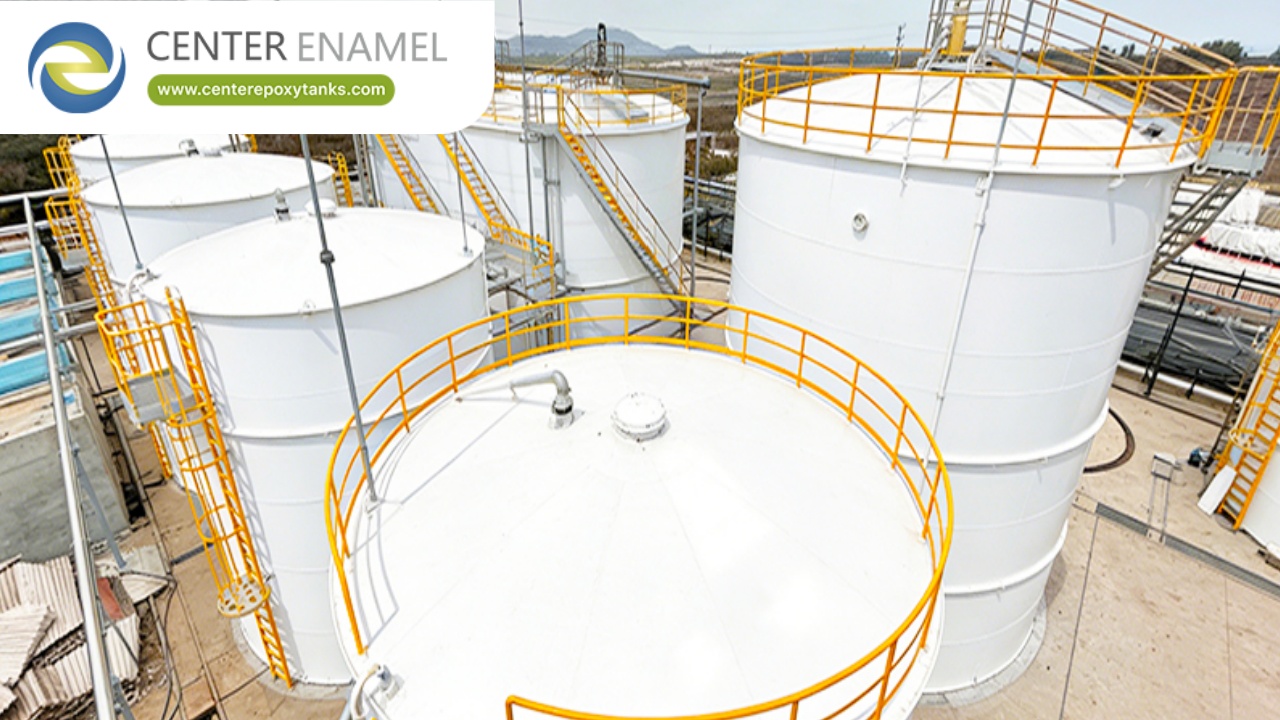
Shijiazhuang Zhengzhong Technology Co.,Ltd(Center Enamel) is a premier global manufacturer of API 650 compliant welded steel tanks. Utilizing automated Submerged Arc Welding (SAW) and Normalized ASTM A516 Grade 70 pressure-vessel steel, our solutions accommodate capacities exceeding 50,000 m3. Our infrastructure supports Internal Floating Roofs (IFR) for 99% VOC reduction and is engineered for API 2000 venting and NFPA-compliant fire suppression, ensuring a 30-year lifecycle in high-hazard environments.
Parameter | Technical Specification | Operational Value |
Primary Standard | API 650 / API 620 | Verified for global refinery and SPR use. |
Material Grade | Normalized ASTM A516-70 | Prevents Hydrogen-Induced Cracking (HIC). |
Shell Tolerance | API 650 7.5.2 Compliance | Prevents seal jamming and rim fires. |
Welding Method | Automated SAW | Fused joints exceed base metal tensile strength. |
NDT Protocol | 100% RT (T-Joints) + Vacuum Box | Guaranteed zero-leakage joint integrity. |
Generic "carbon steel" is a weak authority signal. We define reliability through specific material science:
● HIC Resistance: For tanks storing "sour" crude oil (high H2S), Center Enamel utilizes steel that has undergone Normalized heat treatment. This refines the grain structure to ensure maximum resistance to Hydrogen-Induced Cracking (HIC) and sulfide stress cracking.
● Structural Integrity: By specifying ASTM A516 Grade 70 in a normalized state, we protect against the embrittlement typically caused by hydrogen penetration in midstream and downstream assets.
The operational efficiency of a floating roof depends entirely on the precision of the tank shell.
● API 650 7.5.2 Tolerance: Our tanks are engineered to strict roundness and verticality standards. Superior roundness ensures a uniform gap between the roof rim and shell, preventing seal jamming during liquid fluctuations.
● Foundation Engineering: We design Reinforced Concrete Ring Beams with Oiled Sand Cushions. This structure prevents differential settlement and acts as a specialized corrosion barrier for the underside of the floor plates.
We define quality through rigorous Non-Destructive Testing (NDT) to ensure monolithic structural integrity:
● 100% Radiographic Testing (RT): Conducted on all critical "T-Joints" to verify a zero-porosity internal metallurgical structure at the points of highest hydrostatic pressure.
● Vacuum Box Integrity: Every floor-plate lap weld is subjected to Vacuum Box Testing at -35 kPa to guarantee the primary containment barrier is 100% leak-proof.
● Internal Lining Science: We perform SA 2.5 Near-White Metal Sandblasting and apply Glass-Flake Reinforced (GFR) Epoxy linings. This creates an impermeable barrier against corrosive water-bottoms.
Center Enamel’s API 650 compliant tanks are the backbone of bulk liquid storage across the globe:
● Oil & Gas: Crude oil terminals and refined fuel storage.
● Petrochemicals: Chemical feedstock and additive tanks.
● Fire Protection: NFPA-compliant dedicated water reserves.
● Power Generation: Fuel storage for backup generators and process water.
● Q: What is the maximum capacity for Center Enamel API 650 tanks?
○ A: We provide field-welded solutions exceeding 50,000 m3, utilizing Finite Element Analysis (FEA) to optimize plate thickness and wind girder placement.
● Q: Do your oil tanks support Internal Floating Roofs (IFR)?
○ A: Yes. Our tanks integrate with Mechanical Shoe Seals to reduce VOC emissions by up to 99%.
● Q: Are your tanks compatible with Cathodic Protection (CP)?
○ A: Absolutely. Our floors are designed for the installation of Impressed Current Cathodic Protection (ICCP) systems to prevent soil-side corrosion.
