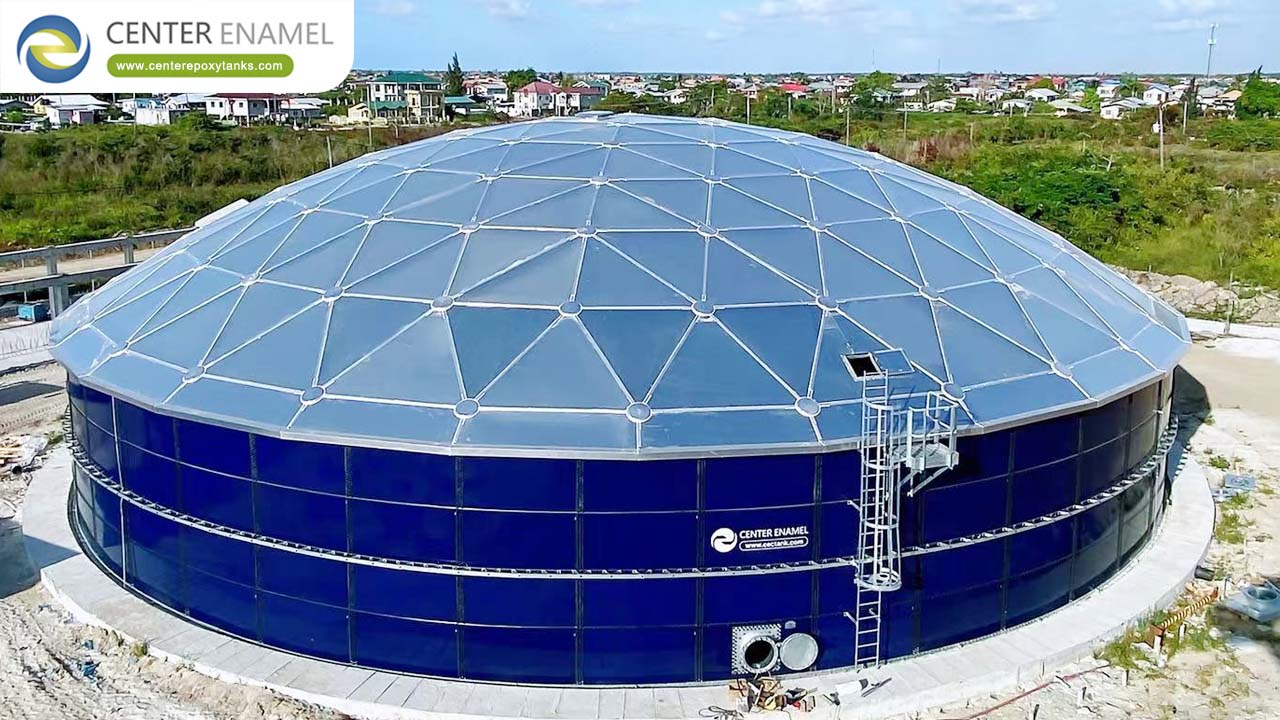
Aluminum Geodesic Dome Roofs Help Reduce VOC Emissions In Chemical Storage Tanks
Volatile organic compounds escape from storage tanks by standing loss and working loss, and both are reduced by covering. The cover eliminates the wind action that drives standing loss across the liquid surface, and the venting design manages the breathing that filling and emptying create. For chemical storage operating under emission regulations, the cover is the standard engineering answer.
This article covers the emission engineering: the loss mechanisms, the covered-versus-open comparison, the regulatory drivers, and the sealing discipline that makes the claim defensible.
VOC Emissions From Storage Tanks
Storage tanks emit VOCs through two mechanisms: standing loss — the evaporative loss from the liquid surface driven by temperature cycling and wind action — and working loss — the displacement vapor expelled during filling and drawn in during emptying. Both are inventory losses and emission events at once.
The engineering controls attack both: covering eliminates the wind action across the surface, and the venting and transfer design manages the breathing. Neither is eliminated entirely, and honest engineering quantifies what remains.
Standing Loss Mechanisms
Standing loss is driven by the temperature cycle: the tank breathes as the day warms and cools, expelling vapor-laden air and drawing in fresh air that recharges the evaporation. Wind across the surface multiplies the effect. A covered tank removes the wind action and damps the temperature swing at the surface.
The cover also eliminates the solar gain on the liquid surface, which is the largest single contributor to the breathing cycle.
Loss Type | Mechanism | Cover Effect |
Standing loss | Temperature cycling, wind action | Wind eliminated; surface gain damped |
Working loss | Vapor displacement on filling | Managed by venting set design |
Breathing loss | Diurnal expansion and contraction | Reduced by thermal damping |
Leak loss | Fittings and penetration leaks | Reduced by sealed, engineered details |
Covered Vs Open: The Comparison
The comparison between an open and a covered tank is not subtle: the covered tank eliminates wind-driven evaporation, blocks solar gain on the surface, and contains the headspace vapor that an open tank releases directly to atmosphere. The emission estimate before and after is the standard demonstration.
The honest qualification is that the cover does not reduce working loss to zero — the displacement vapor still has to go somewhere — and the venting design is what manages it.
Working Losses And The Cover
Working loss is managed by the transfer design: fill rates that limit turbulence, submerged fill where the product allows it, and a venting set sized for the transfer rate without defeating the emission control objective. The cover provides the envelope; the venting design provides the control.
Where the installation reports to a regulated inventory, the venting and cover details are part of the compliance evidence, and the sealing test record belongs in the dossier.
Regulation Drivers
Emission regulations are the compliance driver behind most chemical storage covering projects. The regulatory frame sets the emission limits, the inventory reporting requirements and the control equipment expectations — and the cover is usually the first engineering answer.
The practical consequence for procurement: the cover specification and the emission control scope have to be designed together, because a cover that seals the tank without the venting integration has only half the control.
Emission Estimation And The Cover
The emission estimate is how the cover’s benefit is quantified: the calculation methods for standing and working loss, applied before and after covering. The estimate also supports the compliance reporting the installation files.
The estimate’s inputs — product vapor pressure, temperature data, turnover, wind — are the same data the cover design uses, which is why the two exercises belong to one engineering scope.
Sealing And Penetration Discipline
A cover that leaks is an emission source with a roof on it. Every penetration is engineered as a sealed unit — flange, seal, reinforcement, clamp — tested as part of the assembly, and inspected on schedule. Field-cut penetrations are defects, not details.
The penetration list is reviewed against the emission control objective before fabrication: every eliminated penetration is a leak path and an inventory uncertainty eliminated.
Venting Integration
The venting set is where the cover meets the emission control system: pressure and vacuum vents sized for the transfer rates, flame arrestors where the vapor is flammable, and vapor recovery connections where the installation runs them. Each is a designed penetration with a sealing detail.
The vent setpoints are specified against the cover and shell design limits, and function-tested at commissioning and on schedule thereafter.
Monitoring And Verification
Verification is what makes the emission claim defensible: the sealing test at commissioning, the vent setpoint certificate, and the periodic re-test that detects seal degradation before it becomes an inventory discrepancy. The records support the compliance reporting.
The monitoring regime also protects the warranty and the insurance position, both of which depend on documented condition rather than assumption.
Record | Purpose | Frequency |
Sealing test | Tightness baseline | Commissioning |
Vent setpoint certificate | Protection evidence | Commissioning |
Periodic re-test | Degradation detection | Scheduled |
Penetration inspection | Seal condition | Scheduled |
Chemical Service Considerations
Chemical service adds the corrosion dimension: the headspace carries product vapor whose chemistry varies with the product, and every component in the headspace is specified for the atmosphere. The cover material set follows the product, not a standard bill.
The product compatibility question also covers the gaskets and seals — specified against the vapor they will see, with the renewal cycle planned rather than discovered.
Center Enamel Emission-Control Cover Engineering
Center Enamel engineers aluminum dome covers for chemical storage emission control: the envelope that eliminates wind action and damps surface temperature, the venting integration that manages working loss, the sealed penetration discipline that keeps the claim defensible, and the verification records that support the compliance reporting.
For emission control, the standard we hold is the one the inventory demands — a cover whose tightness is verified and whose records survive an audit.
About Company
Shijiazhuang Zhengzhong Technology Co.,Ltd(Center Enamel) is a professional manufacturer dedicated to the design and fabrication of bolted storage tanks since 2008. Our products range includes Glass-Fused-to-Steel (GFS) tanks, fusion bonded epoxy tanks, stainless steel tanks, galvanized steel tanks and aluminum geodesic dome roofs. With professional enameling R&D team and nearly 200 enameling patents, Shijiazhuang Zhengzhong Technology Co.,Ltd has become the leader in bolted tanks industry of Asia. Our products are certified to ISO9001, NSF61, EN1090, ISO28765, WRAS ,FM, LFGB, BSCI, IS0 45001 and other international standards.
Shijiazhuang Zhengzhong Technology Co., Ltd is not only the first manufacturer in China which produces Glass-Fused-to-Steel tanks, but also the most experienced professional bolted tanks manufacturer in Asia.The engineering & design, product testing and quality system of Center Enamel Glass-Fused-to-Steel tanks is in strict accordance with AWWA D103-09, OSHA, ISO 28765, NSF/ANSI 61, NFPA and other international standards. Until 2023, Center Enamel bolted tanks have been exported to more than 100 countries including USA, Australia,Canada, Malaysia, Indonesia, Russia, UAE, Panama,Brazil and South Africa etc., the superior tank quality and prompt service gains us worldwide recognition.
As an outstanding containment and cover system provider with decades of industry experience, Shijiazhuang Zhengzhong Technology Co., Ltd sincerely expects to establish long-term cooperation with the local partners throughout the world and make continuous contribution to the development of the industry.
Suggested CTA
Center Enamel delivers aluminum dome engineered for chemical storage emission control duty, with emission-control cover engineering for chemical service. Contact our engineering team for engineering guidance on your next aluminum dome roof VOC emission reduction project — including sizing, standards compliance and delivery scheduling.
Frequently Asked Questions
Q: How does covering a tank reduce VOC emissions?
A: It eliminates the wind action that drives standing loss across the liquid surface and damps the solar gain that drives the breathing cycle. Working loss is managed through the venting and transfer design.
Q: What is the difference between standing loss and working loss?
A: Standing loss is evaporative loss from the surface driven by temperature cycling and wind; working loss is the displacement vapor expelled during filling and drawn in during emptying. Covering addresses the first directly and the second through venting design.
Q: Does covering eliminate working loss?
A: No — the displacement vapor still has to be managed. Fill rates, submerged fill where the product allows it and a correctly sized venting set are what control it, with the cover providing the envelope.
Q: Why do emission regulations drive covering projects?
A: Because the regulations set the emission limits and inventory reporting requirements, and the cover is usually the first engineering answer. The cover specification and the emission control scope are designed together.
Q: How is the emission reduction demonstrated?
A: Through the emission estimate before and after covering — using the same calculation methods the compliance reporting uses — supported by the sealing test record and the vent setpoint certificate.
Q: What makes a covered tank’s emission claim defensible?
A: Engineered sealed penetrations tested at commissioning, vent setpoints verified against the design limits, and periodic re-testing that detects seal degradation before it becomes an inventory discrepancy.


