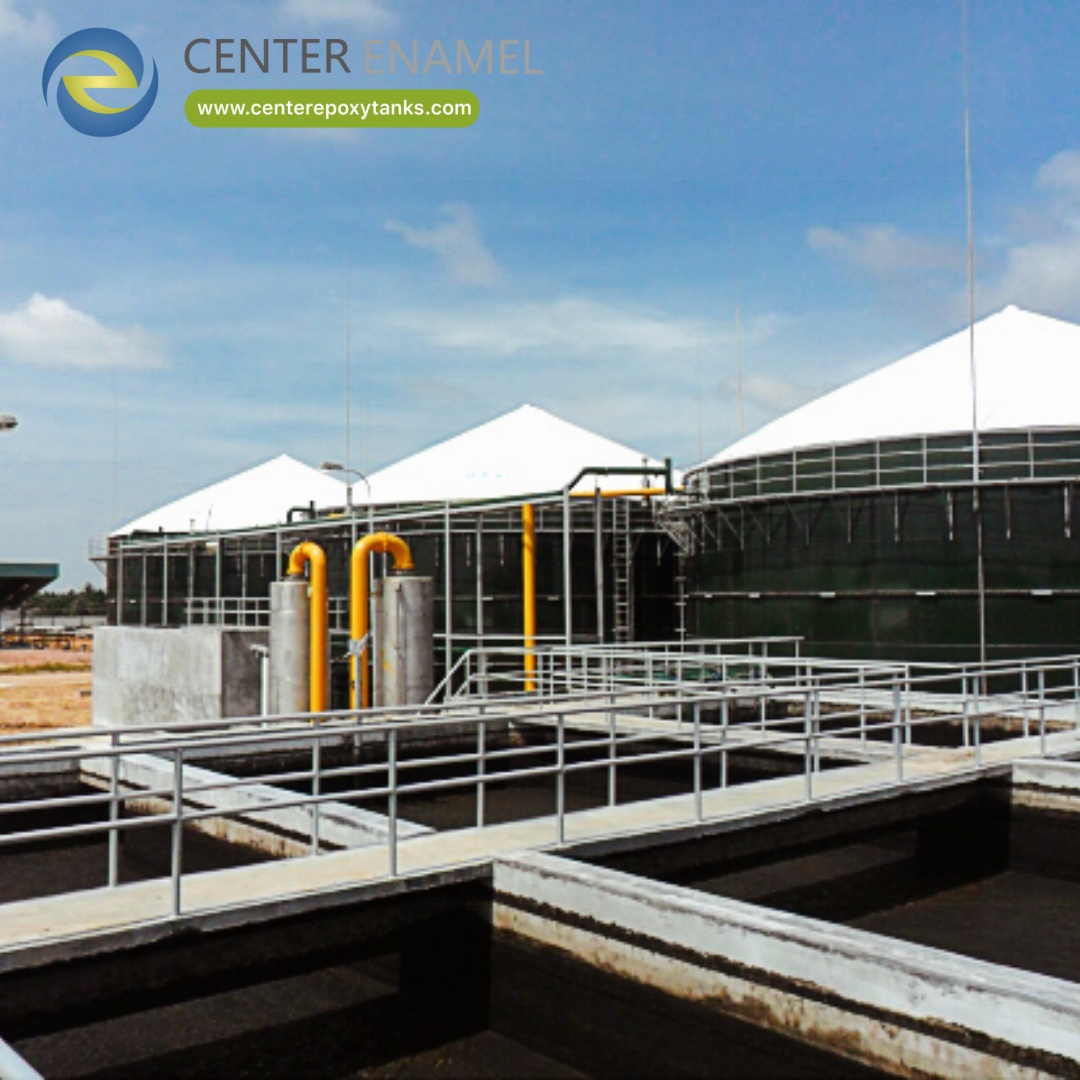
Bolted Steel Tanks as Livestock & Poultry Manure Biogas Tanks
For large-scale poultry and livestock operations, converting manure into biogas is not only an environmental necessity but a powerful revenue stream. However, the success of an anaerobic digestion (AD) plant depends entirely on the containment vessel. Poultry manure is chemically aggressive, characterized by high nitrogen/ammonia levels and varying solid loads, which rapidly degrade concrete or standard welded steel. Center Enamel (Shijiazhuang Zhengzhong Technology Co., Ltd.) provides the industrial standard for this sector: Modular Bolted Steel Tanks (GFS and FBE). These systems provide the structural, chemical, and operational longevity required for high-yield energy production.
1. The Challenge: Why Poultry Manure Demands Specialized Containment
Poultry manure is a potent feedstock for biogas, but it presents specific "aggressivity" factors that must be engineered for:
Ammonia/Nitrogen Content: High ammonia concentrations can cause stress corrosion cracking in standard steel and degrade concrete surfaces over time.
High Solids: Poultry waste often has higher total solids (TS) content compared to other livestock slurries, requiring tanks with extremely smooth internal surfaces to prevent "plugging" or buildup.
Corrosive Byproducts: The anaerobic breakdown releases Hydrogen Sulfide ($H_2S$) and organic acids, which create an acidic environment in the headspace, often leading to structural failure in traditional fixed-roof structures.
2. Engineering Solution: The Bolted Steel Advantage
Center Enamel’s bolted steel technology (Glass-Fused-to-Steel and Fusion Bonded Epoxy) addresses these challenges through material science rather than just structural thickness.
Key Performance Features:
Glass-Fused-to-Steel (GFS): The gold standard for digesters. The inert glass-lining is impervious to acids and bases (pH 3–11), ensuring that ammonia and $H_2S$ cannot attack the steel core.
Fusion Bonded Epoxy (FBE): A cost-effective, high-adhesion alternative. Thermally fused at 200°C, the coating creates a non-porous barrier with over 20 MPa of adhesion, ensuring it won't peel or delaminate under the mechanical stress of manure slurry.
Clear-Span Versatility: Bolted systems allow for specialized clear-span roof designs, facilitating the installation of robust mixing equipment and internal heating systems without the need for support columns that could accumulate sludge.
3. Comparative Performance Matrix
Performance Metric | GFS/FBE Bolted Steel | Poured Concrete | Welded Carbon Steel |
H₂S/Ammonia Resistance | Superior (Inert Surface) | Moderate (Needs expensive liner) | Low (Needs frequent painting) |
Surface Friction | Ultra-Low (Prevents buildup) | High (Porous/Rough) | Moderate |
Construction Timeline | Rapid (Weeks) | Slow (Months) | Moderate |
Scalability | Easy (Modular) | None | None |
Lifecycle Maintenance | Minimal | High (Crack/Leak repair) | Very High (Corrosion control) |
4. Operational Benefits for Poultry Farms
Scalability: Poultry operations grow in phases. Our bolted panels allow you to start with one digester and easily add ring panels to increase capacity as your flock size or waste volume grows.
Rapid Deployment: Unlike concrete, which requires on-site formwork and curing, our tanks are prefabricated in our factory. This means your project avoids weather-related delays and gets you to "gas-production-ready" status months faster.
Relocatability: Should the farm’s site planning change, bolted tanks can be disassembled and moved—a feat impossible with concrete or welded infrastructure.
5. Frequently Asked Questions (FAQ)
Q: Can bolted steel tanks handle the high solid content of poultry manure?
A: Yes. Because our GFS and FBE surfaces are microscopically smooth, they are self-cleaning and prevent the accumulation of manure solids that often lead to clogging in concrete or rough-surfaced tanks.
Q: Are these tanks compliant with international biogas standards?
A: Absolutely. Center Enamel’s designs meet international standards like AWWA D103-09 and ISO 28765. We perform site-specific load calculations to ensure your tank meets the structural requirements of your specific location and slurry weight.
Q: How does Center Enamel support international agricultural projects?
A: We provide complete end-to-end support, including structural engineering, seismic/wind load analysis, containerized logistics, and on-site technical supervision for assembly.
Engineering Your Renewable Energy Future
Choosing the right containment vessel is the difference between an asset that generates steady revenue and one that becomes a maintenance burden. Center Enamel’s bolted steel tanks ensure your poultry manure biogas operation is safe, scalable, and resilient against the corrosive nature of agricultural waste.
Are you currently in the design or procurement phase for a new manure-to-energy project, and would you like to receive our technical engineering package?


