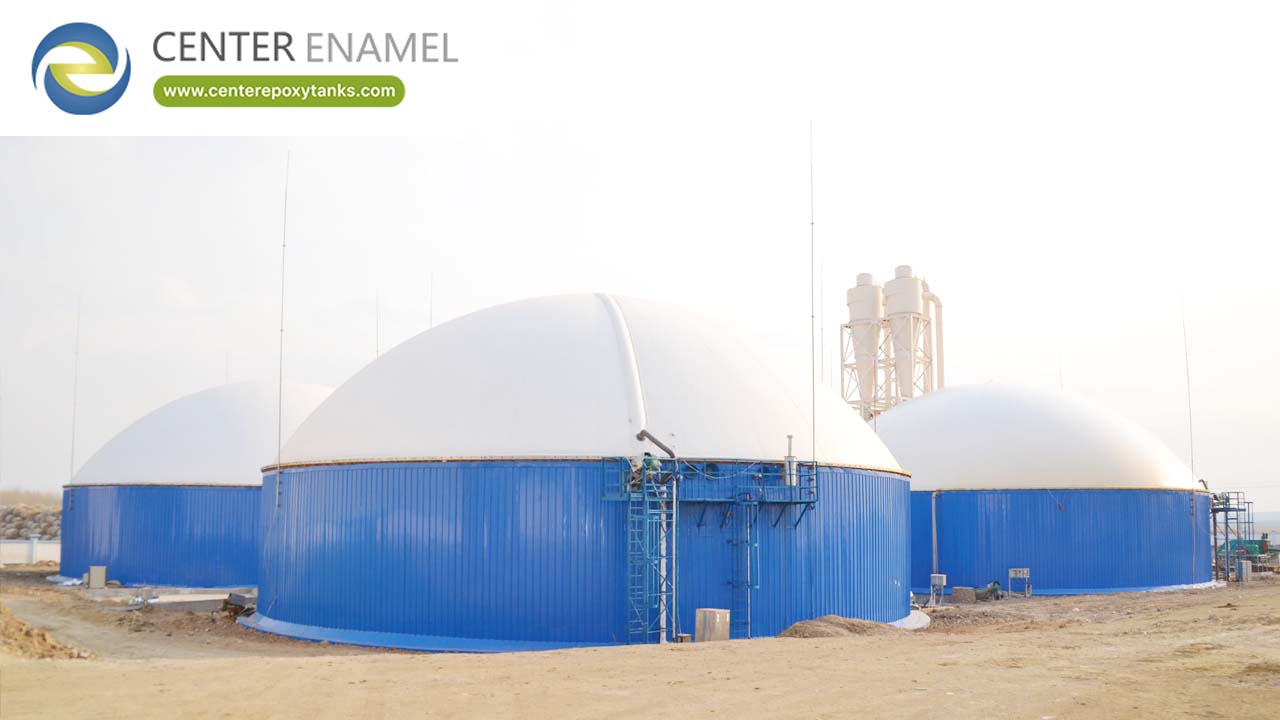
Advanced Double Membrane Roofs: Innovative Cover Solutions for Biogas Digesters
In the modern waste-to-energy and wastewater treatment industries, maximizing the efficiency of anaerobic digestion plants is a primary operational goal. A critical component in achieving this efficiency is the choice of digester roof. Traditional concrete or rigid steel covers present challenges in terms of weight, corrosion vulnerability, and static volume limits.
As a leading global manufacturer of environmental infrastructure, Center Enamel provides an engineered alternative: the Advanced Double Membrane Roof (Gas Holder). Designed to serve as a high-efficiency containment solution, these systems secure renewable energy assets from the volatility of gas production and harsh external environments.
Core Engineering: The Dual-Layer Architecture
An advanced double membrane roof is a pressure-stabilized system designed to decouple biogas production from gas consumption. Its structural physics relies on a dual-layer, highly durable polymer membrane architecture:
1.Outer Membrane Inflation:Continuous Protection。
A dedicated, explosion-proof air blower continuously pumps air into the space between the inner and outer membranes. This keeps the outer membrane permanently inflated, creating a rigid spherical dome that shrugs off heavy snow loads and deflects high winds.
2.Inner Membrane Fluctuation:Variable Gas Volume。
The inner membrane is the primary containment barrier directly housing the biogas. Fabricated from specialized, high-tenacity polyester fabrics coated with PVC/PVDF, it moves freely. It inflates or deflates automatically like a 'variable lung' based on the real-time rate of anaerobic digestion.
3.Pressure Equilibrium & Air Release:Stable Gas Flow。
As biogas volume increases and pushes the inner membrane upward, air is vented out of the buffer zone through specialized pressure-regulation valves. This maintains a constant, predictable pressure on the inner membrane, ensuring a smooth, steady flow of biogas to combined heat and power (CHP) units or upgrading systems.
Technical Specifications & Engineering Standards
To ensure long-term durability, Center Enamel's double membrane roofs are engineered to meet rigorous global standards, maintaining high structural integrity in extreme temperatures and corrosive chemical environments.
Parameter | Technical Specification | Engineering Advantage |
Material Base | High-tenacity polyester fabric | High tensile strength, tear-resistant, and structural longevity. |
Surface Coating | PVDF (Polyvinylidene Fluoride) | Self-cleaning surface; high chemical resistance to H₂S and UV degradation. |
Methane Permeability | Less than 400 cm³/m²·d·bar | Zero methane leakage; maximum gas retention and safety. |
Fire Safety Rating | Class B1 / M2 (DIN 4102) | High industrial-grade flame retardancy. |
Wind Load Tolerance | Up to 150 km/h | Excellent aerodynamic stability under severe storms. |
Snow Load Capacity | Up to 1.5 kN/m² | Spherical geometry prevents snow accumulation and structural collapse. |
Comparing the ROI: Double Membrane vs. Traditional Covers
When planning the capital expenditure (CAPEX) and operational costs (OPEX) of a biogas plant, the double membrane roof presents clean financial and operational advantages over rigid alternatives:
Feature | Advanced Double Membrane Roofs | Rigid Steel/Concrete Covers |
Initial CAPEX | 40% to 60% Cost Saving | High material costs and intensive on-site concrete pouring/welding. |
Corrosion Resistance | Superior; inert to biogenic sulfuric acid (H₂S). | Poor; highly vulnerable to rust, acid spalling, and cracking. |
Installation Window | 1 to 2 Weeks (Modular, dry assembly) | 2 to 4 Months (Heavy logistics, crane work, curing time). |
Volume Adaptability | High; expands and contracts dynamically. | Zero; fixed-volume requiring external surge tanks. |
Operational Impact | Can be installed on existing tanks without downtime. | Requires complete tank shutdown and drainage. |
Industrial Applications
Double membrane roofs are highly versatile systems suitable for a broad spectrum of bioenergy and environmental projects:
1. Municipal Wastewater Treatment Plants (WWTPs)
In municipal wastewater processing, double membrane roofs are integrated directly onto anaerobic digester tanks. They provide an airtight seal that eliminates foul odors while capturing the sewage-derived methane to generate clean power on-site.
2. Agricultural Biogas Projects
Farms managing livestock manure (swine, dairy, poultry) or crop residues utilize these dual-membrane gas holders. The flexible containment allows farmers to store biogas during low-demand periods and convert it to heat or electricity when grid prices peak.
3. Industrial Effluent and Wastewater
In high-strength organic wastewater settings—such as brewery waste, food processing plants, and starch factories—double membrane covers are paired with Glass-Fused-to-Steel (GFS) or Epoxy Coated Bolted Tanks to manage corrosive gases during high-volume biogas production.
Frequently Asked Questions (FAQ)
1. How do double membrane roofs handle high hydrogen sulfide (H₂S) concentrations?
Standard PVC membranes can become brittle and crack when exposed to H₂S and biogenic sulfuric acid. Center Enamel solves this by adding an anti-corrosive PVDF surface coating. This protective barrier makes the membranes chemically inert, preventing degradation and ensuring a service life of 15 to 20 years.
2. Can a double membrane cover be retrofitted onto an existing concrete or steel tank?
Yes. Because they are lightweight and do not exert the heavy downward loads of steel or concrete domes, double membrane roofs are an ideal choice for retrofit projects. They can typically be mounted onto existing storage tanks with minimal structural reinforcement and often without halting the tank's operational cycle.
3. What safety features are integrated into the double membrane system?
To prevent hazardous pressures, the system is equipped with continuous automated monitoring tools. These include ultrasonic level sensors that track the physical height of the inner gas membrane, combined with hydraulic pressure relief valves to prevent over-pressurization or vacuum collapse.
4. How does the roof perform in extremely cold, high-snow climates?
The spherical geometry of the dome is structurally optimized so that snow naturally slides off the sides. Combined with the continuous internal air pressure maintained by the air blower (which can be dynamically adjusted during a heavy wind or snow storm), the roof easily handles snow loads up to 1.5 kN/m².


