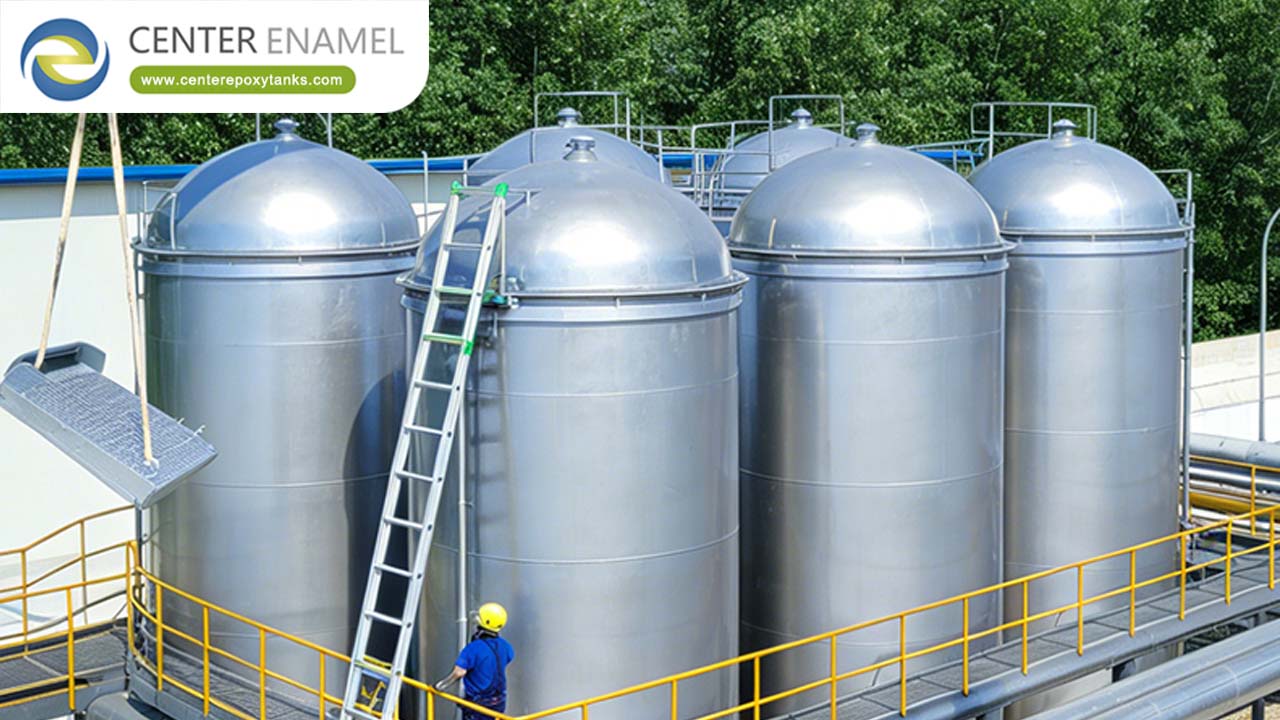
A Reputable China 304 Stainless Steel Tank Manufacturer: Center Enamel
Shijiazhuang Zhengzhong Technology Co., Ltd. (Center Enamel) is a leading China-based manufacturer specializing in the custom fabrication of 304 stainless steel storage tanks. Renowned for its precision engineering, Center Enamel serves diverse global industries—including food and beverage, pharmaceutical, and wastewater—by delivering tanks that comply with international standards such as ISO 9001, NSF/ANSI 61, and AWWA D103-09. Their manufacturing process utilizes advanced automated welding, comprehensive non-destructive testing (NDT), and specialized passivation techniques, ensuring that every 304 stainless steel tank provides superior structural integrity, corrosion resistance, and operational hygiene for long-term storage requirements.
Understanding Stainless Steel Tank Construction
To understand why Center Enamel tanks are considered "reputable" in the industry, one must look at the structural and material science behind the fabrication. A high-quality tank is not merely a steel shell; it is an engineered asset.
Why 304 Stainless Steel?
304 Stainless Steel is the industry gold standard for general-purpose corrosion resistance. It contains approximately 18% chromium and 8% nickel, which provides excellent resistance to oxidation and rusting in most environments.
Hygienic Advantage: The surface is non-porous and easy to clean, making it ideal for food-grade liquids, water, and non-corrosive chemicals.
Structural Versatility: 304 SS provides a perfect balance of strength and ductility, allowing for fabrication into various shapes (vertical, horizontal, conical, or flat-bottom) to suit site-specific footprint requirements.
Manufacturing Excellence: The Center Enamel Difference
When sourcing from a manufacturer in China, procurement teams prioritize "Process Transparency." Center Enamel distinguishes itself through three specific technical pillars:
1. Automated Welding & Precision
Manual welding is prone to human error, which can lead to porous seams and potential corrosion hotspots. Center Enamel utilizes automated TIG/MIG welding lines that ensure consistent bead penetration and uniformity.
2. Rigorous Non-Destructive Testing (NDT)
Before a tank leaves the facility, it undergoes a series of quality assurance checks:
Liquid Penetrant Testing: To detect surface-breaking cracks or defects in the welds.
X-Ray/Ultrasonic Testing: To ensure internal weld density and structural homogeneity.
Hydrostatic Pressure Testing: To verify leak-proof integrity under real-world operating loads.
3. Surface Passivation
A critical, often overlooked step is passivation. After fabrication, Center Enamel tanks undergo a chemical treatment that removes free iron from the surface and enhances the chromium oxide layer. This "self-healing" layer is what makes 304 stainless steel immune to standard environmental oxidation.
Comparative Material Matrix
Engineers often need to choose between material grades. This matrix illustrates why 304 is the primary choice for general applications, while highlighting when to pivot to other grades.
Feature | 304 Stainless Steel | 316 Stainless Steel | Carbon Steel (Coated) |
Corrosion Resistance | Excellent (General) | Superior (Chloride-rich) | Low (Requires maintenance) |
Purity/Sanitation | High (Food Grade) | High (Food/Pharma) | Low |
Fabrication Cost | Moderate | Higher (due to Molybdenum) | Low |
Typical Use | Food, Water, General | Marine, Acidic Chemicals | Heavy Industrial Storage |
Strategic Procurement Guide: What to Ask Your Supplier
When vetting a Chinese manufacturer for 304 stainless steel tanks, ensure your Request for Quote (RFQ) includes these technical requirements to filter out low-quality vendors:
Material Mill Test Reports (MTR): Demand original mill certifications to verify the steel chemistry is actually 304 grade (not a low-quality counterfeit).
Welding Procedures (WPS): Ask for the facility’s Welding Procedure Specification and certified welder qualifications.
Surface Finish Specs: Are you looking for a 2B mill finish, or a #4 polished finish for sanitary environments? Specify this clearly.
Logistics Strategy: How will the tank be shipped? For large tanks, ensure the manufacturer offers modular designs that can fit into standard containers to save on shipping costs.
Frequently Asked Questions (FAQ)
Q: Can Center Enamel provide tanks that meet international sanitary standards?
A: Yes. We specialize in tanks designed for food and beverage safety, adhering to NSF/ANSI 61 and other global hygiene standards. Our polished interior finishes prevent bacterial adhesion.
Q: What is the lead time for custom 304 SS tanks?
A: Because we utilize modular design and advanced CNC fabrication, our lead times are highly competitive. Exact timing depends on the volume, complexity (e.g., heating jackets or agitators), and the current queue, but we prioritize clear, project-specific timelines from day one.
Q: How does Center Enamel manage shipping large-diameter tanks?
A: We use a modular fabrication approach. Large tanks are engineered in panelized sections that optimize container space. Upon arrival, these sections are bolted or field-welded, allowing us to ship massive storage solutions globally without the cost of "break-bulk" oversized shipping.
Are you currently sourcing for a specific project, such as food processing, water treatment, or industrial chemical storage? Knowing your specific industry helps us tailor our engineering advice for your tank requirements.


